


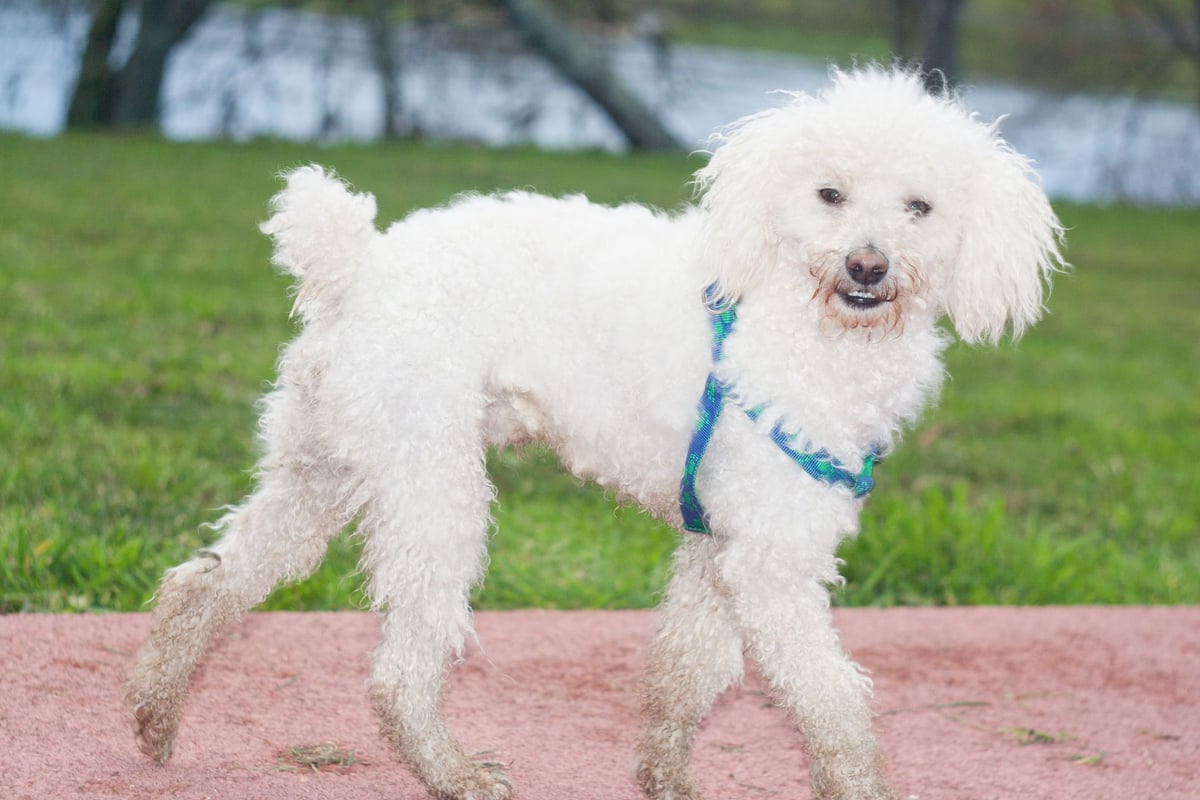
Toy Poodle
The Toy Poodle is the smallest of the four Poodle varieties (FCI 172): height at the withers above 24 cm and below 28 cm, weight 2 to 3.5 kg. A French breed with a curly coat that does not shed, classed as hypoallergenic. Life expectancy 12 to 15 years. It inherits the exceptional trainability of the Standard Poodle — ranked 2nd according to Coren — but shows toy-specific conditions: patellar luxation, Legg-Calvé-Perthes disease, tracheal collapse.
- Weight
- 2 to 3.5kg
- Height
- 24 to 28cm
- Life expectancy
- 14years
- Monthly cost
- 65 to 110€
Personality profile
Energy 3/5
Independence 2/5
Trainability 5/5
Good with children 4/5
Barking 4/5
Space needed 1/5
Attachment to home 5/5
Good with strangers 3/5
Good with dogs 4/5
Good with cats 4/5
Coat care 5/5
Exercise needs 3/5
Scores given on measured axes, data confidence: high.
Living with a Toy Poodle
Description
Elegant, athletic build despite its size: fine but well-muscled bone structure, proud carriage, a long straight head with a fine muzzle, dark oval eyes with a lively expression. Dense curly coat with a woolly or corded texture, continuous growth with no seasonal shedding, available in solid colors: black, white, brown, gray, apricot, red. The Toy variety is distinguished from the Miniature (28-35 cm) by a height strictly under 28 cm at the withers.

Temperament
Gifted with an extraordinary learning capacity (ranked 2nd according to Coren), the Toy Poodle is hyper-attentive to its surroundings and barks to flag any change (doorbell, hallway noises, passersby) — a vocal tendency to channel from puppyhood through desensitization. Playful and energetic in bursts, it enjoys daily learning sessions. Strongly attached to its family, it copes badly with prolonged isolation. Sociable with children, cats, and dogs if socialized before 14 weeks.
Training
Among the best-known trainability ratings: the Standard Poodle is ranked 2nd by Stanley Coren (after the Border Collie), picking up a new cue in 2 to 5 repetitions. The Toy inherits this cognitive ability but can be more distracted by environmental stimuli owing to its small size. Excellent response to positive reinforcement (clicker, treats, play). Suited to obedience, rally-o, nano agility, and nosework disciplines. Housetraining achieved in 2 to 4 weeks.

Feeding
50 to 80 g of premium small-breed kibble a day for a 3 kg adult, split into 2 meals. Puppies under 3 months: 3 meals to prevent hypoglycemia. Treats capped at 10% of caloric intake. Active dental care (brushing at least 3 times a week) is needed since small breeds accumulate tartar quickly.
Affiliate links, no extra cost to you. Legal notice

Living conditions
Suited to apartments of any size thanks to its compact build. Sensitive to cold (non-waterproof coat, low body mass): a coat is essential below 7 °C. Must live indoors. 30 to 40 minutes of daily exercise is enough — split into 2 to 3 outings with play and mental stimulation. Without regular mental stimulation, it can develop repetitive or barky behaviors.

Grooming and coat care
Hypoallergenic curly coat with continuous growth: it does not shed but mats if left unbrushed. Daily or near-daily brushing to prevent unmanageable felting. Professional grooming every 4 to 6 weeks (lion clip, sporting clip, or continental clip). Hair inside the ear canal should be plucked at each grooming session to help prevent ear infections.

Health
Patellar luxation: the most common condition in the Toy variety, grades 1 to 4, surgical correction required from grade 3. Legg-Calvé-Perthes disease: necrosis of the femoral head occurring between 4 and 12 months, detectable by X-ray, treated surgically. Progressive retinal atrophy (PRA): a hereditary disease leading to blindness, DNA test available (PRCD mutation). Von Willebrand disease: a hereditary blood-clotting disorder, DNA testing recommended before breeding. Tracheal collapse: increased risk in small poodles, avoid collars — a harness is mandatory. Chronic ear infections due to drop ears and hair in the ear canal: weekly cleaning required. Addison's disease (adrenal insufficiency): uncommon but documented in the Poodle line, with vague symptoms (lethargy, vomiting).
Breed history
The Poodle descends from the Barbet, a duck-hunting dog used in Europe as early as the 15th century. France claims official origin with the FCI (standard 172), though Germany disputes this. The size varieties (Standard, Medium, Miniature, Toy) developed successively: the Toy variety, the smallest, became established in the 20th century as an urban companion dog. Recognized by the FCI Group 9, standard updated in March 2024. In France, it regularly ranks in the top 10 of LOF registrations across all varieties combined.
Getting ready for your Toy Poodle
Five essentials to line up before day one.
Affiliate links, no extra cost to you. Legal notice
FAQ: Toy Poodle
Sources
- FCI Standard No 172 · FCI breed standard 172, Group 9 Companion and Toy Dogs, Section Poodle, standard updated March 2024
- AKC Breed Profile · AKC Toy Poodle breed profile, Toy Group
FCI, Fédération Cynologique Internationale, the world body that has codified breed standards since 1911. FCI number 172 is assigned to the Toy Poodle.
Breeds similar to a Toy Poodle

