


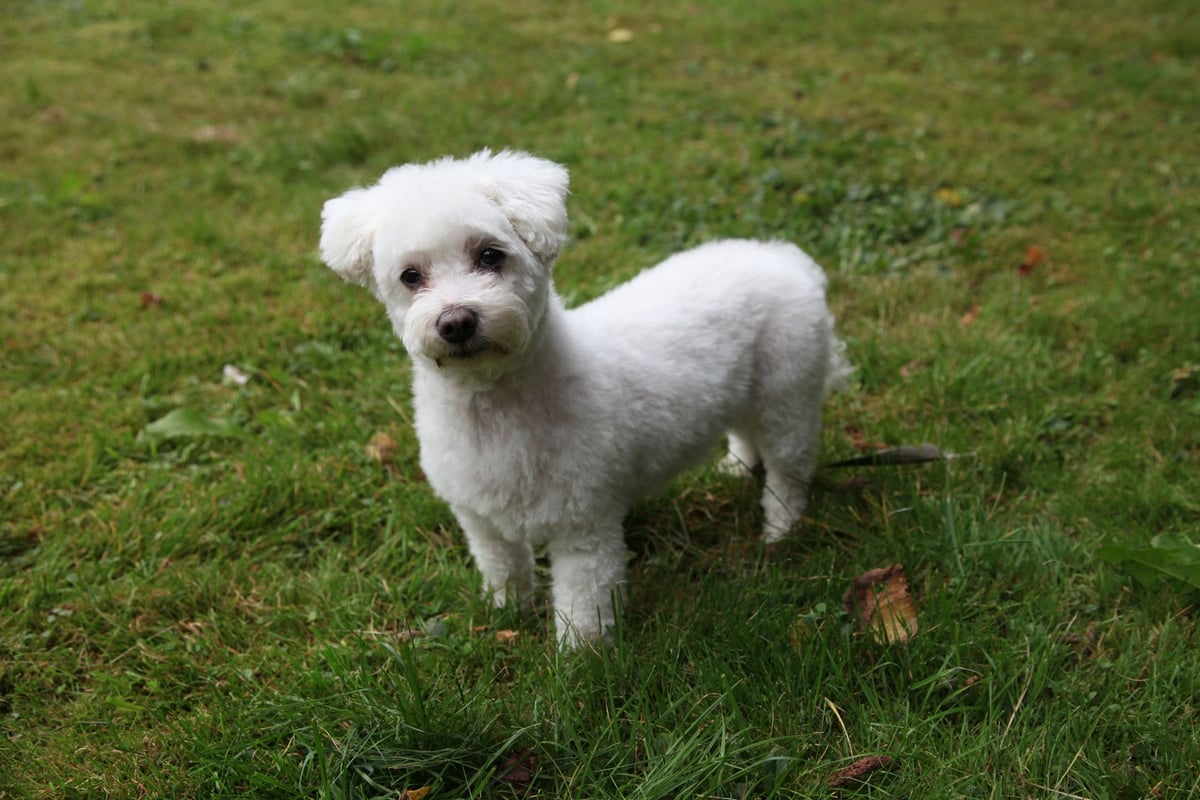
Maltese
The Maltese is a Mediterranean toy breed of 3 to 4 kg for 20 to 25 cm at the withers, recognized by the FCI under number 65, Group 9 Section 1. Its long, silky white coat sheds practically nothing (the undercoat is nearly absent), which classifies it as semi-hypoallergenic. Life expectancy of 12 to 15 years, a hardy breed for its size but prone to patellar luxation, portosystemic shunt, and hypoglycemia in puppies.
- Weight
- 3 to 4kg
- Height
- 20 to 25cm
- Life expectancy
- 14years
- Monthly cost
- 60 to 100€
Personality profile
Energy 2/5
Independence 2/5
Trainability 4/5
Good with children 3/5
Barking 3/5
Space needed 1/5
Attachment to home 5/5
Good with strangers 3/5
Good with dogs 4/5
Good with cats 4/5
Coat care 5/5
Exercise needs 2/5
Scores given on measured axes, data confidence: high.
Living with a Maltese
Description
A compact, well-proportioned build: a slightly rounded head, muzzle of moderate length, round, dark, expressive eyes, drop ears covered in long hair. Entirely white or pale ivory coat, silky texture, without a dense undercoat — this hair structure is responsible for the very low shedding. Weight 3 to 4 kg for both sexes, males 21-25 cm at the withers, females 20-23 cm.

Temperament
Lively, alert and playful, it keeps a puppyish attitude well into old age. Deeply attached to its reference family, it signals strangers with a few barks (a guarding instinct despite its size), without being pathologically vocal. May develop separation anxiety after 4 to 5 hours alone. Not recommended for families with children under 4: its small size makes it vulnerable to falls and rough handling.
Training
Good trainability: an intelligent breed that picks up basic cues in 5 to 10 repetitions with positive reinforcement. Motivated by human contact and food. Housetraining achieved in 3 to 5 weeks with a consistent method. Can excel in level-1 obedience and nano agility. Does not respond to punishment: it shuts down under rigidity as much as under overly long sessions.

Feeding
60 to 90 g of premium kibble a day for a 3.5 kg adult, split into 2 fixed meals. Puppies under 3 months should receive 3 to 4 meals daily to prevent hypoglycemia. Treats limited to 10% of caloric intake — obesity worsens patellar luxation and strains the joints. Small-sized kibble suited to narrow jaws.
Affiliate links, no extra cost to you. Legal notice

Living conditions
Perfectly suited to an apartment of any size thanks to its low space needs and moderate energy. Must live indoors — sensitive to cold below 8 °C (a coat is recommended in winter), does not tolerate prolonged rain. Two daily outings of 15 to 20 minutes cover its physical needs. No garden required.

Grooming and coat care
A hypoallergenic long coat requiring daily brushing to prevent tight mats, particularly behind the ears and under the armpits. Professional grooming every 6 to 8 weeks to maintain the cut or keep the length. Bathe every 2 to 3 weeks, with blow-drying mandatory (damp skin under the dense coat means a risk of dermatitis). A low-allergen breed thanks to the absence of a dense undercoat and very low shedding.

Health
Patellar luxation (grade 1 to 4): a common condition in toy breeds, clinical signs to watch for from 6 months (intermittent hind-leg lameness). Congenital portosystemic shunt: a liver vascular malformation that can cause growth delay and neurological issues after meals (hepatic encephalopathy) — detectable by abdominal ultrasound before 6 months. Hypoglycemia in puppies (< 3 kg): elevated risk before 4 months if rations are insufficient or under stress, with symptoms including trembling, lethargy, and seizures. Glaucoma and progressive retinal atrophy (PRA) are possible. Critical dental hygiene: narrow jaws with crowded teeth predispose to periodontal disease — daily tooth brushing recommended from puppyhood. Frequent epiphora: requires daily cleaning of the eye corners to prevent reddish-brown stains.
Breed history
One of the oldest known breeds: mentioned by Aristotle in the 4th century BC, depicted in Egyptian and Greek frescoes. Used in Mediterranean ports as a shipboard ratter. Recognized by the FCI under number 65 on April 13, 1955, Group 9, Section 1. Patronage entrusted to Italy even though the breed is named after Malta. Sustained popularity in France since the 1980s, regularly in the top 20 LOF registrations.
Getting ready for your Maltese
Five essentials to line up before day one.
Affiliate links, no extra cost to you. Legal notice
FAQ: Maltese
Sources
- FCI Standard No 65 · FCI breed standard 65, Group 9 Companion and Toy Dogs, Section 1 Bichons and related breeds
- AKC Breed Profile · AKC Maltese breed profile, Toy Group
FCI, Fédération Cynologique Internationale, the world body that has codified breed standards since 1911. FCI number 65 is assigned to the Maltese.
Breeds similar to a Maltese

