


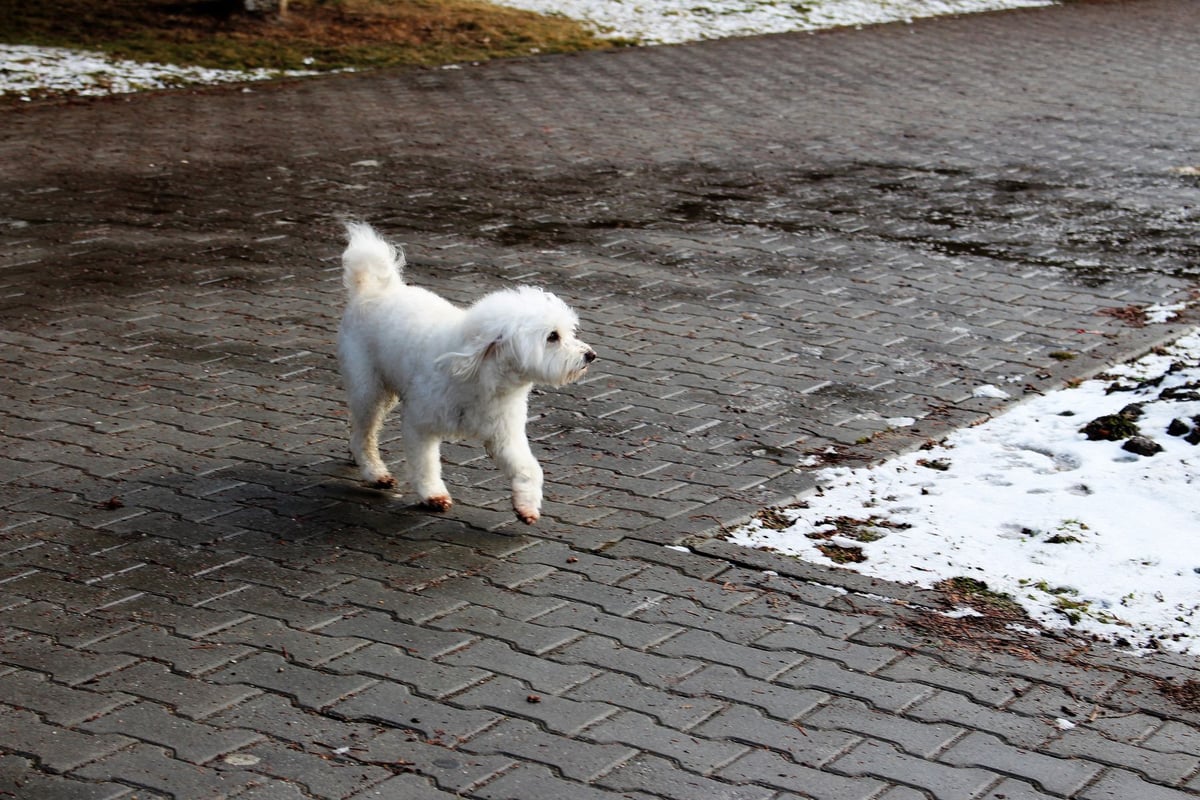
Bichon Frise
The Bichon Frise is a companion dog of 5 to 10 kg for 25 to 30 cm at the withers, recognized by the FCI under number 215, Group 9, Section 1. White, curly coat with a corkscrew texture and near-zero shedding — classified as hypoallergenic. A breed of Mediterranean origin popularized by European courts in the 16th-17th centuries. Life expectancy of 12 to 15 years. Predisposed to patellar luxation, atopic skin allergies, Cushing's syndrome, and hip dysplasia.
- Weight
- 5 to 10kg
- Height
- 25 to 30cm
- Life expectancy
- 13years
- Monthly cost
- 80 to 140€
Personality profile
Energy 3/5
Independence 2/5
Trainability 4/5
Good with children 4/5
Barking 3/5
Space needed 1/5
Attachment to home 5/5
Good with strangers 4/5
Good with dogs 4/5
Good with cats 4/5
Coat care 5/5
Exercise needs 3/5
Scores given on measured axes, data confidence: high.
Living with a Bichon Frise
Description
A compact, well-proportioned build: body slightly longer than tall, a proud head carriage, tail carried curled over the back. Round head with round, dark, expressive eyes, muzzle of moderate length. Exclusively white coat, double-layered: a soft undercoat under a fine, curly outer coat, a very loose corkscrew texture giving the impression of a voluminous fleece. Almost no seasonal shedding. Weight 5 to 10 kg, height 25 to 30 cm at the withers for both sexes.

Temperament
Lively, playful and sociable: the Bichon Frise keeps a puppyish attitude well into old age. Deeply attached to its human family, it copes poorly with solitude beyond 4 to 5 hours. Good sociability with strangers and other dogs, excellent with children over 5. Moderate vocal tendency — barks to signal strangers without being pathologically noisy if trained from puppyhood. Sensitive to punishment, it responds exclusively to positive reinforcement.
Training
Good trainability: picks up basic cues in 5 to 10 repetitions with positive reinforcement (treats, play, contact). Motivated by human contact and very sensitive to tone of voice. Can excel in level-1 obedience, nano agility, and rally obedience. Housetraining achieved in 3 to 6 weeks with a consistent method. Does not respond to coercive methods — harsh reprimands inhibit learning. Early socialization before 14 weeks is essential to limit wariness of strangers.

Feeding
For a 7 kg adult: 120 to 180 g of premium small-breed kibble a day, in 2 meals. Treats capped at 10% of caloric intake — obesity worsens patellar luxation and atopy. Kibble formulated for sensitive skin (omega-3 and omega-6 fatty acids) if atopy is diagnosed. Dental hygiene: brushing at least 3 times a week, as small breeds build up tartar quickly.
Affiliate links, no extra cost to you. Legal notice

Living conditions
Perfectly suited to an apartment of any size: low space needs, moderate energy. 30 to 45 minutes of daily exercise is enough for an adult — 2 outings of 15 to 20 minutes with free play. Sensitive to cold below 8 °C (a coat is recommended in winter) and to prolonged rain (the long coat takes a while to dry). Must live indoors.

Grooming and coat care
A hypoallergenic, double-layered curly coat that needs daily brushing: without upkeep, the curls mat within 7 to 10 days, particularly behind the ears, under the armpits and in the groin. Monthly professional grooming is mandatory (the rounded "Bichon" cut or a sport trim) to keep the silhouette and prevent tangles. Bathe every 2 to 3 weeks, with blow-drying needed to avoid dermatitis under the dense coat. A low-shedding breed: the undercoat traps dander and limits its spread.

Health
Patellar luxation: a common condition in small breeds, grades 1 to 4 — intermittent hind-leg lameness, surgical correction from grade 3 upward. Atopic skin allergies: the Bichon Frise is among the breeds most prone to atopy (chronic itching, redness, paw licking) — diagnosed via allergy testing, managed with antihistamines or immunotherapy. Cushing's syndrome (hyperadrenocorticism): excess cortisol production, with progressive symptoms (pot-bellied abdomen, increased thirst, symmetrical hair loss) — treated medically with trilostane. Hip dysplasia: less common than in large breeds but documented in the Bichon family. Hereditary cataracts: onset between 2 and 8 years depending on the line. Chronic epiphora: significant tear staining requiring daily cleaning of the eye corners to prevent reddish-brown stains.
Breed history
The Bichon Frise descends from Mediterranean bichon dogs brought to the Canary Islands (Tenerife) by Genoese sailors in the 14th century, hence its former name "Bichon Tenerife." Brought back to mainland Europe, it won over the French and Spanish royal courts in the 16th and 17th centuries — and appears throughout European painting, from Jan van Eyck to Goya. After a decline in the 19th century, the breed was rebuilt by Belgian and French breeders between the two world wars. Recognized by the FCI in 1959 under joint Belgian-French patronage (standard 215, Group 9, Section 1). Recognized by the AKC in 1973 in the Non-Sporting Group.
Getting ready for your Bichon Frise
Five essentials to line up before day one.
Affiliate links, no extra cost to you. Legal notice
FAQ: Bichon Frise
Sources
- FCI Standard No 215 · FCI breed standard 215, Group 9 Companion and Toy Dogs, Section 1 Bichons and related breeds, patronage Belgium/France
- AKC Breed Profile — Bichon Frise · AKC Bichon Frise breed profile, Non-Sporting Group, recognized 1973
FCI, Fédération Cynologique Internationale, the world body that has codified breed standards since 1911. FCI number 215 is assigned to the Bichon Frise.
Breeds similar to a Bichon Frise

