


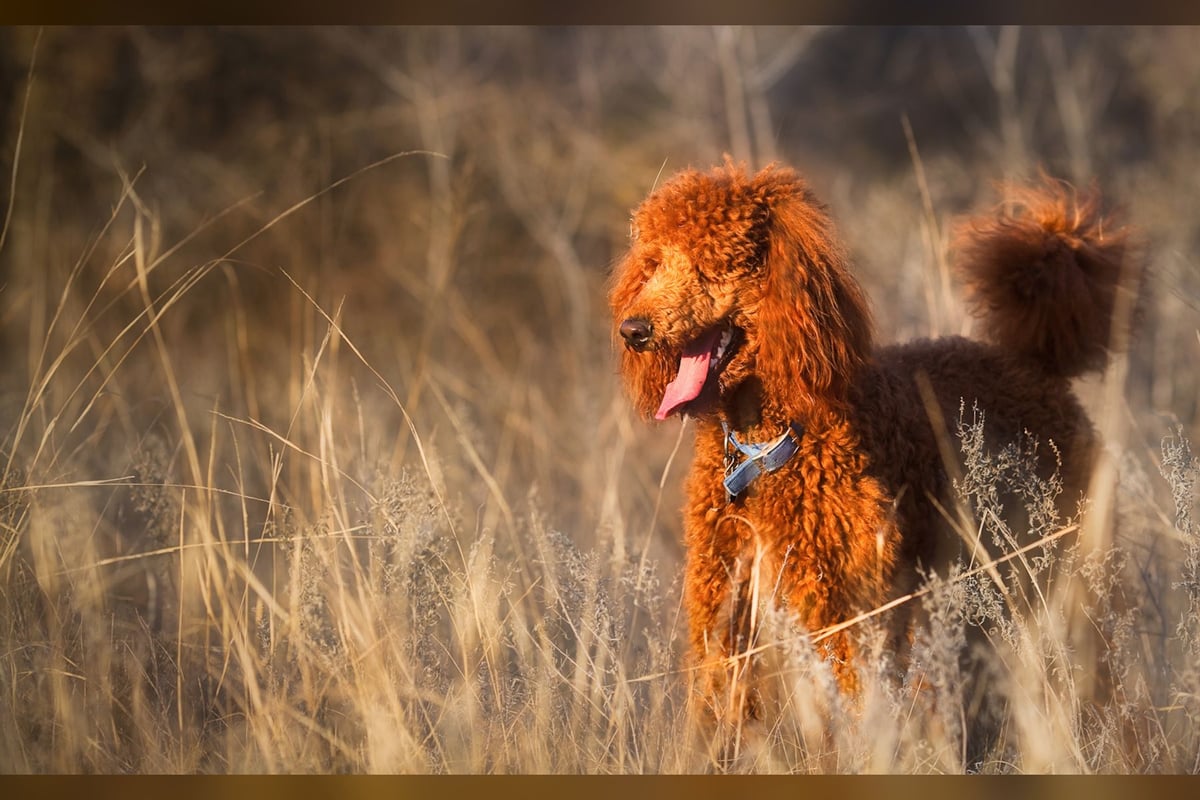
Standard Poodle
The Standard Poodle (or Grand Caniche) is the largest of the four Poodle varieties (FCI 172): height at the withers 45 to 62 cm, weight 20 to 32 kg. A curly or corded coat with continuous growth, reputed to be hypoallergenic and to shed practically nothing. Ranked the 2nd most intelligent breed according to Stanley Coren. Life expectancy 12 to 15 years. Predisposed to gastric dilatation-volvulus (GDV), Addison's disease, hip dysplasia and sebaceous adenitis.
- Weight
- 20 to 32kg
- Height
- 45 to 62cm
- Life expectancy
- 13years
- Monthly cost
- 100 to 180€
Personality profile
Energy 4/5
Independence 2/5
Trainability 5/5
Good with children 5/5
Barking 3/5
Space needed 3/5
Attachment to home 5/5
Good with strangers 4/5
Good with dogs 4/5
Good with cats 4/5
Coat care 5/5
Exercise needs 4/5
Scores given on measured axes, data confidence: high.
Living with a Standard Poodle
Description
An athletic, well-proportioned build: solid bone structure, a body slightly longer than tall, a long, fine head with a straight muzzle, expressive dark oval eyes, long ears lying flat. A dense, curly or corded coat with a woolly texture, available in solid colors — black, white, brown, gray, apricot, red — with continuous growth and no notable seasonal shedding. The Standard variety is distinguished from the Medium (35-45 cm), Miniature (28-35 cm) and Toy (24-28 cm) varieties by its height above 45 cm at the withers. All four varieties share the same FCI 172 standard.

Temperament
A cheerful, curious, sociable temperament: the Standard Poodle interacts easily with children, adults and other dogs. Its high operational intelligence (rank 2 per Coren, learns a new command in 2 to 5 repetitions) makes it a top candidate for obedience, agility and tracking disciplines. Less vocal than the miniature or toy varieties at an equal build. Strong attachment to its family, copes poorly with prolonged isolation beyond 5 to 6 hours. Good sociability with strangers provided early socialization occurs before 14 weeks.
Training
Rank 2 on Stanley Coren's scale of obedience intelligence — after the Border Collie. Learns a new command in 2 to 5 repetitions and performs it correctly in 95% of cases on the first attempt. Excellent response to positive reinforcement (clicker, treats, ball). Capable of mastering multi-step tasks: agility, tracking, object retrieval, assistance for people with disabilities. Recommended sport: 60 to 90 minutes of physical activity a day — long walks, swimming, agility. Without mental and physical stimulation, it can develop repetitive behaviors.

Feeding
For a 25 kg adult: 300 to 400 g of premium large-breed kibble a day, split into 2 meals morning and evening — splitting is mandatory to reduce GDV risk. Avoid intense exercise within 90 minutes of eating. Treats capped at 10% of caloric intake. Quarterly weight check: obesity worsens hip dysplasia. Omega-3 supplementation (fish oil) is beneficial for sebaceous adenitis.
Affiliate links, no extra cost to you. Legal notice

Living conditions
Can live in a large apartment or a house with a garden. Its size (45-62 cm, 20-32 kg) requires a minimum of 60 to 90 minutes of daily exercise — long walks, ball games, agility or swimming. Without enough physical activity, it develops outlet behaviors (chewing, vocalizing). Suited to active families who practice sport or hiking. Adequate cold tolerance thanks to the dense coat, but it should not sleep outdoors in severe cold. Hypoallergenic: no significant seasonal shedding.

Grooming and coat care
A hypoallergenic, continuously growing curly coat: without regular brushing, forms compact mats within 2 to 3 weeks. Brushing at least 3 to 4 times a week with a wide-toothed comb. Professional grooming mandatory every 4 to 6 weeks (lion clip, sporting clip or continental clip depending on preference). Ear canal hair plucking at every grooming session to prevent ear infections. A hypoallergenic breed: the curly coat traps scales and limits their dispersal into the air.

Health
Gastric dilatation-volvulus (GDV): a condition common in large, deep-chested breeds — an absolute surgical emergency. Risk factors: a single heavy meal, exercise immediately after eating. Prevention: 2 split meals, avoiding elevated bowls, prophylactic gastropexy can be considered. Addison's disease (adrenal insufficiency): nicknamed the "great imitator" because of its vague symptoms (episodic lethargy, vomiting, weight loss) — documented at excess frequency in the breed. Diagnosed via an ACTH stimulation test. Hip dysplasia: a progressive deformation of the hip joint, an OFA X-ray of breeding stock is recommended. Granulomatous sebaceous adenitis: an inflammatory disease of the sebaceous glands, more common in the Standard Poodle than elsewhere; skin signs (scaling, hair loss, patches). Progressive retinal atrophy (PRA-prcd): DNA test available. Chronic ear infections: a damp, hairy ear canal, weekly cleaning required.
Breed history
The Poodle descends from the Barbet, a water-game hunting dog used as early as the 15th century in central and western Europe. The German etymology "Pudel" (to paddle in water) and the French origin are both claimed simultaneously — the FCI has attributed patronage to France since 1936. The Standard variety is the ancestral stock from which the Medium, then the Miniature, then the Toy were derived through successive size selections. In the 19th and 20th centuries, the Standard Poodle was used in European circuses for its learning ability. FCI standard 172 updated in March 2024. In France, the breed regularly ranks among the top 15 LOF registrations across all varieties combined.
Getting ready for your Standard Poodle
Five essentials to line up before day one.
Affiliate links, no extra cost to you. Legal notice
FAQ: Standard Poodle
Sources
- FCI Standard No 172 · FCI breed standard 172, Group 9 Companion and Toy Dogs, Section 2 Poodle, standard updated March 2024
- AKC Breed Profile — Standard Poodle · AKC Standard Poodle breed profile, Non-Sporting Group
FCI, Fédération Cynologique Internationale, the world body that has codified breed standards since 1911. FCI number 172 is assigned to the Standard Poodle.
Breeds similar to a Standard Poodle

