


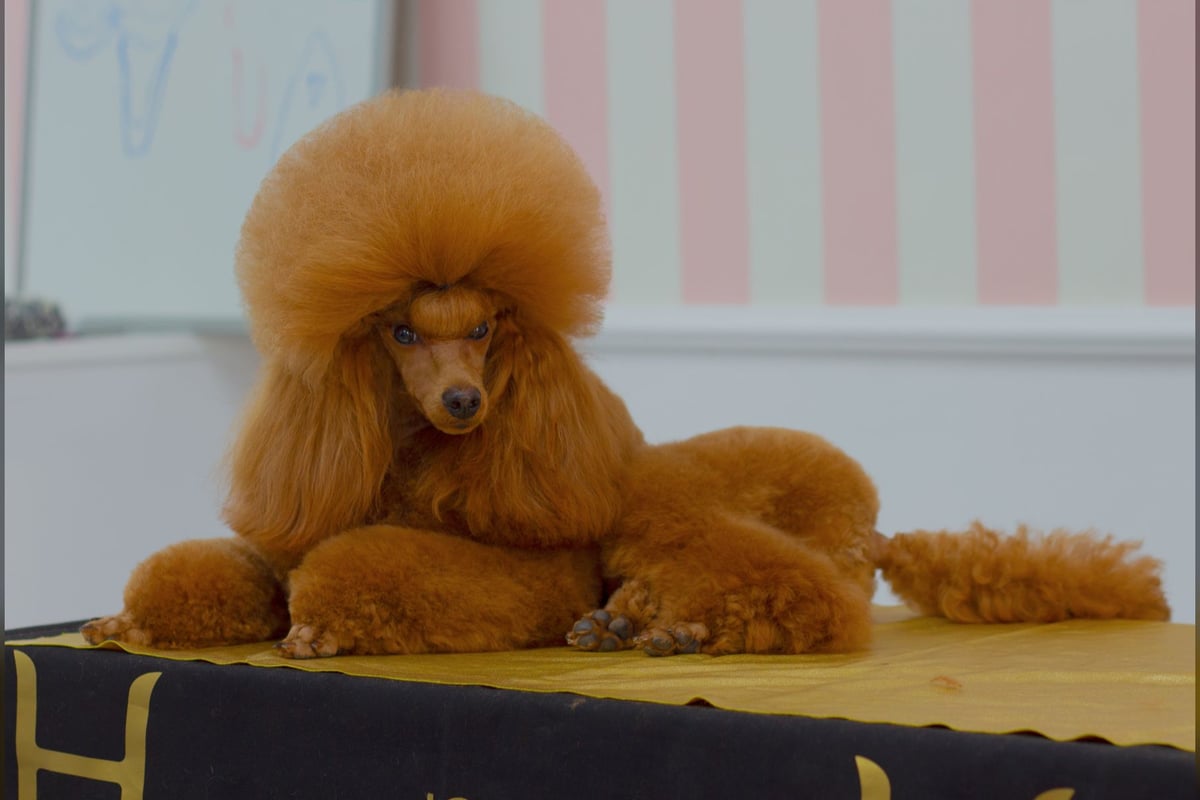
Miniature Poodle
The Miniature Poodle is the second-largest of the four FCI 172 Poodle varieties by size: height at the withers 28 to 35 cm, weight 4 to 7 kg. Sturdier than the Toy (under 28 cm) and more compact than the Medium (35-45 cm), it occupies an intermediate, high-energy segment. A curly, non-shedding coat classified as hypoallergenic, requiring professional grooming every 6 to 8 weeks. Life expectancy 12 to 15 years. Predisposed to Addison's disease (adrenal insufficiency) and granulomatous sebaceous adenitis.
- Weight
- 4 to 7kg
- Height
- 28 to 35cm
- Life expectancy
- 14years
- Monthly cost
- 75 to 130€
Personality profile
Energy 4/5
Independence 2/5
Trainability 5/5
Good with children 4/5
Barking 4/5
Space needed 2/5
Attachment to home 5/5
Good with strangers 3/5
Good with dogs 4/5
Good with cats 4/5
Coat care 5/5
Exercise needs 4/5
Scores given on measured axes, data confidence: high.
Living with a Miniature Poodle
Description
A proportioned, muscled bone structure for its size: a body slightly longer than tall, a long head with a fine, straight muzzle, dark oval eyes with an alert expression, drop ears lying flat. A dense, curly coat with a woolly or corded texture, available in solid colors — black, white, brown, gray, apricot, red. Compared with the Toy Poodle, the Miniature's skeletal frame is noticeably sturdier: an average weight of 5.5 kg versus 2.8 kg for the Toy, which reduces the risk of fractures and puppy hypoglycemia. All four varieties share the same FCI 172 standard; only the size ranges set them apart.

Temperament
A high energy level (4/5) combining physical and intellectual needs: the Miniature Poodle spends as much effort learning a new task as it does running. Rank 2 on the Coren scale, it learns a command in 2 to 5 repetitions — a performance identical to the larger varieties. More vocal than the Medium or the Standard at a comparable size, it signals every sound stimulus from puppyhood if desensitization is absent. Strong attachment to its household, copes poorly with solitude beyond 5 hours. Socialization before 14 weeks is decisive for tolerance of strangers and animals.
Training
Maximum trainability (5/5): the Miniature Poodle fully inherits the cognitive abilities of the Standard variety, ranked 2nd per Coren. An excellent candidate for rally obedience, small/medium-sized agility and nosework — a recommended sport, along with 45 to 60 minutes of intense physical activity a day split into 2 to 3 sessions. The Miniature's liveliness can translate into slight distraction from outside stimuli in urban settings — short sessions (10 to 15 minutes), varied, rewarded with play and treats. Housetraining in 2 to 4 weeks. Avoid over-protectiveness: excessive attachment leads to separation anxiety, a behavioral issue common in this variety.

Feeding
For a 5.5 kg adult: 100 to 140 g of premium small-breed kibble a day, split into 2 meals. Puppies under 3 months: 3 meals a day to stabilize blood sugar, a lower risk of hypoglycemia than the Toy but not zero. Monitor body condition: Miniature Poodles tend toward weight gain past age 5 if activity decreases. Treats capped at 10% of intake. Regular dental hygiene (brushing 3 times a week): intermediate-sized breeds build up tartar faster than large breeds.
Affiliate links, no extra cost to you. Legal notice

Living conditions
Suited to an apartment from 35 m², provided a minimum of 45 to 60 minutes of activity a day is respected, split into 2 to 3 outings. Its body mass of 4 to 7 kg makes it less space-demanding than the Medium, but its energy level of 4/5 requires daily mental stimulation — search games, nosework, trick training. Sensitive to cold (non-waterproof coat, light build): a coat recommended below 5 °C. Not suited to households where it would be alone the entire day with no scheduled activity.

Grooming and coat care
A hypoallergenic, continuously growing curly coat: mats into compact tangles within 2 to 3 weeks without upkeep. Brushing 3 to 4 times a week with a wide-toothed comb. Professional grooming every 6 to 8 weeks — lion clip, sporting clip or puppy clip depending on preference. Grooming session: 60 to 90 minutes, typical price between 40 and 65 € in mainland France. Ear canal hair plucking at every groomer visit to prevent ear infections. The absence of seasonal shedding holds scales within the curly coat, limiting allergen dispersal.

Health
Addison's disease (adrenocortical insufficiency): documented as overrepresented across the whole Poodle lineage, with misleading symptoms — episodic lethargy, vomiting, loss of appetite. Diagnosed via an ACTH stimulation test; lifelong hormone replacement treatment. Granulomatous sebaceous adenitis: inflammation of the sebaceous glands causing scaling, hair loss and patches; more common in the Miniature and the Standard than in other breeds. Progressive retinal atrophy (PRA-prcd): a hereditary disease leading to night blindness and then total blindness, DNA test available for both parents. Patellar luxation: less common than in the Toy but to watch, assessed at 8 weeks by palpation. Chronic ear infections: a hairy, damp ear canal, weekly cleaning.
Breed history
The Poodle descends from the Barbet, a water-game hunting dog documented as early as the 15th century in Europe. The FCI attributes the origin to France since 1936 (standard 172), though the German etymology Pudel — to paddle in water — is claimed across the Rhine. The size varieties developed through successive selections from the Standard stock: the Miniature stabilized in the 18th century as a parlor dog favored by the French bourgeoisie, a natural in-between of the boudoir Toy and the working Medium. FCI standard 172 updated in March 2024. In France, it is one of the most represented varieties in the breed's LOF registrations.
Getting ready for your Miniature Poodle
Five essentials to line up before day one.
Affiliate links, no extra cost to you. Legal notice
FAQ: Miniature Poodle
Sources
- FCI Standard No 172 · FCI breed standard 172, Group 9 Companion and Toy Dogs, Section 2 Poodle — Miniature variety (28-35 cm), standard updated March 2024
- AKC Breed Profile — Miniature Poodle · AKC Miniature Poodle breed profile, Non-Sporting Group — height 10-15 inches, weight 10-15 lbs
- SCC — Miniature Poodle breed profile · Société Centrale Canine, Poodle breed profile — Miniature variety, morphological ranges and health data
FCI, Fédération Cynologique Internationale, the world body that has codified breed standards since 1911. FCI number 172 is assigned to the Miniature Poodle.
Breeds similar to a Miniature Poodle

