


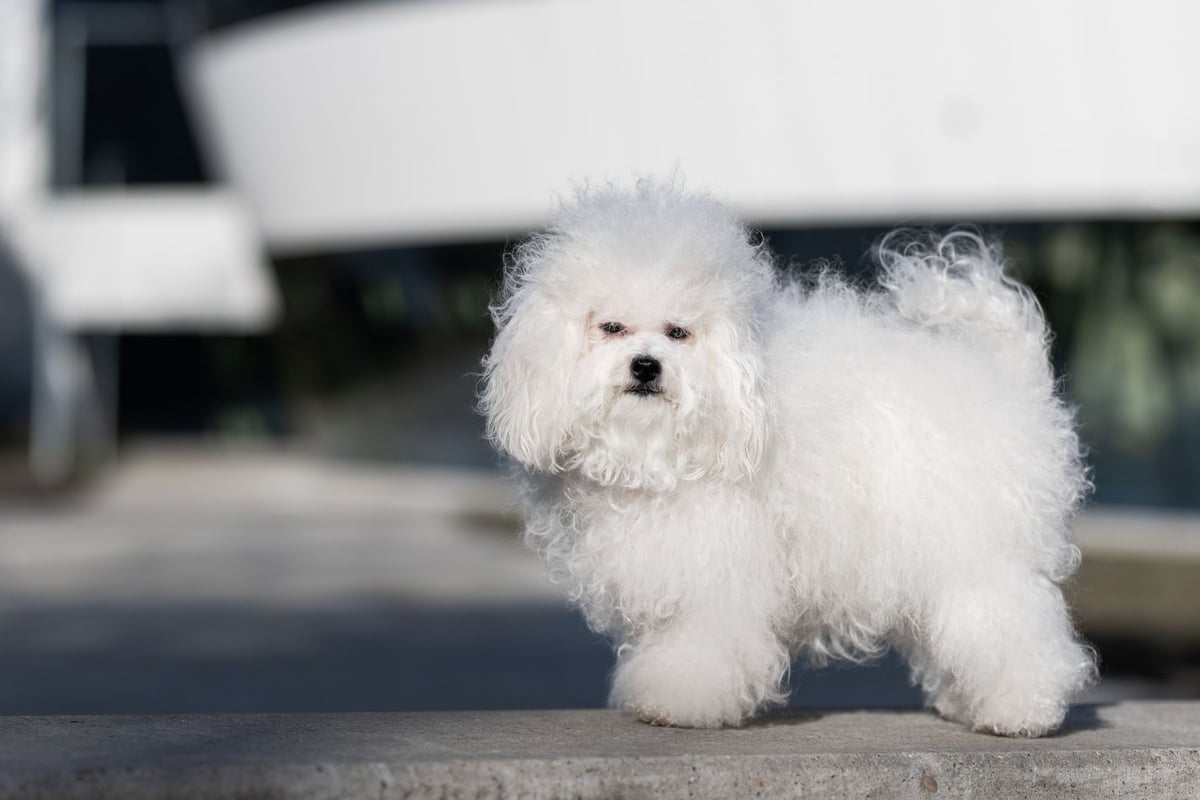
Bolognese
The Bolognese is a toy breed of 2.5 to 4 kg for 25 to 30 cm at the withers, recognized by the FCI under number 196, Group 9 Section 1. Originating in Bologna, Italy, it is documented in Italian aristocratic courts as early as the 15th century; Titian and later Goya both painted it. Its cottony white coat, not curled (unlike the wavy-coated Maltese), sheds almost nothing, which classifies it as hypoallergenic. Life expectancy of 13 to 15 years, with a healthy genetic profile thanks to a historical founder bottleneck.
- Weight
- 2.5 to 4kg
- Height
- 25 to 30cm
- Life expectancy
- 14years
- Monthly cost
- 60 to 100€
Personality profile
Energy 2/5
Independence 2/5
Trainability 4/5
Good with children 3/5
Barking 3/5
Space needed 1/5
Attachment to home 5/5
Good with strangers 3/5
Good with dogs 4/5
Good with cats 4/5
Coat care 4/5
Exercise needs 2/5
Scores given on measured axes, data confidence: medium.
Living with a Bolognese
Description
A square, compact build: a slightly rounded head, muzzle of moderate length, round dark expressive eyes, drop ears carried high. Entirely white coat, cottony texture in soft locks — neither curly nor smooth, a trait that distinguishes the breed from the Bichon Frise and the Maltese. Weight 2.5 to 4 kg for both sexes, height 25 to 30 cm. Undercoat only lightly developed, negligible shedding.

Temperament
Calm and composed compared with other bichon breeds: energy 2/5, it prefers human closeness to intense play. Deeply attached to a reference household, it signals strangers with a few barks without being pathologically vocal. May develop separation anxiety if repeatedly left alone more than 4 hours. Supervision is required with children under 4 — its small size makes it vulnerable to rough handling.
Training
Good trainability: picks up basic cues in 5 to 10 repetitions with positive reinforcement and human contact. Motivated by food and closeness. Housetraining achieved in 3 to 5 weeks with a consistent method. Sessions of 5 to 10 minutes are enough — the breed is attentive but has low resistance to boredom.

Feeding
55 to 80 g of premium small-breed kibble a day for a 3 kg adult, split into 2 meals. Puppies: 3 meals until 3 months to prevent toy-breed hypoglycemia. Treats limited to 10% of intake — excess weight worsens patellar luxation. Small-sized kibble suited to narrow jaws.
Affiliate links, no extra cost to you. Legal notice

Living conditions
Perfectly suited to any type of housing, including apartments. Its exercise needs are met by two 15-to-20-minute outings a day. Sensitive to cold below 8 °C (a coat is recommended in winter) and must live indoors. No garden required, though an indoor play area enriches its day.

Grooming and coat care
Cottony, hypoallergenic coat without a dense undercoat, near-zero shedding. Brush 2 to 3 times a week to prevent tangles in the cottony locks, particularly behind the ears and in the armpits. Professional scissor grooming every 4 to 6 weeks — the coat must not be clipped short, as the Bolognese cut keeps the characteristic locks. Bathe every 3 to 4 weeks.

Health
One of the healthiest profiles in the bichon category: the breed's rarity in the 20th century paradoxically created a healthy founder bottleneck, with few genetic disorders documented in the LOF population. Patellar luxation (grade 1 to 2) remains the most common orthopedic condition in toy breeds — patella palpation of the parents is recommended. Dental hygiene is critical: small jaws predispose to periodontal disease. Epiphora is common and needs daily cleaning. Life expectancy of 13 to 15 years.
Breed history
The Bolognese is documented in Italian nobility as early as the 15th century; later, Titian and then Goya portrayed it in court paintings, first in Italy and then in Spain. In 1668, Cosimo III de' Medici gave several Bolognese dogs as prestige diplomatic gifts, an event documented in the Florentine archives. The breed nearly disappeared in the 20th century before Italian breeders rebuilt its registry in the 1950s. Recognized by the FCI under number 196, Group 9 Section 1, with patronage entrusted to Italy. About 80 annual LOF registrations in France make the Bolognese one of the rarest bichon breeds.
Getting ready for your Bolognese
Five essentials to line up before day one.
Affiliate links, no extra cost to you. Legal notice
FAQ: Bolognese
Sources
- FCI Standard No 196 · FCI breed standard 196, Group 9 Companion and Toy Dogs, Section 1 Bichons and related breeds
- SCC Breed Profile — Bolognese · Société Centrale Canine, breed profile Bolognese, FCI standard 196
FCI, Fédération Cynologique Internationale, the world body that has codified breed standards since 1911. FCI number 196 is assigned to the Bolognese.
Breeds similar to a Bolognese

