


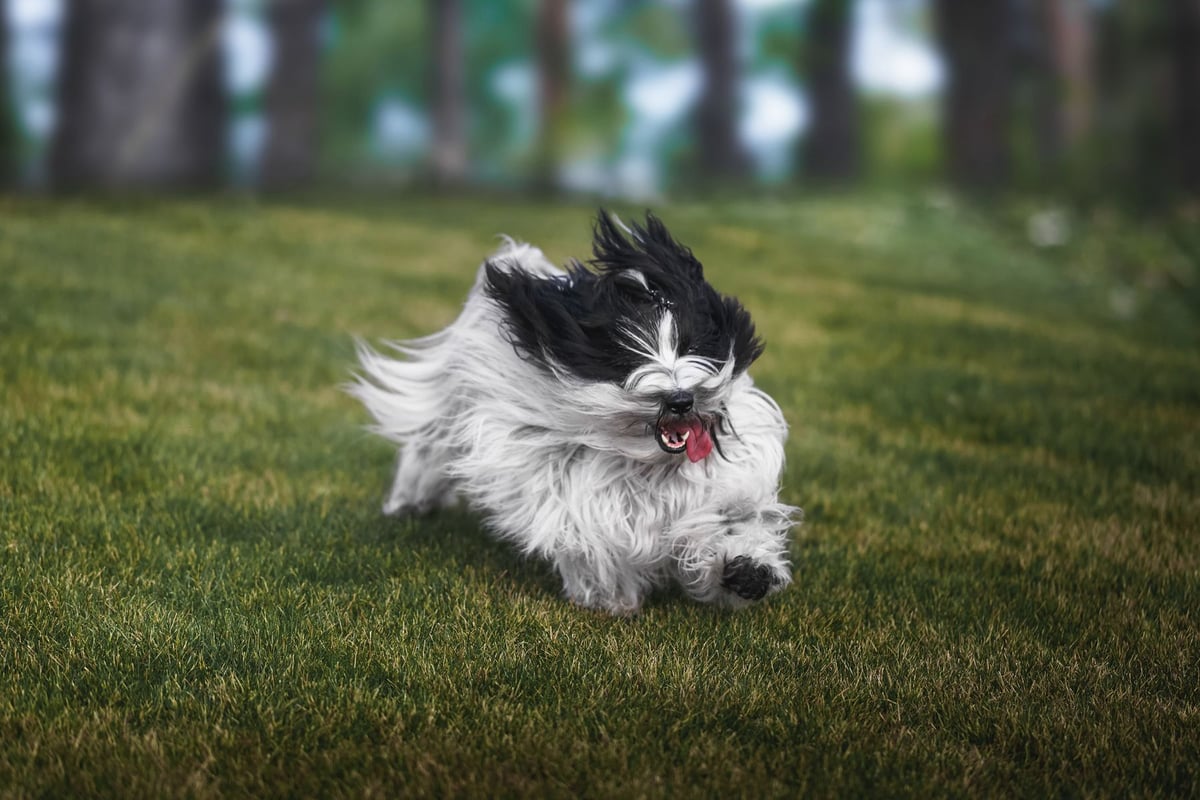
Tibetan Terrier
The Tibetan Terrier (Tsang Apso, FCI 209) is not a terrier despite its name — the term was assigned to it by the British in the 20th century based on its size, not its function. An ancient Tibetan breed with over 2 000 years of history, it was bred by Buddhist monks in the monasteries of the Tsang region (southern Tibet) and regarded as a sacred good-luck dog. Never sold according to tradition — presenting one to honored guests was a ritual gift, since selling it was believed to bring misfortune on the monastery. The FCI standard was fixed in 1957.
- Weight
- 8 to 14kg
- Height
- 35 to 41cm
- Life expectancy
- 14years
- Monthly cost
- 80 to 140€
Personality profile
Energy 3/5
Independence 4/5
Trainability 3/5
Good with children 4/5
Barking 3/5
Space needed 2/5
Attachment to home 4/5
Good with strangers 2/5
Good with dogs 3/5
Good with cats 3/5
Coat care 4/5
Exercise needs 3/5
Scores given on measured axes, data confidence: high.
Living with a Tibetan Terrier
Description
A medium-sized dog, 35 to 41 cm at the withers for 8 to 14 kg, with a square, well-proportioned build. Its most distinctive anatomical trait is the shape of its feet: large, flat, with abundant fur between the toes — a natural adaptation to the snowy, rocky terrain of the Tibetan high plateaus, where they act as snowshoes. The coat is double: a dense woolly undercoat and a long, fine topcoat, allowed in every color except liver (chocolate brown). The tail is carried curled over the back, typical of Himalayan breeds.

Temperament
A markedly independent breed, the Tibetan Terrier bonds deeply with its owner or a small family circle, but stays reserved, even aloof, with strangers — a long-standing wariness inherited from its role as monastery guardian. It barks to signal any unusual presence, making it a good watchdog without being excessively noisy. Its behavior toward other dogs is moderate: neither dominant nor particularly playful, it can cohabit without much difficulty. With children in the household it knows, it is patient; less tolerant of unfamiliar, boisterous children.
Training
The Tibetan Terrier's independence calls for a consistent, positive training approach: it learns well but at its own pace, and does not tolerate mechanical repetition without stimulation. Short, varied sessions give better results than long exercises. Scent work and tracking exercises engage its intelligence effectively without demanding intense physical activity — it does not need several hours of exercise a day but enjoys mental activities. Early socialization before 12 weeks is decisive for limiting wariness toward strangers.

Feeding
180 to 250 g of premium small-to-medium breed kibble a day for a 10 to 12 kg adult, split into two meals. Kibble formulated for active medium-sized breeds works well; there is no breed-specific formulation. Omega-3 fatty acid supplementation (salmon oil) supports coat quality and reduces skin itching. Watch the weight of less active individuals — the breed tends to gain weight when caloric intake exceeds actual needs.
Affiliate links, no extra cost to you. Legal notice

Living conditions
Its manageable size makes it suited to apartment life provided daily outings stay regular — two to three active walks a day are enough. Its dense double coat, however, adapts poorly to hot, humid environments: it needs guaranteed access to cool, shaded areas in summer, and intense exercise should be avoided during heat peaks. Cold poses no problem at all — its coat is built for altitudes above 3 000 m. An apartment in a temperate or cold climate suits it fully.

Grooming and coat care
The double coat needs frequent brushing — at least three times a week — to prevent matting in the woolly undercoat, particularly behind the ears and around the hindquarters. A visit to a professional groomer every two to three months keeps the coat in good condition and allows a thorough cleaning of the tufted feet. Shedding stays discreet, with no seasonal blowout, thanks to the fine texture of the topcoat. The area around the eyes should be cleaned regularly to prevent buildup.

Health
Life expectancy of 12 to 15 years. The breed carries two genetic conditions for which specific DNA tests exist: progressive retinal atrophy type PRA-3 and neuronal ceroid lipofuscinosis (NCL), both detectable before breeding. Serious breeders systematically provide the results of these tests. Patellar luxation and hip dysplasia round out the orthopedic issues to watch. Cases of deafness have been reported in some lines. An annual eye exam is recommended from age 6.
Breed history
The breed originates from the Tsang region in southern Tibet, where it had lived for over 2 000 years in high-altitude Buddhist monasteries. Tibetan monks regarded it as a good-luck charm. The first specimens reached Europe in the early 20th century, introduced by Dr. Agnes Greig, who received one as a gift from a Tibetan chieftain in 1920. It was she who popularized the name "Tibetan Terrier" in Britain — a misleading name, since the breed never hunted or went to ground. The FCI standard (number 209) was officially fixed in 1957, assigned to Group 9 Companion and Toy Dogs.
Getting ready for your Tibetan Terrier
Five essentials to line up before day one.
Affiliate links, no extra cost to you. Legal notice
FAQ: Tibetan Terrier
Sources
- FCI Standard No 209 — Tibetan Terrier · FCI breed standard 209, Group 9 Companion and Toy Dogs
- Société Centrale Canine — Tibetan Terrier · SCC official breed record, Tibetan Terrier, Group 9
- AKC Breed Profile — Tibetan Terrier · AKC Tibetan Terrier breed profile, Non-Sporting Group
FCI, Fédération Cynologique Internationale, the world body that has codified breed standards since 1911. FCI number 209 is assigned to the Tibetan Terrier.
Breeds similar to a Tibetan Terrier

