


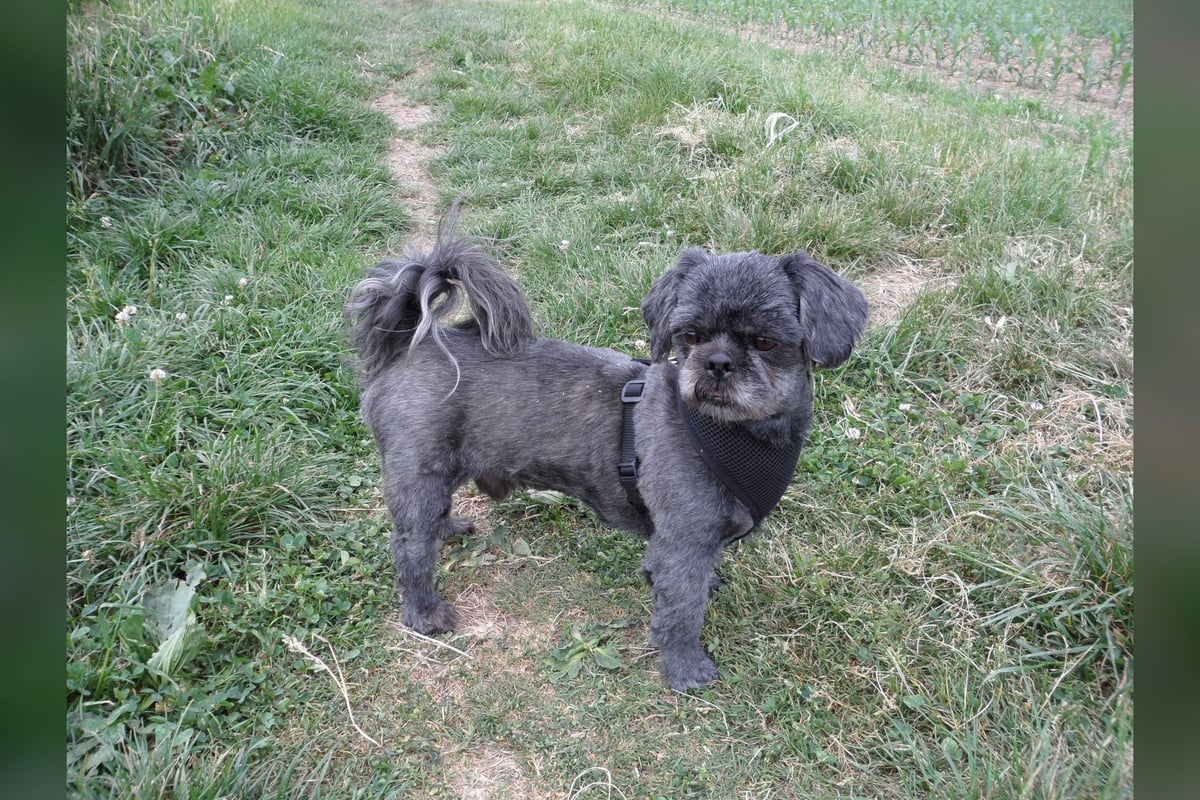
Shih Tzu
The Shih Tzu weighs 4 to 7.5 kg for 20-27 cm at the withers, recognized by the FCI under number 208, Group 9. A brachycephalic breed of Tibetan origin, it develops BOAS (brachycephalic obstructive airway syndrome) in 30 to 50% of individuals and shows marked heat intolerance from 24 °C. Life expectancy 12-14 years.
- Weight
- 4 to 7.5kg
- Height
- 20 to 27cm
- Life expectancy
- 13years
- Monthly cost
- 60 to 100€
Personality profile
Energy 2/5
Independence 3/5
Trainability 3/5
Good with children 4/5
Barking 3/5
Space needed 1/5
Attachment to home 4/5
Good with strangers 4/5
Good with dogs 4/5
Good with cats 4/5
Coat care 5/5
Exercise needs 2/5
Scores given on measured axes, data confidence: high.
Living with a Shih Tzu
Description
A compact breed with a long, dense, non-curly coat that falls to the ground, all colors accepted by the FCI standard. Broad, round head with a pronounced stop, prominent dark eyes set well apart, large ears with long drooping leathers covered in hair. Short, flattened muzzle (brachycephalic) with narrow slit nostrils in the typical form. Plumed tail carried high over the back. A body longer than it is tall, with solid bone. Males and females are the same size, the FCI standard's upper limit being 27 cm at the withers.

Temperament
Playful but not high-energy, and independent-minded: the breed responds better to motivation through play and food than to repetitive commands. Sociable with unfamiliar people — none of the wariness typical of Asian utilitarian breeds. Gets along with familiar dogs and cats given early socialization. Can be stubborn and ignore recall outdoors if scent distracts it. Tolerates solitude moderately well — up to 4 hours without destructive behavior in most individuals.
Training
Moderate trainability (3/5). Learns basic commands in 10 to 25 repetitions — slower than a Border Collie but entirely trainable. Positive reinforcement only: pressure or coercion triggers shutting down and refusal to cooperate. Short sessions of 5 to 10 minutes, twice a day maximum. Housetraining achieved in 4 to 6 weeks with a strict routine. Short but regular walks contribute as much to behavioral balance as to physical exercise.

Feeding
110 to 160 g of premium kibble a day for a 6 kg adult, split into 2 meals. A breed with a moderate obesity risk — weigh the ration, and count treats toward it (max 10% of calories). Kibble suited to the brachycephalic build (flat or semi-moist kibble that's easier to pick up with a short muzzle). Monitor kidney function after age 5: reduce phosphorus levels if the vet indicates it.
Affiliate links, no extra cost to you. Legal notice

Living conditions
A breed built for indoor living, suited to an apartment of any size. Low exercise needs: 2 outings of 15 to 20 minutes a day are enough for an adult. Heat is the main limiting factor: air-conditioned indoor space is essential in summer (from 24 °C, exertion triggers rapid hyperthermia), with walks shifted to cooler hours (morning before 9am, evening after 7pm). Sensitive to damp cold below 5 °C because its long coat soaks up water.

Grooming and coat care
Heavy, non-negotiable grooming. Daily brushing is mandatory on the long coat to prevent matting (particularly at the armpits, behind the ears, and around the collar). Professional grooming every 6 to 8 weeks for trimming or maintaining the long coat. Daily cleaning of the facial folds and eye corners (frequent reddish staining linked to the conformation). Inspect the long ears twice a week (yeast infections from moisture buildup). Monthly nail trimming. Owners who opt for a short "puppy cut" can cut brushing frequency to 3 times a week.

Health
Four priority conditions to watch. (1) Brachycephalic syndrome (BOAS): stenotic nares, an elongated soft palate, and a hypoplastic trachea reduce airflow — 30 to 50% of Shih Tzus develop clinical symptoms (loud snoring, visible respiratory effort, heat-triggered fainting). Corrective nasal surgery is available and effective in moderate to severe cases. (2) Keratoconjunctivitis sicca (KCS): frequent tear-production deficiency due to the exposed eye conformation, treated with lifelong cyclosporine eye drops once confirmed. (3) Chondrodystrophy: a chondrodystrophic breed at risk of intervertebral disc disease (IVDD) — avoid jumps off sofas, ramps recommended. (4) Kidney failure: a genetic predisposition to hereditary renal amyloidosis — annual urea/creatinine monitoring from age 5. Entropion (the eyelid rolling inward toward the eye) is present in lines with a very flattened conformation. Life expectancy 12 to 14 years with regular veterinary follow-up.
Breed history
A breed developed in Tibet, introduced to China in the 16th century, where it became a court dog of the Forbidden City under Empress Cixi in the 19th century. Exported to Great Britain in 1928 by Lady Brownrigg, recognized by the British Kennel Club in 1940 and by the FCI in 1957 under number 208. Introduced to France in the 1950s, it has regularly ranked in the top 20 of LOF registrations since the 2000s.
Getting ready for your Shih Tzu
Five essentials to line up before day one.
Affiliate links, no extra cost to you. Legal notice
FAQ: Shih Tzu
Sources
- FCI Standard No 208 — Shih Tzu · FCI breed standard 208, Group 9 Companion and Toy Dogs, Section 5 Tibetan breeds
- AKC Breed Profile — Shih Tzu · AKC Shih Tzu breed profile, Toy Group
FCI, Fédération Cynologique Internationale, the world body that has codified breed standards since 1911. FCI number 208 is assigned to the Shih Tzu.
Breeds similar to a Shih Tzu

