


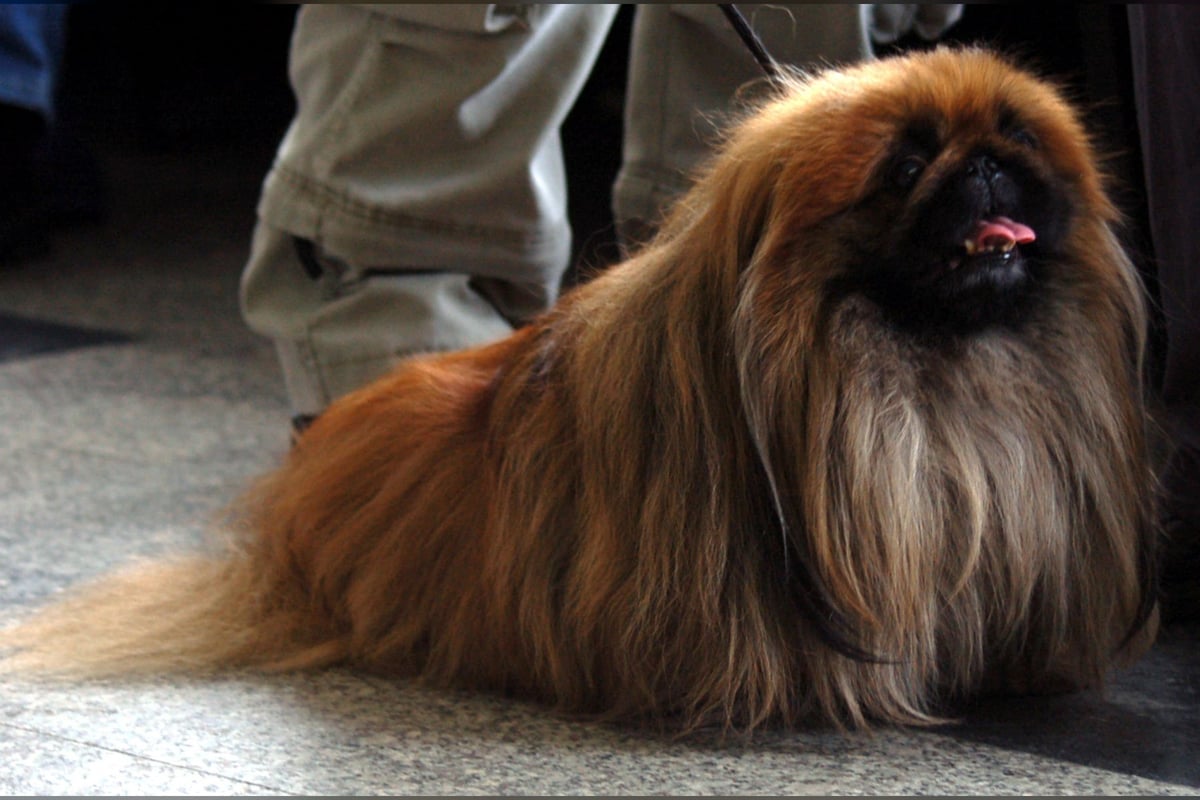
Pekingese
The Pekingese weighs 3 to 6 kg for 15-23 cm at the withers, recognized by the FCI under number 207, group 9. An extreme brachycephalic breed of Chinese imperial origin, it presents severe BOAS with life-threatening heat intolerance from as low as 25-28 °C. Dystocia is nearly universal: over 95% of litters require a planned cesarean section. Life expectancy 12 to 14 years.
- Weight
- 3 to 6kg
- Height
- 15 to 23cm
- Life expectancy
- 13years
- Monthly cost
- 60 to 110€
Personality profile
Energy 1/5
Independence 4/5
Trainability 2/5
Good with children 2/5
Barking 3/5
Space needed 1/5
Attachment to home 3/5
Good with strangers 2/5
Good with dogs 2/5
Good with cats 3/5
Coat care 5/5
Exercise needs 1/5
Scores given on measured axes, data confidence: high.
Living with a Pekingese
Description
A very compact breed with a massive, muscular body, wider in front than behind, giving it a characteristic rolling gait. Broad, flat head, domed skull, flattened muzzle with almost no stop — among the most extreme brachycephaly in the canine world. Typical narrow, slit-like nostrils. Long, abundant double coat: thick woolly undercoat and straight outer coat forming a mane around the neck and shoulders. Deep facial wrinkles in front of the muzzle. Tail carried over the back, feathered. Front legs slightly bowed. All colors except albino and liver.

Temperament
Independent and dignified in character — bred to be carried, not to obey. Selective bonding: it attaches to one or two key people and stays distant with strangers. Not very demonstrative but possessive of its space and its owners. Can become aggressive if its warning signals are ignored, particularly around unpredictable children. Very low daily energy level, sleeping 16 to 18 hours a day.
Training
Low trainability — not from a lack of cognitive ability but from an inherited independence of character. Responds to basic commands with patience and positive reinforcement, but immediate obedience and reliable recall remain hard to achieve. Coercive methods are counterproductive and dangerous (defensive risk). Intensive early socialization before 16 weeks helps limit wariness toward children and strangers.

Feeding
80 to 130 g of premium kibble a day for a 5 kg adult, in 2 meals. Flat kibble shapes suited to eating with a short muzzle. Obesity should be actively monitored: every excess kilo directly worsens BOAS and the joint load on the short legs.
Affiliate links, no extra cost to you. Legal notice

Living conditions
Suited to even the smallest apartment — its exercise needs are the lowest in group 9 (one short 10-15 minute outing a day is enough). Heat is its main, absolute constraint: above 25-28 °C, respiratory intolerance can quickly become fatal (pulmonary edema, collapse). Air-conditioned indoor space is mandatory in summer. Never left in a parked vehicle. Walks limited to the cooler hours (before 8am, after 8pm) during summer. Sensitive to damp cold despite the double coat.

Grooming and coat care
Heavy grooming despite the small size. Double coat requiring a full brushing at least 3 to 4 times a week to prevent undercoat matting — daily during shedding season (spring and fall). Daily cleaning of the deep facial wrinkles with a dry or slightly damp wipe: residual moisture in the folds leads to dermatitis and bacterial infections. Eye corners to be cleaned every day. Drop ears to be checked weekly. Monthly nail trimming. Professional groomer every 6 to 8 weeks (50 to 80 €).

Health
Multiple severe, high-priority conditions. (1) Extreme Brachycephalic Obstructive Airway Syndrome (BOAS): stenotic nares, hypertrophied soft palate, hypoplastic trachea, everted laryngeal saccules — present in the large majority of type-typical individuals. Corrective surgery is recommended before age 2 to prevent chronic lung deterioration. (2) Life-threatening heat intolerance: severe BOAS eliminates thermoregulation through panting — heatstroke can kill in under 10 minutes of exposure. This point is non-negotiable in buyer counseling. (3) Near-universal dystocia: the broad head and the mother's pelvic shape make natural birth dangerous for both mother and puppies — over 95% of litters are delivered by planned cesarean, at a cost of 600 to 1 200 €. (4) Necrotizing keratitis and corneal ulcers: the prominent eyes, poorly protected by the eyelids, are exposed to trauma, dry keratoconjunctivitis and deep ulcers requiring urgent ophthalmological care. (5) Spinal conditions: a chondrodystrophic breed at high risk of intervertebral disc disease (IVDD) — avoid stairs, provide access ramps.
Breed history
Among the oldest breeds in the canine world, present at the Chinese imperial court since at least the 8th century (Tang dynasty). Reserved exclusively for the imperial family: possession by a commoner was punishable by death. Introduced to the West in 1860 during the sack of the Summer Palace in Beijing by Franco-British troops — five individuals brought back to Britain, including one given to Queen Victoria. Recognized by the British Kennel Club in 1898. FCI standard set under number 207, group 9, section 8 (Japanese and Chinese breeds). Registrations in France have been in steady decline since the 1990s in favor of more recent brachycephalic breeds.
Getting ready for your Pekingese
Five essentials to line up before day one.
Affiliate links, no extra cost to you. Legal notice
FAQ: Pekingese
Sources
- FCI Standard No 207 — Pekingese · FCI breed standard 207, Group 9 Companion and Toy Dogs, Section 8 Japanese Chin and Pekingese
- AKC Breed Profile — Pekingese · AKC Pekingese breed profile, Toy Group
FCI, Fédération Cynologique Internationale, the world body that has codified breed standards since 1911. FCI number 207 is assigned to the Pekingese.
Breeds similar to a Pekingese

