


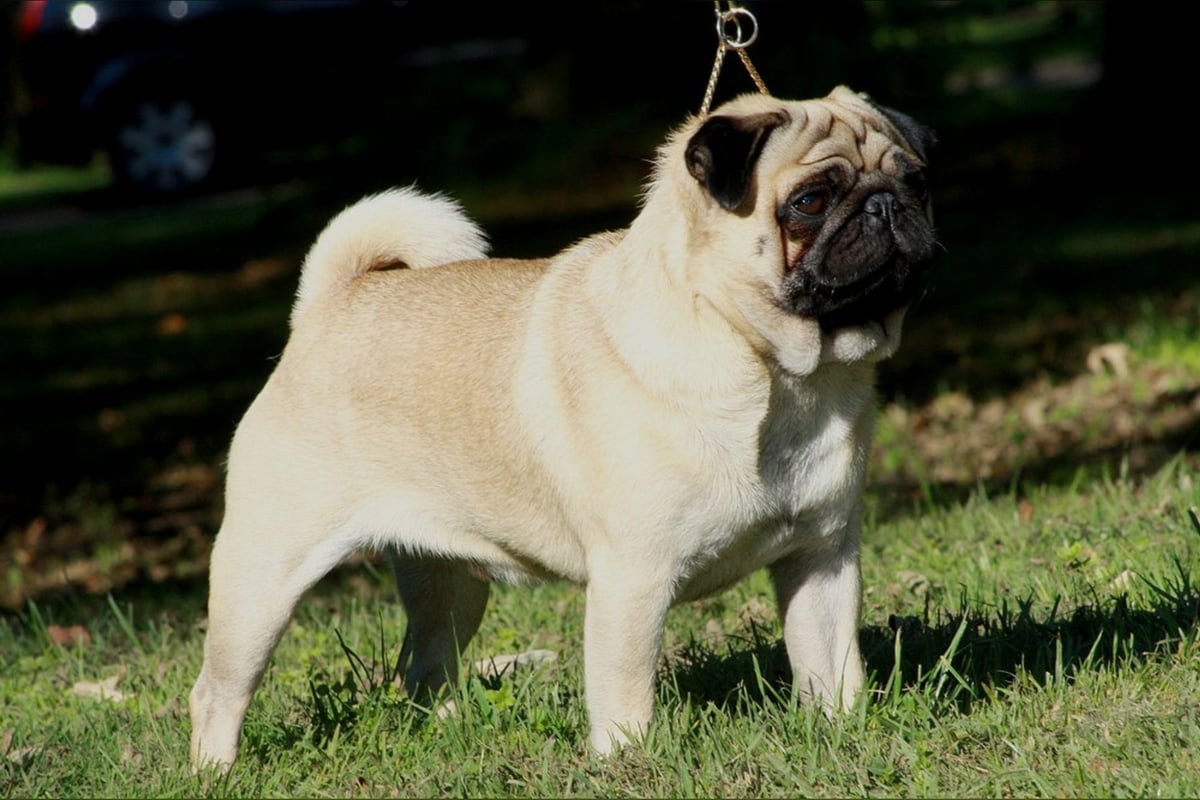
Pug
The Pug is an extreme brachycephalic molossoid of 6 to 8 kg and 25 to 36 cm, descended from the imperial Chinese courts of the Han dynasty. Recognized by the FCI under number 253, it shows severe BOAS in more than 50% of individuals, a breed-specific fatal hereditary encephalitis (PDE), and a life expectancy of 12 to 15 years compromised by its accumulated structural defects.
- Weight
- 6 to 8kg
- Height
- 25 to 32cm
- Life expectancy
- 13years
- Monthly cost
- 60 to 120€
Personality profile
Energy 2/5
Independence 2/5
Trainability 3/5
Good with children 4/5
Barking 2/5
Space needed 1/5
Attachment to home 5/5
Good with strangers 4/5
Good with dogs 4/5
Good with cats 4/5
Coat care 2/5
Exercise needs 1/5
Scores given on measured axes, data confidence: high.
Living with a Pug
Description
The Pug is marked by a round, massive head, an almost absent muzzle, deep facial wrinkles, prominent bulging eyes, and a tail curled into a corkscrew resulting from congenital hemivertebrae. The coat is short, smooth, and dense, in fawn or black. Despite a compact silhouette, handling the dog reveals a muscular body that is heavy for its size. Its exaggerated morphology is the product of recent selection for extreme traits — recognized as a source of chronic suffering by European veterinary authorities.

Temperament
Sociable with people and other animals, minimally territorial, rarely aggressive. It becomes strongly attached to its household and suffers from marked separation anxiety — it copes badly with absences over 4 hours. Vocally discreet for a toy breed, it barks little; on the other hand, snoring, reverse sneezing, and respiratory grunting are constant. Playful in short bursts, it tires quickly due to its limited breathing capacity.
Training
Cooperative and food-motivated, it grasps requested behaviors quickly in sessions of 5 to 8 minutes maximum — beyond that, respiratory fatigue affects concentration. Housetraining achieved around 4 to 5 months. Reliable recall in a secured environment. Prone to separation anxiety: gradual desensitization to departures from the first weeks onward.

Feeding
120 to 180 g of premium kibble a day depending on weight and activity, split into 2 meals. A kibble shape adapted for brachycephalic breeds (star-shaped or U-shaped kibble) is preferable. Obesity is common — every extra kilo mechanically worsens BOAS and adds pressure on the spine. Do not exceed the manufacturer's recommended ration; treats count toward the daily allowance.
Affiliate links, no extra cost to you. Legal notice

Living conditions
An apartment or a house without a garden suits it, provided indoor temperature stays below 22 °C in summer. Air conditioning is essential above 25 °C ambient — without it, hyperthermia sets in within 20 minutes of exposure. Outings limited to 15-20 minutes outside peak heat hours (before 9 am, after 9 pm in summer). Stairs are discouraged due to the hemivertebrae. It does not swim — never leave it unsupervised near a pool.

Grooming and coat care
Despite the short coat, the Pug sheds heavily year-round (high shedding level, 4/5) — twice-weekly brushing with a rubber grooming glove is required to control loose hair. Facial wrinkles need cleaning 2 to 3 times a week with an unscented wipe: moisture trapped in the folds promotes bacterial and yeast dermatitis (Malassezia). Weekly check of the corneas (bulging eyes prone to trauma). Monthly ear cleaning, nail trimming every 3 to 4 weeks.

Health
Brachycephalic obstructive airway syndrome (BOAS), moderate to severe, in more than 50% of individuals according to British functional BOAS studies: stenotic nares, elongated soft palate, hypoplastic trachea, everted laryngeal saccules. Surgery (rhinoplasty, palatoplasty) recommended before age 2 for grades 2 and 3. Pug Dog Encephalitis (PDE): a hereditary necrotizing meningoencephalitis unique to the breed, affecting roughly 1.2% of individuals — sudden onset between 2 and 3 years, seizures, behavioral changes, death within a few weeks. A genetic test is available (MHC class II gene). Thoracic hemivertebrae causing progressive spinal cord compression. Skin atopy and demodicosis are common. Exposure keratitis and corneal ulcers on the bulging eyes.
Breed history
The Pug is documented in China under the Han dynasty (206 BC – 220 AD) as a companion dog of the emperors. It was introduced to Europe via Dutch trade routes in the 16th century — the breed became an emblem of the House of Orange-Nassau after a Pug reportedly alerted William I to a Spanish attack in 1572. FCI standard 253, Group 9, Section 11 (small Molossoid-type dogs). Aggressive selection for extreme morphology since the 1980s-2000s is responsible for the worsening of today's conditions.
Getting ready for your Pug
Five essentials to line up before day one.
Affiliate links, no extra cost to you. Legal notice
FAQ: Pug
Sources
- FCI Standard No 253 · FCI breed standard 253, Group 9 Companion and Toy Dogs, Section 11
- AKC Breed Profile · AKC Pug breed profile, Toy Group
FCI, Fédération Cynologique Internationale, the world body that has codified breed standards since 1911. FCI number 253 is assigned to the Pug.
Breeds similar to a Pug

