


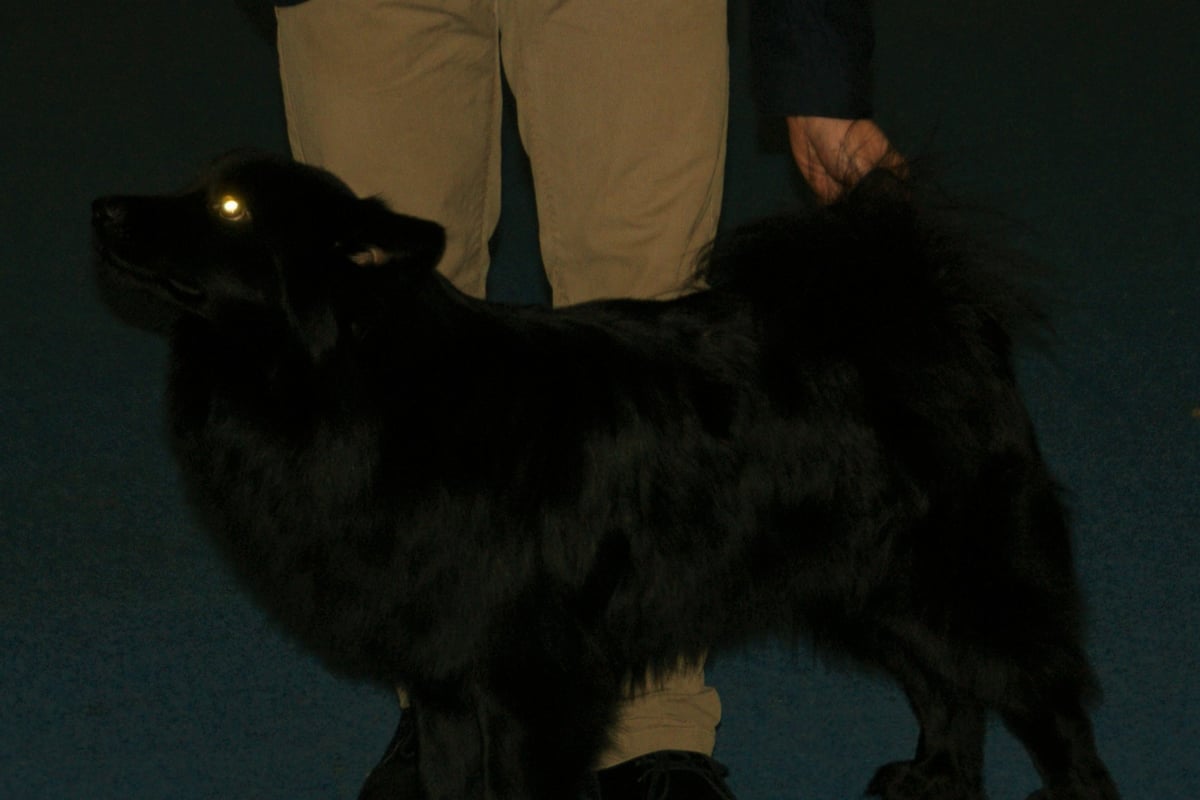
Swedish Lapphund
The Swedish Lapphund (Svensk Lapphund) is a pastoral spitz developed by the Swedish Sami people to herd reindeer in Scandinavian Lapland, today one of the oldest formally recognized Swedish breeds. Weighing 17 to 21 kg, recognized by the FCI under number 135, it differs from its Finnish cousin through a dominant black coat, lower international spread (~80 LOF registrations/year in France), and a documented genetic predisposition to prcd-type progressive retinal atrophy, requiring systematic DNA testing of breeding dogs.
- Weight
- 17 to 21kg
- Height
- 40 to 51cm
- Life expectancy
- 13years
- Monthly cost
- 70 to 110€
Personality profile
Energy 4/5
Independence 3/5
Trainability 4/5
Good with children 4/5
Barking 4/5
Space needed 3/5
Attachment to home 4/5
Good with strangers 3/5
Good with dogs 4/5
Good with cats 3/5
Coat care 3/5
Exercise needs 4/5
Scores given on measured axes, data confidence: medium.
Living with a Swedish Lapphund
Description
Compact, well-muscled spitz. Males 45-51 cm for 19-21 kg, females 40-46 cm for 17-19 kg. Predominantly black coat at its base, sometimes black with limited tan markings, brown rare — the black immediately distinguishes it from the Finnish Lapponian Dog, which is more often fawn. Abundant double coat with a dense woolly undercoat and a straight, relatively long topcoat. Medium-sized triangular pricked ears, plumed tail carried up over the back in motion. Dark, well-almond-shaped eyes, lively and attentive expression.

Temperament
Less open to strangers than its Finnish cousin (3/5 versus 4/5): centuries of selection within an isolated Sami community produced a dog more wary of novelty, without reaching the suspicion of a guard dog. A vocal breed (barking 4/5): giving voice is part of the pastoral work it was selected for, worth factoring in before moving into a building with thin walls. Good sociability within a pack (4/5), good responsiveness to human cues due to its pastoral coordination heritage.
Training
Trainability 4/5, in the same vein as the Finnish Lapponian Dog and higher than the Siberian Husky. Responsive to positive reinforcement, memorizes new behaviors in 15 to 25 repetitions. Its Swedish pastoral heritage gives it an ability to work in coordination with humans without waiting for an order for every micro-decision — an asset for agility, treibball, or light pulka over sessions of 5 to 10 km. Exercise needs rated 4/5 require building in at least 1h of intense physical activity a day into the training schedule: a dog that has burned off energy has less residual energy left to release through disruptive behavior. Punishment or physical restraint durably damages trust: gentle, consistent training only.

Feeding
250 to 360 g of premium kibble a day depending on weight and activity, in 2 meals. Animal protein 28-32%, fat 14-18% to support its Nordic metabolism. The breed stays within a tight weight range (17-21 kg) — monitor body condition monthly and adjust the ration if activity varies seasonally. Omega-3 supplementation (5 ml of salmon oil/day) is beneficial for the quality of the black coat.
Affiliate links, no extra cost to you. Legal notice

Living conditions
Suited to a house or a spacious apartment with regular outdoor access and 1h to 1h30 of daily activity. Cold tolerance 5/5 inherited from Swedish Lapland (down to -35 °C), but marked heat sensitivity (tolerance 2/5) above 22 °C during activity: in Mediterranean regions, adjusting outing times in July-August is mandatory. A fenced garden is appreciated but not essential if enough exercise is guaranteed. Rarer than the Finnish Lapponian Dog, it often requires joining a waiting list at an approved SCC breeder.

Grooming and coat care
Upkeep comparable to the Finnish Lapponian Dog: brushing 1 to 2 times a week under normal conditions, daily during the two annual shedding seasons. The black coat shows white hair on clothing less than the Samoyed, but the amount of undercoat shed during molting remains substantial. Areas to watch: behind the ears, inner thighs, armpits — matting develops quickly if brushing is neglected for more than a week. Bath at most once a month with a shampoo suited to dark coats to preserve the shine of the black.

Health
Main genetic condition: prcd-type progressive retinal atrophy (progressive rod-cone degeneration) — a known recessive mutation, DNA testing available and mandatory for any serious breeding dog. An "affected" dog (homozygous carrier) develops progressive blindness starting between 3 and 8 years. Require results from both parents (clear or carrier, never affected) before purchase. Hip dysplasia and elbow dysplasia documented at a moderate incidence: SCC radiographs of the parents mandatory. Life expectancy 12 to 14 years.
Breed history
Before the 20th century, the Lapponian-type dog populations of the Swedish and Finnish Sami corridor formed a genetic continuum with no clear ethnic boundary. It was in 1944 that the Svenska Kennelklubben and the Suomen Kennelliitto formalized the split into two distinct breeds, under pressure from breeders in both countries wanting to protect their national lines. The Swedish Lapphund received FCI standard 135, the Finnish Lapponian Dog FCI standard 189. Today, the Swedish breed remains rarer than the Finnish one internationally: about 400-500 births a year in Sweden, about 80 LOF registrations/year in France. The breed is protected by the Nordiska Lapphundklubben, which centralizes health data and DNA testing.
Getting ready for your Swedish Lapphund
Five essentials to line up before day one.
Affiliate links, no extra cost to you. Legal notice
FAQ: Swedish Lapphund
Sources
- FCI Standard No 135 — Swedish Lapphund · FCI breed standard 135, Group 5 Spitz and Primitive Types, Section 3 Nordic Watchdogs and Herding Dogs
- AKC Breed Profile — Swedish Lapphund · AKC Swedish Lapphund breed profile, FSS (Foundation Stock Service)
- SCC — Swedish Lapphund Breed · Société Centrale Canine, official Swedish Lapphund breed profile, Group 5
FCI, Fédération Cynologique Internationale, the world body that has codified breed standards since 1911. FCI number 135 is assigned to the Swedish Lapphund.
Breeds similar to a Swedish Lapphund

