


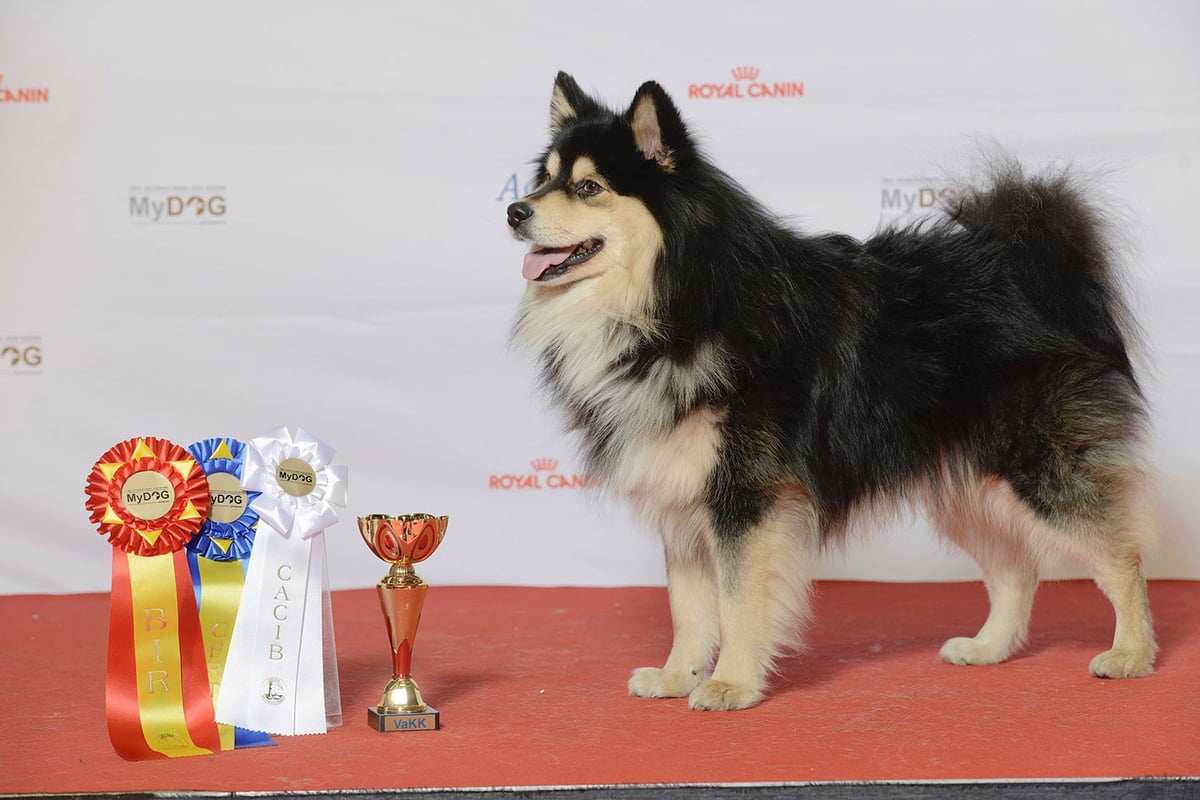
Finnish Lapponian Dog
The Finnish Lapponian Dog (Suomenlapinkoira) is a herding spitz selected by the Sami people beyond the Finnish Arctic Circle to drive reindeer herds — not by guarding them like a molossoid, but by actively directing them through barking and movement. Weighing 15 to 24 kg and recognized FCI number 189, it combines a cold tolerance of 5/5 (down to -40 °C) with marked openness toward strangers and higher trainability than other Nordic spitz breeds. The breed nearly disappeared during World War II in Lapland, before being reconstructed starting in 1945.
- Weight
- 15 to 24kg
- Height
- 43 to 51cm
- Life expectancy
- 13years
- Monthly cost
- 70 to 110€
Personality profile
Energy 4/5
Independence 3/5
Trainability 4/5
Good with children 5/5
Barking 4/5
Space needed 3/5
Attachment to home 4/5
Good with strangers 4/5
Good with dogs 4/5
Good with cats 3/5
Coat care 3/5
Exercise needs 4/5
Scores given on measured axes, data confidence: high.
Living with a Finnish Lapponian Dog
Description
A compact, muscular spitz build. Males 46-51 cm at 17-24 kg, females 43-46 cm at 15-19 kg. Abundant coat, predominantly a bear-fawn color with a frequent dark mask, or black, brown, wolf gray — always bicolor or tricolor, never a pure solid color. A very dense woolly undercoat protected by an abundant top coat. Medium-sized triangular erect ears, a plumed tail carried over the back. Alert, curious expression, expressive dark eyes set slightly obliquely.

Temperament
Biddable without being servile: far more responsive to human cues than most Nordic spitz breeds, it accepts strangers without excessive wariness (4/5 for openness to strangers) — a trait inherited from centuries of close cohabitation within Sami communities. A vocal breed by functional selection: barking was the main working tool for encircling and directing reindeer, not a guard-dog alert. Its barking level reaches 4/5 — plan for sound desensitization in an apartment from 8 weeks. It tolerates being alone better than the Samoyed (threshold 5-6 hours), but remains a pack dog by nature.
Training
Among Nordic spitz breeds, the Finnish Lapponian Dog is one of the most cooperative: trainability 4/5, with 15 to 20 repetitions enough to establish a new behavior versus 30 to 50 for the Husky. Its pastoral herding heritage — active coordination with humans, reading body language — translates into sustained attention during short sessions (10-15 minutes max). Responds to positive reinforcement exclusively; punishment or force triggers prolonged shutdown. Excellent for agility, nosework, canicross, and light pulka.

Feeding
250 to 380 g of premium kibble a day depending on weight and activity, split into 2 meals. Animal protein 28-32%, fat 14-18% to support the Nordic metabolism and maintain coat density. Omega-3 supplementation (salmon oil, 5 ml/day) recommended for skin health and coat shine. Watch for weight gain during the Nordic winter or low-activity periods: the breed stores reserves easily if exercise levels drop.
Affiliate links, no extra cost to you. Legal notice

Living conditions
Less demanding of space than the Husky, suited to a house with a garden in a temperate or cold climate — it tolerates a spacious apartment if physical exertion is guaranteed at 1 to 1.5 hours a day. Sensitive to heat above 22 °C during intense activity (a double coat inherited from Lapland): in Mediterranean regions, plan morning and evening outings in summer, with permanent fresh water and shade. Its tolerance of children (5/5) combined with its trainability (4/5) make it a more resilient breed for an active family than the Husky or the Samoyed.

Grooming and coat care
Moderate upkeep compared with the Samoyed: brushing 1 to 2 times a week during off-shedding periods, daily brushing with a pin brush during the two annual shedding seasons (spring and fall). The very dense undercoat can mat behind the ears and under the armpits if ignored for more than 10 days. No clipping — the double coat provides thermal insulation in both summer and winter. Bathe monthly or every two months with a mild, sulfate-free shampoo to avoid stripping the top coat's natural oils.

Health
A hardy breed with limited hereditary conditions. Hip dysplasia and elbow dysplasia should be monitored: require SCC X-rays of the parents before buying. Progressive retinal atrophy (PRA) is documented in the breed: an annual eye exam is recommended, with a DNA test available (prcd mutation). Hypothyroidism is reported sporadically in some Nordic lines. Life expectancy 12 to 14 years, in the upper average for a dog of 17-24 kg.
Breed history
The Sami people used spitz-type dogs to drive reindeer herds across the Finnish Lapland tundra since at least the 17th century, according to ethnographic sources. World War II devastated Finnish Lapland during the Wehrmacht's retreat (1944-1945): kennels were destroyed, dogs scattered or killed. Reconstruction of the breed began at the Helsinki Kennel Club show in 1945 from the few survivors preserved in the most isolated Sami communities. Official FCI standard 189 set in 1955. Today growing internationally, with around 150 LOF registrations a year in France and more than 3 000 annual births in Finland, where the breed is among the most popular.
Getting ready for your Finnish Lapponian Dog
Five essentials to line up before day one.
Affiliate links, no extra cost to you. Legal notice
FAQ: Finnish Lapponian Dog
Sources
- FCI Standard No 189 — Finnish Lapponian Dog · FCI breed standard 189, Group 5 Spitz and Primitive Types, Section 3 Nordic Watchdogs and Herding Dogs
- AKC Breed Profile — Finnish Lapphund · AKC Finnish Lapphund breed profile, Herding Group
- SCC — Finnish Lapponian Dog Breed Profile · Société Centrale Canine, official breed profile, Finnish Lapponian Dog, Group 5
FCI, Fédération Cynologique Internationale, the world body that has codified breed standards since 1911. FCI number 189 is assigned to the Finnish Lapponian Dog.
Breeds similar to a Finnish Lapponian Dog

