


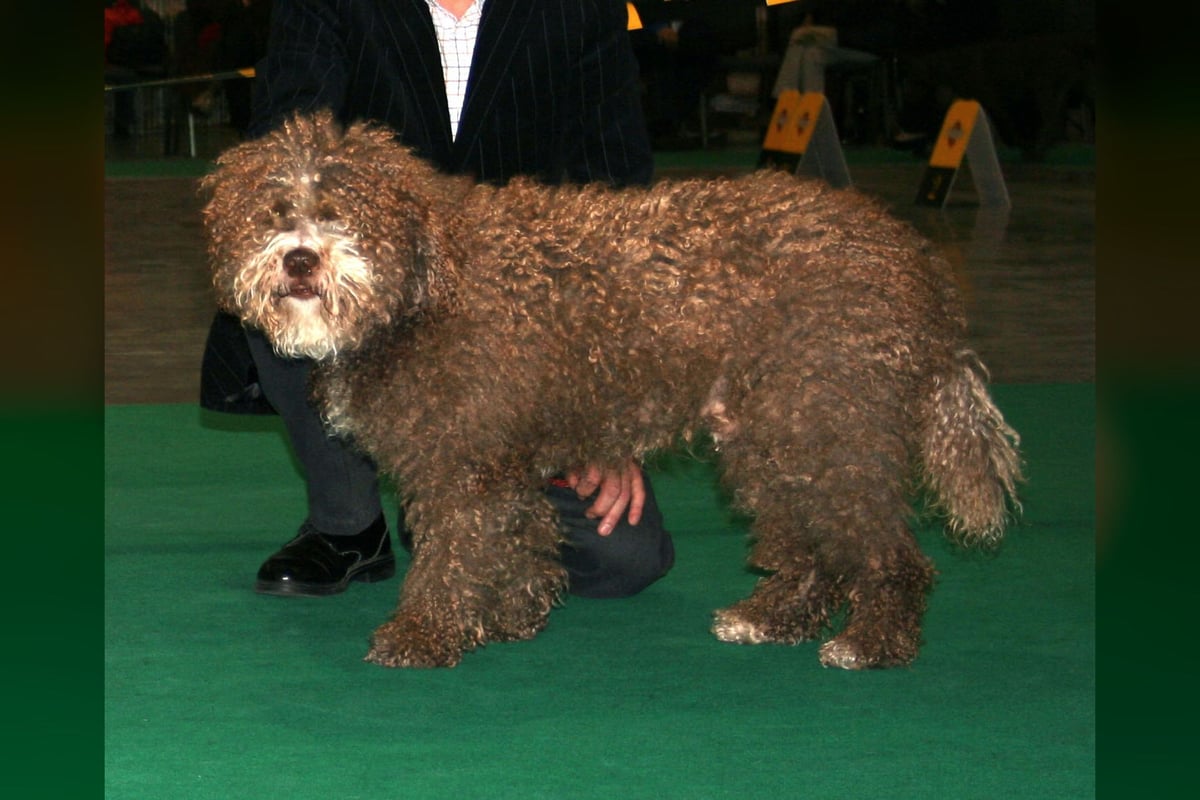
Spanish Water Dog
The Spanish Water Dog (Perro de Agua Español, FCI 336, Group 8) is an old Andalusian breed, only recognized by the FCI in 1985. It weighs 14 to 22 kg at 40 to 52 cm at the withers. Its main feature is a woolly coat that forms natural cords — like the Komondor or the Puli — which is never brushed and is clipped once a year. A triple-purpose working breed: fisherman's helper, herder, and hunter.
- Weight
- 14 to 22kg
- Height
- 40 to 52cm
- Life expectancy
- 13years
- Monthly cost
- 80 to 140€
Personality profile
Energy 5/5
Independence 3/5
Trainability 4/5
Good with children 4/5
Barking 3/5
Space needed 3/5
Attachment to home 4/5
Good with strangers 2/5
Good with dogs 3/5
Good with cats 3/5
Coat care 3/5
Exercise needs 5/5
Scores given on measured axes, data confidence: high.
Living with a Spanish Water Dog
Description
The coat is the breed's central feature: woolly strands that naturally form tight cords with no brushing at all. Solid or bicolor coats: white, black, brown, or white-black and white-brown combinations. A compact, athletic build, webbed feet for swimming, a tail traditionally docked at birth — a practice now banned in France except on veterinary prescription. A muscular, sturdy body, well proportioned for a versatile working breed.

Temperament
An energetic, alert breed, the Spanish Water Dog bonds closely with its core family and develops real wariness toward strangers — not out of pathological nervousness, but from a guarding instinct inherited from its pastoral use. This reserve toward strangers is structural and requires intensive early socialization to be channeled. Its intelligence and learning ability are above average for sporting breeds; it likes to work and gets bored quickly without enough mental or physical stimulation.
Training
The Spanish Water Dog learns fast and retains well — its historical versatility (herder, hunter, fisherman's helper) selected for a rare behavioral plasticity. Positive methods give the best results; it responds to food reinforcement and retrieving play with a sport-level intensity that makes teaching easier. Its energy level of 5 calls for short, frequent sessions rather than long, monotonous ones. Miles of exercise through swimming, agility, or tracking channel its drive and prevent hyperactivity or destructive behavior.

Feeding
200 to 300 g of premium medium-breed kibble a day for an 18 kg adult, in two meals. Medium-breed kibble up to 12-14 months, without overfeeding — this breed can gain weight easily if physical activity drops. Protein intake should match the activity level: a dog doing intensive swimming or agility several times a week needs a sport ration with 28-30% protein. Glucosamine and chondroitin recommended from age 7 for joint protection.
Affiliate links, no extra cost to you. Legal notice

Living conditions
Its contained size (40-52 cm) allows it to live in an apartment provided it gets hours of intense daily exercise — at least 1.5 hours of sustained activity a day, ideally with access to water (swimming, water retrieving). Its energy level of 5 demands an athletic owner able to run, swim, or practice agility regularly. A garden is a welcome bonus but does not replace long, active outings. It tolerates heat well, consistent with its Andalusian origins, and shows satisfactory resilience to cool temperatures.

Grooming and coat care
The corded coat is never brushed — any attempt to brush it destroys the cord structure and creates an unmanageable tangled mass. The only required operation is a full annual clip, with scissors or clippers, which starts the growth cycle over from scratch. Between clips, the coat grows freely and forms its cords naturally. After swimming sessions, careful air drying (not a powerful hair dryer) prevents dermatitis between the cords. Drop ears need weekly cleaning to help prevent ear infections.

Health
Life expectancy of 12 to 14 years, good longevity for a breed of this size. Hip dysplasia should be monitored via X-rays of breeding stock. Hypothyroidism is reported in some lines: a thyroid panel is advisable if the dog shows unexplained weight gain or lethargy. Progressive retinal atrophy (PRA-prcd) is the main hereditary eye condition — a genetic test on breeding stock helps avoid producing affected homozygous carriers. Glycogen storage disease (glycogenosis) is also genetically testable among serious breeders.
Breed history
The Spanish Water Dog is documented on the Andalusian coast from around 1100, likely brought by the Moors from North Africa or Turkey during the Islamic presence on the Iberian peninsula. For centuries, it played a triple role: helping fishermen retrieve nets and fish at sea, herding during transhumance between the Sierra Nevada and the coastal plains, and assisting with waterfowl hunting. Its official recognition by the FCI in 1985 (number 336) came from the efforts of two Spanish cynologists, Antonio García Pérez and Santiago Montesinos, who carried out a systematic survey in the Andalusian provinces starting in the 1970s.
Getting ready for your Spanish Water Dog
Five essentials to line up before day one.
Affiliate links, no extra cost to you. Legal notice
FAQ: Spanish Water Dog
Sources
- FCI Standard No 336 — Spanish Water Dog · FCI breed standard 336, Group 8 Retrievers — Flushing Dogs — Water Dogs
- Société Centrale Canine — Spanish Water Dog · SCC official breed profile, Spanish Water Dog / Perro de Agua Español, Group 8
- AKC Breed Profile — Spanish Water Dog · AKC Spanish Water Dog breed profile, Herding Group
FCI, Fédération Cynologique Internationale, the world body that has codified breed standards since 1911. FCI number 336 is assigned to the Spanish Water Dog.
Breeds similar to a Spanish Water Dog

