


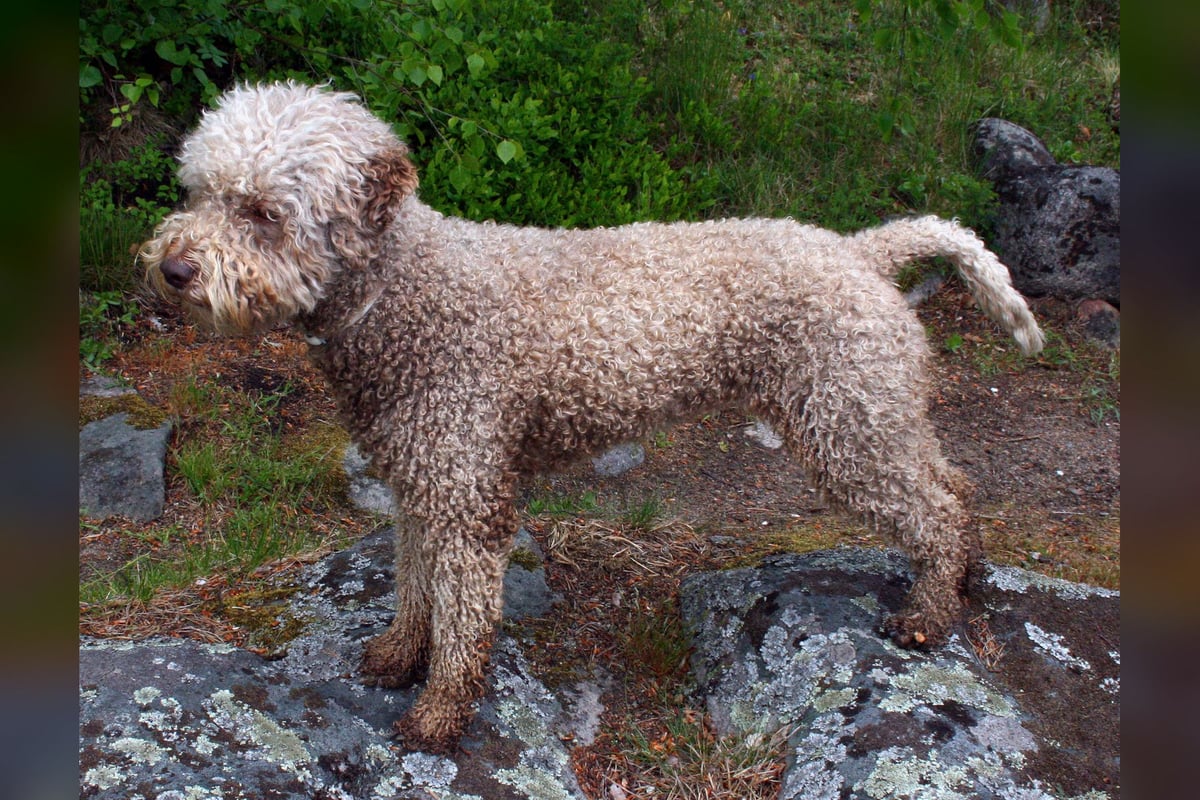
Lagotto Romagnolo
The Lagotto Romagnolo weighs 11 to 16 kg for 41 to 48 cm at the withers — the only dog breed officially recognized as specialized in truffle hunting. Native to the Comacchio marshes in Romagna (northeastern Italy), it was repurposed as a truffle dog in the 19th century after the wetlands were drained. Recognized by the FCI under number 298 (Group 8, Section 3) since 1995. Life expectancy 14 to 17 years.
- Weight
- 11 to 16kg
- Height
- 41 to 48cm
- Life expectancy
- 15years
- Monthly cost
- 65 to 110€
Personality profile
Energy 4/5
Independence 3/5
Trainability 4/5
Good with children 4/5
Barking 3/5
Space needed 3/5
Attachment to home 4/5
Good with strangers 3/5
Good with dogs 4/5
Good with cats 3/5
Coat care 3/5
Exercise needs 4/5
Scores given on measured axes, data confidence: high.
Living with a Lagotto Romagnolo
Description
Compact, well-muscled body, slightly longer than tall. Round head with a marked stop, round hazel to dark brown eyes, medium-sized ears set high, falling in a triangle. Central feature: dense curly coat with a woolly texture, non-shedding — the coat does not fall seasonally but grows continuously. Recognized colors: white, white and brown, orange, orange roan, brown roan (roan). This dense curly coat protects the skin when working in damp undergrowth.

Temperament
Strong scenting instinct inherited from centuries of selection for tracking in natural terrain: without a search outlet, it tends to dig through gardens and flower beds compulsively. Affectionate with its family without being clingy — functional independence higher than the group 8 average. Sociable with children and other dogs, reserved on first approach with strangers without being aggressive. Moderate barking, especially in a stable setting.
Training
Scenting instinct can be tapped from 8 to 10 weeks with progressive hide-and-seek exercises. Truffle work uses a multi-step protocol: fresh scent → buried scent → natural terrain → passive indication (sitting or lying near the source) without scratching. A breed particularly receptive to food reinforcement; the treat must be given as soon as the correct location is indicated to anchor the behavior. For conventional dog sports: nosework, obedience, adapted agility. Its high exercise needs call for regular active outings to channel its energy.

Feeding
Daily ration of premium kibble sized for an active 14 kg adult, split into 2 meals — refer to the manufacturer's chart and adjust to body condition. A breed not very prone to obesity if rations are controlled and activity is maintained. Avoid overfeeding dogs used for seasonal truffle hunting, whose activity drops sharply out of season (fall-winter). Clean, fresh water at all times, mandatory after intensive scenting sessions.
Affiliate links, no extra cost to you. Legal notice

Living conditions
Adaptable to a decent-sized apartment (≥50 m²) if exercise outings are regular — at least 60 to 90 minutes of activity a day, a good share of it off-leash on varied terrain. A house with a garden makes it easier to manage its scenting needs. A breed from the wetlands of Romagna: good tolerance to humidity and waterlogged ground. Do not let it dig unsupervised in landscaped gardens — the digging instinct is strong and purposeful.

Grooming and coat care
Hypoallergenic curly coat with continuous growth: no seasonal shedding, which reduces allergen dispersal in the environment. Targeted upkeep: scissor trimming about once a month to maintain a length of 4 to 6 cm, enough to protect the skin in the woods without matting. Weekly brushing with a metal pin brush to work out emerging tangles before they clump together. No mandatory intensive professional grooming, but a groomer visit every 6 to 8 weeks for the ears and paws makes regular upkeep easier.

Health
Lagotto Romagnolo Benign Juvenile Epilepsy (LJBE): a breed-specific predisposition, episodes occurring between 1 and 3 months of age, spontaneous resolution in nearly all cases before 8 to 13 months without treatment. DNA test available since 2012 — mutation identified on the LGI2 gene — should be required on both parents. Hip dysplasia at a moderate level: OFA radiographs recommended for breeding dogs. Few major pathologies documented outside LJBE; the 14 to 17 year life expectancy is one of the longest in group 8. Pathological storage of certain lipids: rare cases documented in Scandinavia, under ongoing surveillance.
Breed history
The Lagotto Romagnolo is documented in the Romagna region (northeastern Italy) as early as the 16th century, where it worked as a duck-hunting dog in the wetlands of the Po delta, particularly the Comacchio marshes. In the 19th century, the progressive draining of these marshes for agriculture deprived the breed of its original working ground. Local truffle hunters, observing its exceptional scenting abilities, then taught it truffle hunting — Tuber magnatum (Alba white truffle) and Tuber melanosporum (Périgord black truffle). The breed nearly disappeared in the 20th century before a genetic rescue program was launched in Italy in the 1970s. Recognized by the ENCI (Italy) in 1991, then by the FCI under number 298 in 1995: the only breed in the world to carry the official mention 'truffle hunting' in its original standard.
Getting ready for your Lagotto Romagnolo
Five essentials to line up before day one.
Affiliate links, no extra cost to you. Legal notice
FAQ: Lagotto Romagnolo
Sources
- FCI Standard No 298 — Lagotto Romagnolo · FCI breed standard 298, Group 8 Retrievers, Flushing Dogs, Water Dogs, Section 3 Water Dogs, recognized 1995
- ENCI — Club Italiano Lagotto Romagnolo · Ente Nazionale della Cinofilia Italiana, official Lagotto Romagnolo standard, approved 1991
- AKC Breed Profile — Lagotto Romagnolo · AKC Lagotto Romagnolo breed profile, Sporting Group, AKC recognition 2015
FCI, Fédération Cynologique Internationale, the world body that has codified breed standards since 1911. FCI number 298 is assigned to the Lagotto Romagnolo.
Breeds similar to a Lagotto Romagnolo

