


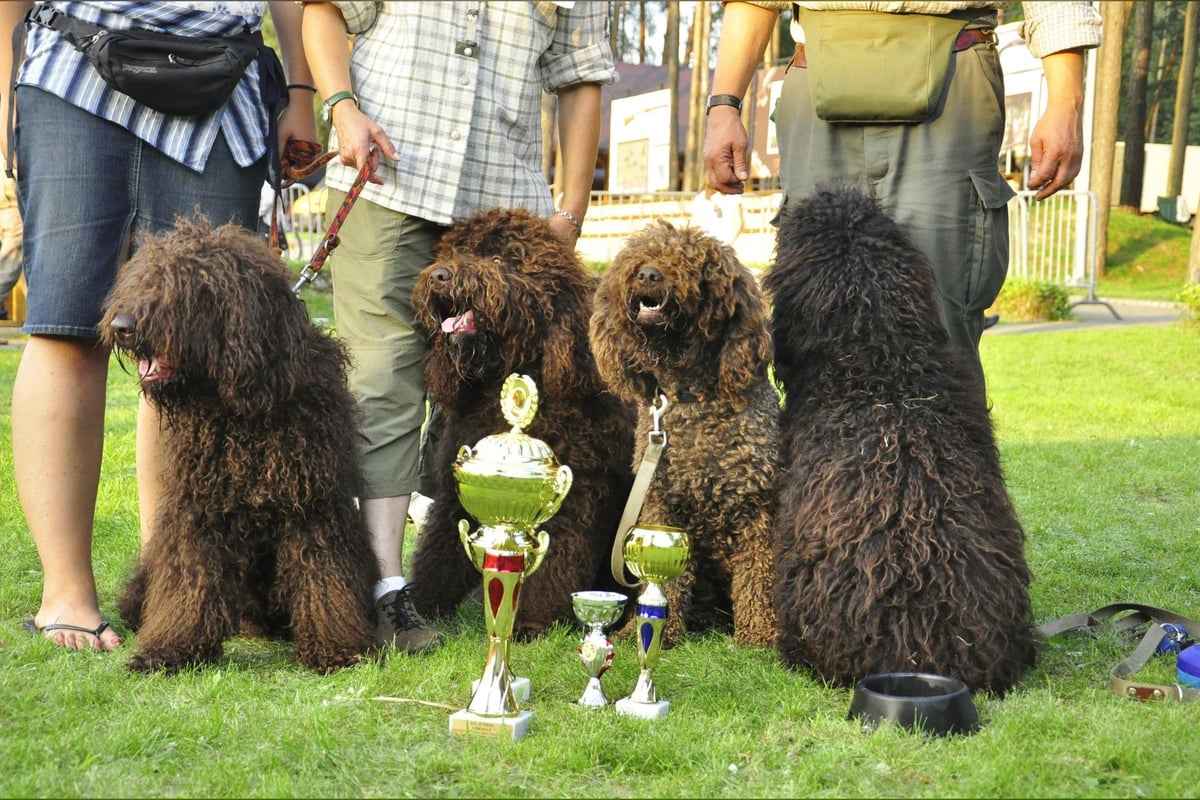
Barbet
The Barbet (FCI 105) is a French water dog standing 52 to 65 cm at the withers and weighing 17 to 30 kg, first mentioned in the 16th century as a hunting aid for waterfowl in the marshes, in service of the French aristocracy. Considered the probable ancestor of the Poodle, the Portuguese Water Dog, the Spanish Water Dog, and the Otterhound, it forms a central link in the genealogy of European retrievers and water spaniels. Nearly extinct in the 1970s, with about 30 individuals recorded, it was rebuilt through the work of Hermine Jeanblanc-Castaing. Life expectancy is 12 to 15 years.
- Weight
- 17 to 30kg
- Height
- 52 to 65cm
- Life expectancy
- 13years
- Monthly cost
- 90 to 150€
Personality profile
Energy 4/5
Independence 2/5
Trainability 4/5
Good with children 5/5
Barking 2/5
Space needed 3/5
Attachment to home 5/5
Good with strangers 4/5
Good with dogs 4/5
Good with cats 3/5
Coat care 3/5
Exercise needs 4/5
Scores given on measured axes, data confidence: high.
Living with a Barbet
Description
A sturdy, well-balanced silhouette, with a dense, curly, medium-length woolly coat that fully covers the body, head, and legs. Webbed feet are a functional adaptation for swimming. The characteristic tail, curved upward, remains visible beneath the dense coat. Coat colors permitted under the FCI standard are black, fawn, brown, gray, and white. Its balanced build, neither too heavy nor too light, makes it an enduring swimmer and a versatile field dog.

Temperament
A sociable, expressive dog, strongly people-oriented — its low independence score (2/5) reflects a real need for contact and participation in family life. It naturally gets along well with other dogs and adapts easily to children, whom it tolerates with notable patience. It is not a barker: calm indoors, it reserves its vocalizations for situations that genuinely call for them. Its sporty, playful side largely persists into adulthood, which makes regular physical activity sessions essential.
Training
Quick to learn and highly responsive to positive reinforcement — its trainability score (4/5) reflects both solid receptiveness and a genuine desire to cooperate with people. It excels in dog sports that draw on its versatility: retrieving, dog swimming, agility, competitive obedience. When under-stimulated, it develops persistent restlessness and seeks to meet its needs destructively.

Feeding
A daily ration of 250 to 380 g of premium medium-breed kibble for a 22 kg adult, in 2 meals. Adjust according to activity level: a dog that regularly swims or does dog sports consumes noticeably more than a less active companion dog. Glucosamine and chondroitin are recommended from age 6 for joint prevention, particularly if the dog frequently practices water sports that stress the elbows. Watch its weight: the dense coat can mask fat gain — regularly feel the ribs to assess body condition.
Affiliate links, no extra cost to you. Legal notice

Living conditions
Apartment living remains possible, provided the two hours of daily activity are covered. A house with access to a garden and bodies of water — pond, river, sea — matches its ideal environment and lets it express its swimming instinct. Its dense curly coat gives it good resistance to cold and damp; it was selected to work in the marshes in cool weather. Excessive heat can bother it, but its tolerance is moderate (3/5) — access to shade and water is enough in summer. It cannot handle prolonged isolation and needs to live in close contact with its family.

Grooming and coat care
The curly woolly coat needs professional grooming every 6 to 8 weeks to maintain a functional length and prevent matting. Between grooming appointments, regular brushing — every week or two — prevents tangling, particularly behind the ears, under the armpits, and in the groin. After every bath or swim, the coat should be rinsed with clean water and dried thoroughly, since a prolonged damp coat favors skin fungal infections and ear infections. The breed sheds very little (1/5), which is appreciated indoors.

Health
Life expectancy is 12 to 15 years. Since numbers remain limited despite the rebuilding effort of the 1980s, genetic monitoring of the population is particularly important. Hip dysplasia is documented — OFA or SCC radiographs of breeding stock are recommended. Idiopathic epilepsy has been reported in certain lines: ask the breeder for family history. Skin atopy is possible, showing up as seasonal itching. Drop ears combined with water activity favor chronic ear infections: thorough ear drying after every swim and weekly inspection are essential.
Breed history
The earliest descriptions of the Barbet appear in French hunting treatises of the 16th century, where it is presented as the quintessential water dog of noble waterfowl hunters in the marshes of the Atlantic coast. Its build — waterproof coat, webbed feet, powerful nose — made it a versatile aid capable of retrieving ducks and marsh birds under the most difficult conditions. Dog experts consider it the probable ancestor of a large family of water dogs: the Poodle, the Portuguese Water Dog, the Spanish Water Dog, the Otterhound. After the Second World War, the breed's numbers fell to about 30 individuals in the 1970s before being rebuilt by Hermine Jeanblanc-Castaing in the 1980s. The FCI has assigned it number 105; the AKC recognized it in 2020.
Getting ready for your Barbet
Five essentials to line up before day one.
Affiliate links, no extra cost to you. Legal notice
FAQ: Barbet
Sources
- FCI Standard No 105 — Barbet · FCI breed standard 105, Group 8 Retrievers, Flushing Dogs, Water Dogs
- Société Centrale Canine — Barbet · SCC official breed profile Barbet, Group 8
- AKC Breed Profile — Barbet · AKC Barbet breed profile, Sporting Group, recognized 2020
FCI, Fédération Cynologique Internationale, the world body that has codified breed standards since 1911. FCI number 105 is assigned to the Barbet.
Breeds similar to a Barbet

