


St. Bernard
Pinscher and Schnauzer - Molossoid and Swiss Mountain and Cattledogs
65 to 90 kg
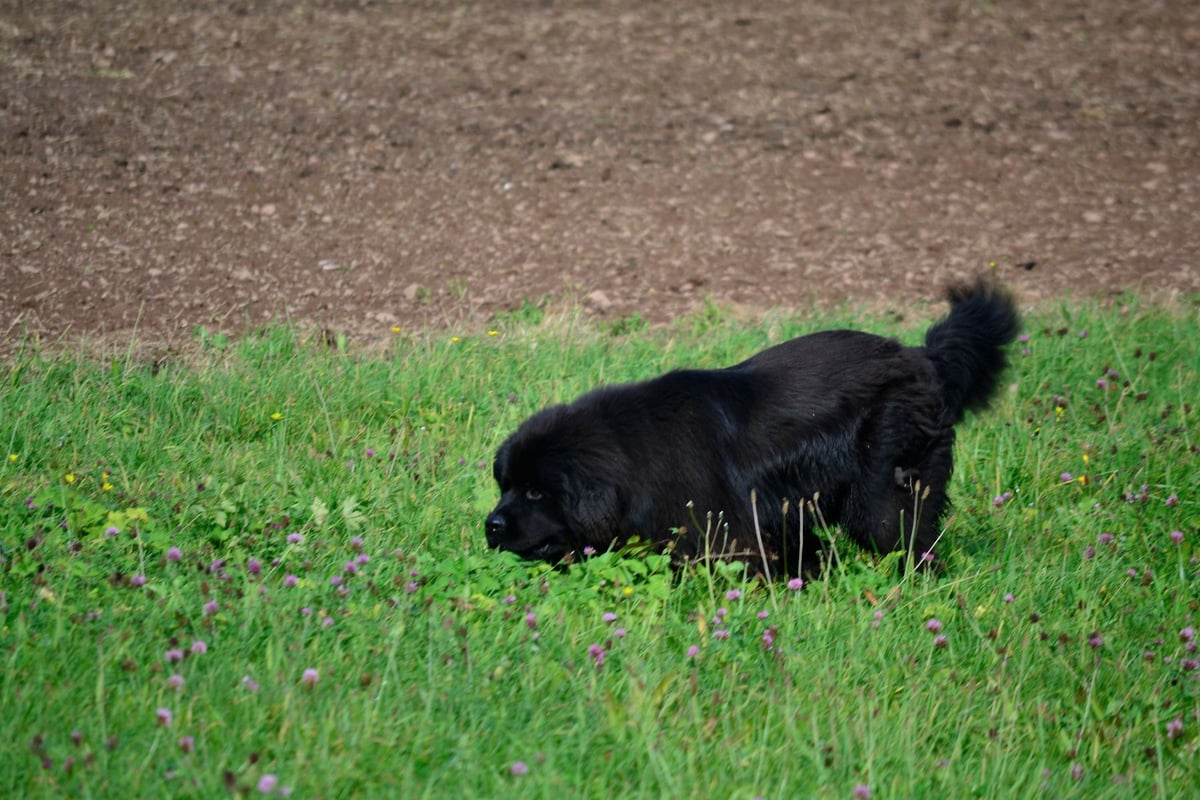
The Newfoundland is a giant breed native to the Canadian island of the same name, recognized by the FCI under number 50. It weighs 45 to 70 kg for 63 to 74 cm at the withers, with a water-resistant double coat in black, brown, or Landseer (white and black). A breed historically employed by Newfoundland fishermen for sea rescue and net hauling, with a life expectancy of 8 to 10 years.
Scores given on measured axes, data confidence: high.
Living with a Newfoundland
A giant-sized breed with a massive, powerful body, it has partially webbed feet — a real morphological trait, rooted in its function as a cold-water swimmer. Its double coat, dense and oily, repels water and lets it withstand temperatures near 0 °C. Males reach 68-74 cm for 60-70 kg; females, 63-70 cm for 45-55 kg. The Landseer color (white ground with black patches), distinct from solid black, is recognized by the FCI as a separate variety in some countries.

Calm, patient, and confident, the Newfoundland shows remarkable tolerance toward children, to the point of being nicknamed the "giant teddy bear" among breeders — which never removes the need for supervision: a 65 kg dog can knock over a young child out of sheer enthusiasm. Its drooling is marked and constant, a trait to anticipate in a domestic setting. A breed that barks little, mostly expressing itself in the presence of a perceived threat.
Positive reinforcement-based training gives good results, but its size demands early leash training: a 65 kg dog that pulls poses a real danger even to an adult owner. It learns slowly but retains durably — expect 15 to 20 repetitions per new command. Swimming and water sports (canine water rescue, water obedience) are the disciplines in which the breed naturally excels.

A 60 kg adult eats 600 to 900 g of premium giant-breed kibble a day, which must be split into 2 meals (risk of gastric dilatation-volvulus syndrome with a single ration). Gradual growth until 24 months with giant-breed food (controlled calcium level for healthy ossification). Glucosamine/chondroitin supplements from age 3-4 recommended by veterinarians specialized in canine orthopedics. Avoid exercise within an hour before and after meals.
Affiliate links, no extra cost to you. Legal notice

An apartment is unsuited, due to this dog's size and the body heat it gives off. A house with an enclosed garden, a cool or tiled floor for resting, and a shaded area in summer are non-negotiable requirements. Above 25 °C, active exercise should be avoided: the breed suffers from excess heat and can show signs of heatstroke quickly. Daily outings of 45 to 60 minutes are enough, split into 2 sessions.

The double coat needs brushing 2 to 3 times a week under normal conditions, daily during the spring and fall sheds, when the undercoat comes out in dense clumps. A wide-tooth comb followed by a stiff-bristle brush is the standard combination. Bath every 6 to 8 weeks with a neutral shampoo that preserves the natural water-resistant coat. Regular cleaning of the folds around the mouth (accumulated drool).

Subaortic stenosis (SAS) is the most concerning cardiac condition in the breed: a hereditary malformation of aortic flow, detectable by auscultation or Doppler echocardiography, present to varying degrees. Hip and elbow dysplasia is common (giant size, rapid growth until 18-24 months). Require official OFA or LOF radiographs from both parents before purchase. The 8 to 10 year life expectancy is directly linked to the joint and cardiac strain of extreme sizes.
Descended from the working dogs of fishermen on the island of Newfoundland (Canada's east coast), the Newfoundland was used from the 17th century onward to retrieve submerged nets and rescue drowning people — its webbed feet and cold-water endurance were direct selection criteria. Lord Byron, the English poet, had a famous epitaph engraved in 1808 for his Newfoundland named Boatswain, who died of rabies, describing the breed as possessing "all the virtues of Man without his vices." Recognized by the FCI in Group 2 (Molossoid breeds).
Five essentials to line up before day one.
Affiliate links, no extra cost to you. Legal notice
FCI, Fédération Cynologique Internationale, the world body that has codified breed standards since 1911. FCI number 50 is assigned to the Newfoundland.
Pinscher and Schnauzer - Molossoid and Swiss Mountain and Cattledogs
65 to 90 kg

Pinscher and Schnauzer - Molossoid and Swiss Mountain and Cattledogs
45 to 77 kg

Pinscher and Schnauzer - Molossoid and Swiss Mountain and Cattledogs
36 to 50 kg