


St. Bernard
Pinscher and Schnauzer - Molossoid and Swiss Mountain and Cattledogs
65 to 90 kg
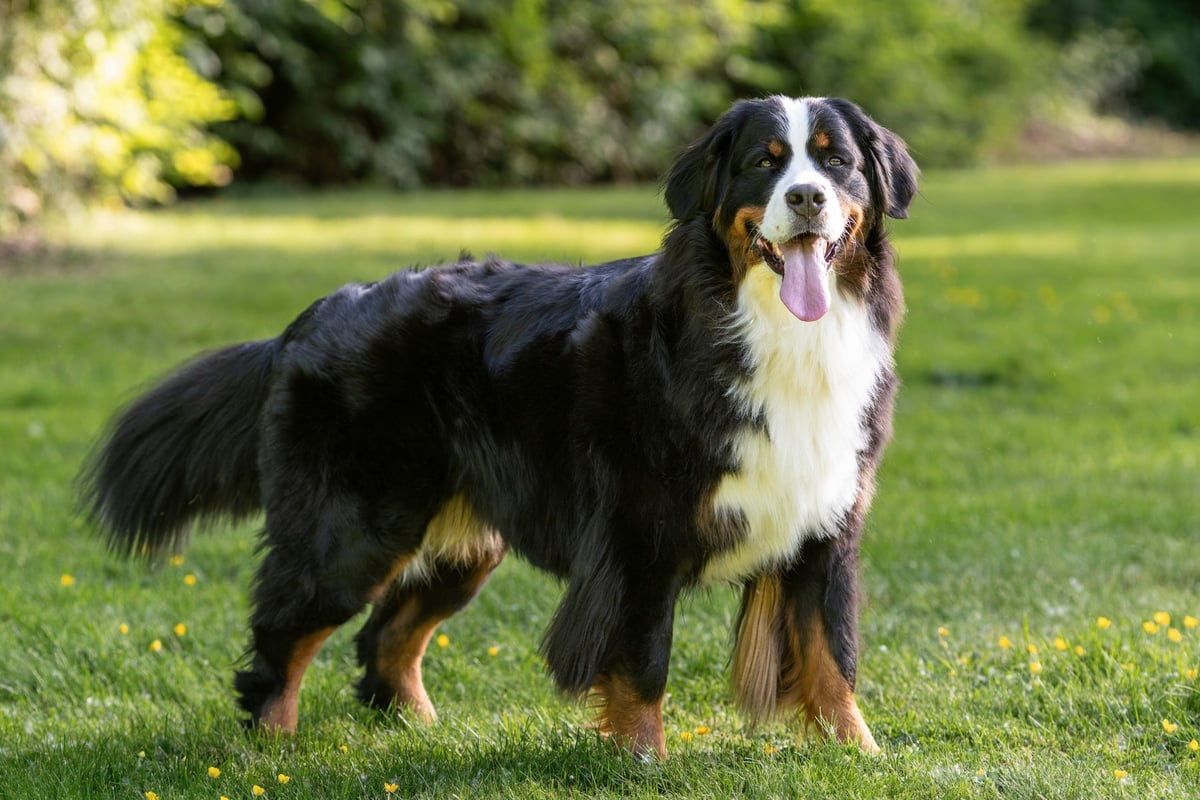
The Bernese Mountain Dog is a Swiss Sennenhund from the canton of Bern, registered in the FCI nomenclature under number 45. It weighs 36 to 50 kg for 58 to 70 cm, with a tricolor black/tan/white coat strictly codified by the standard. Its life expectancy of 7 to 9 years is the shortest of the four Swiss mountain dogs, due to a high prevalence of malignant histiocytosis (25% of causes of death).
Scores given on measured axes, data confidence: high.
Living with a Bernese Mountain Dog
A large breed, solidly built, with a body slightly longer than tall. Males 64-70 cm for 40-50 kg, females 58-66 cm for 36-48 kg. Long, wavy tricolor coat: an intense black base with tan markings above the eyes, on the cheeks, legs and chest, a characteristic white cross on the chest and a white blaze on the head. This precise tricolor marking is mandatory under the FCI standard; any defect in the extent of the markings is penalized in the show ring. Dense double undercoat providing remarkable thermal protection in cold weather.

A farm dog with a calm, patient character, deeply attached to its immediate family, particularly gentle with children it knows. Moderate wariness of strangers without aggression — it observes before welcoming. Tolerates prolonged solitude poorly (4 hours maximum): chronic isolation generates anxiety and destructive behavior. Its high emotional sensitivity makes it receptive to positive reinforcement methods but fragile under harsh corrections.
Good to very good trainability: masters basic commands in 10 to 20 repetitions with positive methods. Sensitive to tone shifts and to the owner's emotional cues — a rushed or tense session degrades learning faster than in other breeds. Suited disciplines: draft work (canicross, pulka), obedience, animal-assisted therapy, loaded mountain hikes. Intense sports (agility, ring sport) not recommended before 18 months to protect growing joints.

450 to 600 g of premium large-breed kibble a day for a 45 kg adult, split into 2 meals (never one alone: risk of gastric dilatation-volvulus given the deep chest). Giant-breed kibble up to 18-24 months to support slow bone growth and prevent premature joint strain. Calcium strictly controlled during growth: unsupervised supplementation worsens dysplasia. Glucosamine/chondroitin recommended from age 3.
Affiliate links, no extra cost to you. Legal notice

A house with an enclosed garden and daily access to open spaces is essential. Not suited to an apartment due to its size and the density of its undercoat. Critical temperature to watch: intense exercise is not recommended above 22 °C, with a risk of rapid heatstroke linked to the thickness of its coat. It thrives in mountainous and temperate cold regions (the Alps, the Pyrenees), which reproduce its original conditions. One to two hours of moderate physical activity a day is enough — no need to overload it.

Double weekly brushing minimum outside of shedding season; daily during the two seasonal spring/fall sheds (heavy undercoat loss over 4 to 6 weeks). A wide-tooth comb is essential to detangle without breaking the long hair of the chest ruff and britches. Quarterly bath with a shampoo suited to long, dense coats. Weekly check of the drop ears to prevent contact ear infections. Nails to monitor regularly in dogs with low activity on hard ground.

Life expectancy of 7 to 9 years, among the shortest of the large breeds (median 8 years according to the Bernese Mountain Dog Club of America 2004 study). Systemic malignant histiocytosis: 25% of documented causes of death in the breed, with somatic mutations of the PTPN11 gene — MAPK signaling pathway — identified in the tumors. High prevalence of hip and elbow dysplasia: mandatory X-rays for LOF breeding stock. Osteosarcoma, splenic and hepatic carcinomas more frequent than in the general dog population. Veterinary budget notably higher than for a dog of comparable size, due to orthopedic workups and oncological risk.
Second in size among the four Swiss Sennenhunds, behind the Great Swiss Mountain Dog, it has been used in the canton of Bern since the Middle Ages as a draft dog, farm guardian and cattle drover. The Schweizer Klub für Sennenhunde was founded in 1899; the breed received its first official description at the Bern dog show in 1902. Official breed recognition came in 1907; the FCI, created in 1911, would register it under number 45. Worldwide popularity has risen sharply since the 1990s, with an introduction to the United States where the BMDCA has rigorously documented hereditary conditions since 1991.
Five essentials to line up before day one.
Affiliate links, no extra cost to you. Legal notice
FCI, Fédération Cynologique Internationale, the world body that has codified breed standards since 1911. FCI number 45 is assigned to the Bernese Mountain Dog.
Pinscher and Schnauzer - Molossoid and Swiss Mountain and Cattledogs
65 to 90 kg

Pinscher and Schnauzer - Molossoid and Swiss Mountain and Cattledogs
22 to 32 kg

Pinscher and Schnauzer - Molossoid and Swiss Mountain and Cattledogs
45 to 70 kg