


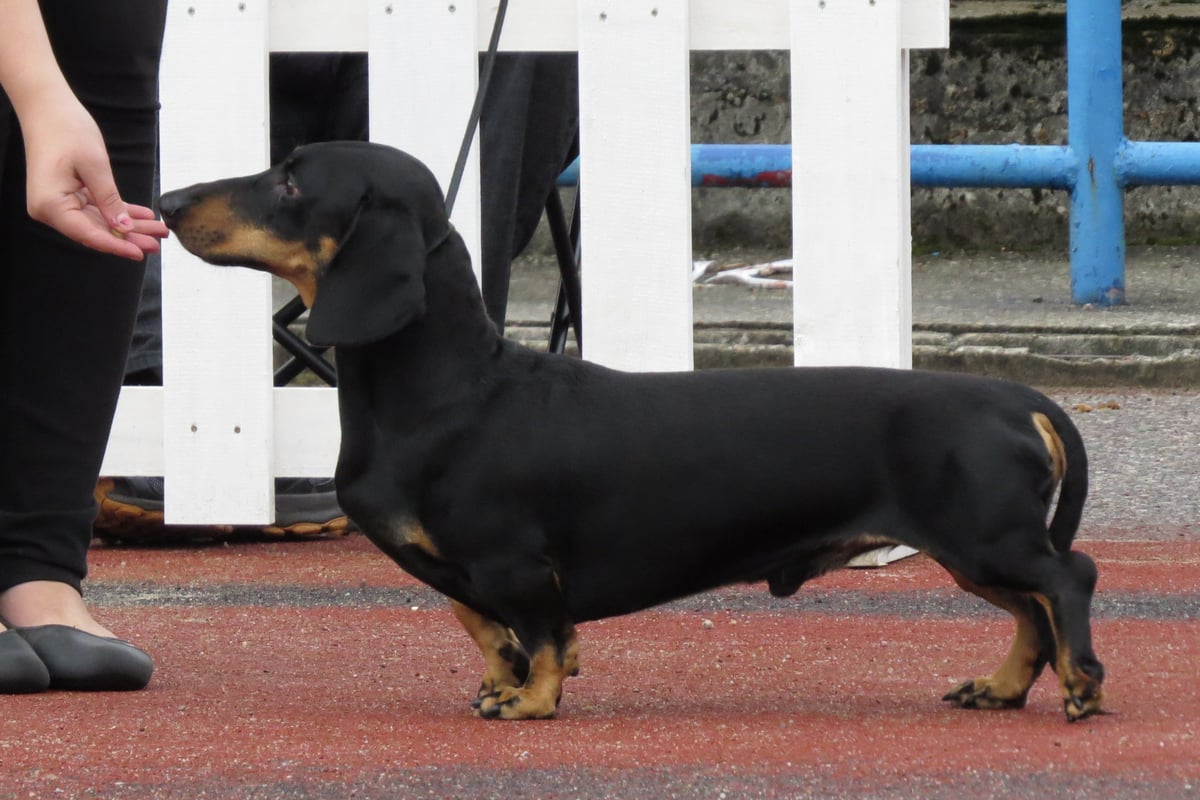
Smooth-Haired Dachshund
The Smooth-Haired Dachshund (Dackel Kurzhaar, FCI 148 smooth variety) is a German breed whose selection dates back to the Middle Ages for hunting badger (Dachs) and fox in their burrows. The breed's first standard was set in 1888; it comes in three coat varieties (smooth, wire, long) and three sizes differentiated by chest circumference — Standard (over 35 cm, 7-9 kg), Miniature or Zwerg (30 to 35 cm, 4-5 kg), and Kaninchen (30 cm or less, up to 3.5 kg). The smooth variety is the oldest and most widespread. Life expectancy: 12 to 16 years.
- Weight
- 7 to 9kg
- Height
- 20 to 27cm
- Life expectancy
- 14years
- Monthly cost
- 60 to 110€
Personality profile
Energy 4/5
Independence 4/5
Trainability 3/5
Good with children 3/5
Barking 5/5
Space needed 2/5
Attachment to home 4/5
Good with strangers 2/5
Good with dogs 3/5
Good with cats 2/5
Coat care 1/5
Exercise needs 3/5
Scores given on measured axes, data confidence: high.
Living with a Smooth-Haired Dachshund
Description
An immediately recognizable low, elongated silhouette: the length of the back is 1.7 to 1.8 times the height at the withers, a characteristic breed proportion. Short, tight, glossy coat, in red-brown (the most typical shade), black and tan, chocolate and tan, or isabella. The elongated, cone-shaped head carries broad drop ears set high on the skull. The short, muscular forelegs are built for active digging. Despite appearances, the Standard Dachshund shows a solid build and significant muscle density for its size.

Temperament
A temperament shaped by centuries of solitary hunting: the Dachshund decided alone when facing a badger underground, with no way to check back with its owner. The result is a dog courageous to the point of recklessness, stubborn and independent in its decisions. Toward its family it's warm and demonstrative; toward strangers it's wary and vigilant — it barks abundantly and doesn't hesitate to signal any outside presence. Its hunting instinct stays active: cohabiting with cats or small animals requires early socialization and constant supervision, with no guarantee of success.
Training
The Dachshund learns the basics quickly but applies them at its own discretion — it systematically tests limits, a legacy of independent work with no checking back with its owner. Positive reinforcement methods with food rewards give better results than coercive repetition. Socialization before 12 weeks is decisive for softening wariness toward strangers and the hunting instinct toward small animals. Daily exercise of 30 to 45 minutes of walking (flat terrain preferred) covers its needs without overtaxing its back.

Feeding
For a Standard adult of 7 to 9 kg, 120 to 180 g of premium medium-breed kibble a day, split into two meals. A tendency toward excess weight is documented in the breed — every extra kilo significantly increases mechanical stress on the vertebral discs. Treats must be counted toward the daily ration. Monthly weighing is recommended until the adult weight stabilizes (reached around 12 to 18 months depending on size).
Affiliate links, no extra cost to you. Legal notice

Living conditions
The Smooth-Haired Dachshund's small build lets it adapt to an apartment provided exercise needs are covered daily. Access to stairs should be controlled from puppyhood — repeated climbing and descending increases the risk of disc herniation (IVDD). A fenced garden remains an asset, but the breed can compensate with regular leashed outings and scent sessions. Watch out in dense settings: its barking, very easy to trigger, can create tension in a shared building if stimulation is insufficient.

Grooming and coat care
The smooth variety is the least demanding of the three coat types: weekly brushing with a grooming mitt is enough to keep the coat in good condition and limit dead hair. No professional grooming or stripping needed. The skin and drop ears deserve regular checking — poorly ventilated ear canals can encourage ear infections. Shedding stays moderate and seasonal.

Health
The Dachshund's major condition is intervertebral disc disease (IVDD): 19 to 25% of individuals according to studies from the University of Bristol (2013) and the University of Cambridge (2018). The chondrodystrophic build — a mutation of the FGF4 gene responsible for the dwarf format — weakens the intervertebral discs and exposes the dog to disc herniation, which can lead to partial or total paralysis of the hind legs. Documented aggravating factors: excess weight, frequent stairs, repeated jumps from height. Other conditions to watch: progressive retinal atrophy (DNA test available), idiopathic epilepsy, Cushing's syndrome, and hypothyroidism.
Breed history
Written records of the Dachshund date back to the 16th century in Germany, where it was called Dachskriecher (badger crawler) or Dachshund in hunting texts. Its low, elongated build was selected to enter burrows and confront the badger — an animal known to be pugnacious and capable of seriously injuring a dog. The breed's first standard was established in 1888 by the German Teckelklub, founded the same year. The breed ranks among the most popular in the world in the 20th century, notably in the United Kingdom, the United States, and Japan. The three size varieties (Standard, Miniature, Kaninchen) were developed to adapt the breed to different prey and burrow sizes: the Kaninchen was used to hunt rabbit (Kaninchen = rabbit in German).
Getting ready for your Smooth-Haired Dachshund
Five essentials to line up before day one.
Affiliate links, no extra cost to you. Legal notice
FAQ: Smooth-Haired Dachshund
Sources
- FCI Standard No 148 — Dachshund · FCI breed standard 148, Group 4 Dachshunds, Section 1, all varieties
- Société Centrale Canine — Dachshund · SCC official breed profile Dachshund, Group 4
- AKC Breed Profile — Dachshund · AKC Dachshund breed profile, Hound Group
FCI, Fédération Cynologique Internationale, the world body that has codified breed standards since 1911. FCI number 148 is assigned to the Smooth-Haired Dachshund.
Breeds similar to a Smooth-Haired Dachshund

