


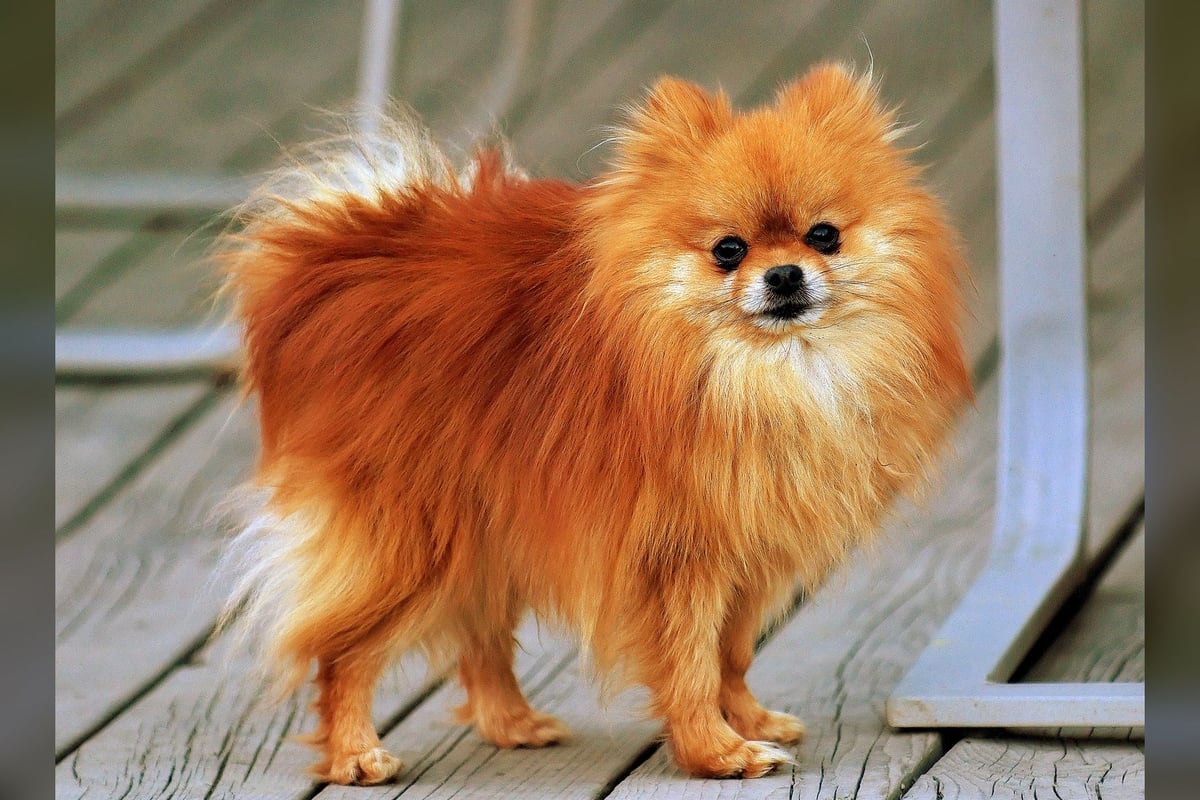
Pomeranian
The Pomeranian weighs 1.8 to 3.5 kg for 18-22 cm at the withers, the toy variety of the German Spitz recognized by the FCI under number 97, Group 5. A vocal breed that barks easily at outside passersby — to be channeled from puppyhood for apartment cohabitation. Prone to alopecia X (Black Skin Disease) in 30% or more of individuals. Life expectancy 12-16 years.
- Weight
- 1.8 to 3.5kg
- Height
- 18 to 22cm
- Life expectancy
- 14years
- Monthly cost
- 55 to 90€
Personality profile
Energy 3/5
Independence 3/5
Trainability 3/5
Good with children 3/5
Barking 5/5
Space needed 1/5
Attachment to home 4/5
Good with strangers 2/5
Good with dogs 3/5
Good with cats 3/5
Coat care 4/5
Exercise needs 2/5
Scores given on measured axes, data confidence: high.
Living with a Pomeranian
Description
A compact, square silhouette with an abundant double coat: a long, straight, standoff outer coat forming a dense ruff around the neck and shoulders, and a short, thick, downy undercoat. A wedge-shaped head (fox type), small pricked ears, expressive dark almond eyes, a plumed tail carried curled over the back. FCI-recognized colors: black, brown, white, orange, wolf-gray, cream, cream sable, orange sable, black and tan, particolor. The Pomeranian is the smallest variety of the German Spitz (18-22 cm), to be distinguished from the Miniature German Spitz (24-29 cm) and the larger varieties.

Temperament
Alert and lively, the Pomeranian is naturally vocal: it signals every passerby (pedestrians, deliveries, animals) with barking and can chain several barking sequences with no apparent trigger. This natural tendency to bark needs channeling from the first weeks through desensitization to urban stimuli and teaching a "quiet" command. Wary of strangers without being aggressive — it accepts contact once its owner has made the introduction. A privileged bond with its primary person, tolerating solitude moderately well (up to 4-5 hours). Active territorial instinct.
Training
Moderate trainability: intelligent and capable of learning many commands, but independent-minded and readily distracted by its surroundings. Positive reinforcement only, sessions of 5 to 8 minutes maximum (sharp but brief attention span). Top priority given to teaching "quiet" and desensitizing to stimuli to reduce barking. Never use a collar for walks — a harness is mandatory to protect the fragile trachea.

Feeding
60 to 100 g of premium kibble a day for a 2.5 kg adult, split into 3 meals until 6 months, then 2 meals. Puppies under 2 kg get 4 meals a day until 4 months to prevent hypoglycemia. Small-sized kibble (diameter < 8 mm) suited to the small jaw. Avoid sugary treats (dental predisposition). Weigh the ration: obesity worsens patellar luxation and tracheal collapse.
Affiliate links, no extra cost to you. Legal notice

Living conditions
Suited to an apartment of any size thanks to its miniature size and low exercise needs. Two outings of 15 to 20 minutes a day cover its physical needs. The main constraint in the city is noise: without early work on barking, it becomes incompatible with neighbors in an apartment building. Sensitive to heat (insulating double coat): from 26 °C, favor walks during cool hours and keep the indoors ventilated. Tolerates moderate cold thanks to its dense undercoat, but deep cold (-5 °C and below) calls for a coat because of its small body mass.

Grooming and coat care
Regular brushing 3 to 4 times a week to detangle and air out the dense undercoat, daily during shedding season (spring and fall) when the undercoat releases heavily. Professional grooming every 8 to 10 weeks to maintain the silhouette — the outer coat isn't shortened, but the sanitary areas (belly, legs) need regular trimming. Heavy double-coat shedding: hair loss stays high despite the small size. Weekly cleaning of the small pricked ears (less prone to ear infections than drop-eared breeds but still to be monitored). Regular tooth brushing recommended (crowded teeth on a small jaw).

Health
Five conditions to watch. (1) Alopecia X (Black Skin Disease): progressive, symmetric hair loss, with no identified hormonal or inflammatory cause, and hyperpigmentation of the exposed skin — mainly in intact males. No validated curative treatment; neutering induces partial regrowth in some individuals. (2) Patellar luxation (grade 1 to 4): common in very small builds, a characteristic intermittent skipping gait, surgical correction from grade 3. (3) Tracheal collapse: weakened tracheal cartilage causing a chronic dry "goose honk" cough on exertion or excitement — harness mandatory, never a collar. (4) Puppy hypoglycemia: between 6 and 16 weeks, a puppy under 2 kg can crash blood sugar during stress or a skipped meal — keep honey or glucose syrup on hand, 4 meals a day until 4 months. (5) Malocclusion and retained baby teeth: common in miniature breeds, veterinary extraction often needed around 6-8 months.
Breed history
The German Spitz descends from Stone Age peat-bog dogs and represents one of the oldest canine types in Europe. The toy variety (Pomeranian) owes its name to Pomerania (a German-Polish region) where it was developed. Queen Victoria contributed to its popularity in Great Britain in the 19th century after bringing back a specimen from Italy in 1888; she is also thought to have contributed to the breed's gradual miniaturization. Recognized by the FCI under number 97, Group 5.
Getting ready for your Pomeranian
Five essentials to line up before day one.
Affiliate links, no extra cost to you. Legal notice
FAQ: Pomeranian
Sources
- FCI Standard No 97 — German Spitz · FCI breed standard 97, Group 5 Spitz and Primitive Types, Section 4 European Spitz — Pomeranian variety
- AKC Breed Profile — Pomeranian · AKC Pomeranian breed profile, Toy Group
FCI, Fédération Cynologique Internationale, the world body that has codified breed standards since 1911. FCI number 97 is assigned to the Pomeranian.
Breeds similar to a Pomeranian

