


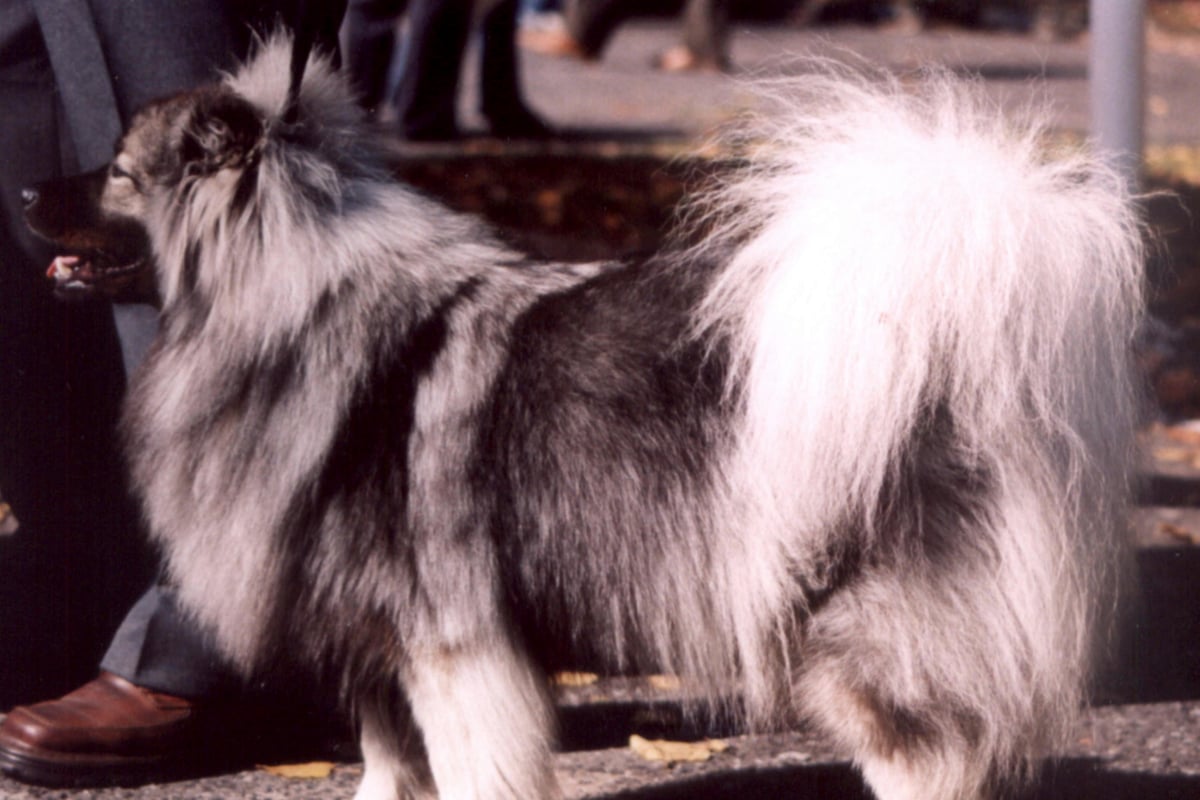
Wolfspitz (Keeshond)
The Wolfspitz (Wolfsspitz in Germany, Keeshond in the Netherlands and the United Kingdom) is the largest variety of the German Spitz, classified FCI 97 variety 1, Group 5. It stands 43 to 55 cm for 25 to 30 kg, with a life expectancy of 12 to 15 years. Its wolf-gray coat — a color exclusive to this German Spitz variety — and the characteristic dark markings around the eyes, called "spectacles," make it immediately recognizable. In the Netherlands, it's known as the Keeshond, a name inherited from an 18th-century political episode.
- Weight
- 25 to 30kg
- Height
- 43 to 55cm
- Life expectancy
- 13years
- Monthly cost
- 80 to 140€
Personality profile
Energy 4/5
Independence 3/5
Trainability 4/5
Good with children 5/5
Barking 5/5
Space needed 3/5
Attachment to home 5/5
Good with strangers 3/5
Good with dogs 4/5
Good with cats 3/5
Coat care 3/5
Exercise needs 4/5
Scores given on measured axes, data confidence: high.
Living with a Wolfspitz (Keeshond)
Description
The silhouette follows the classic Nordic Spitz body type: harmonious proportions, wedge-shaped head, pricked ears, and a tail curled over the back. Its wolf-gray coat is the only color accepted for this German Spitz variety — neither fawn, white, nor black is accepted in the FCI 97 variety 1 standard. The thick ruff forming a mane around the neck is a breed identity trait, along with abundant breeching on the hind legs. The dark "spectacles" — rings of dark hair around the eyes connected by a thin line — are a typical marking recognized in every standard.

Temperament
The Wolfspitz is an alert, vocal dog: it signals every unusual movement with clear barking, a direct legacy of its historical role as a barge guardian. This pronounced barking temperament is constitutional and cannot be suppressed by training alone — neighbors in an apartment building should be informed. With its family, it's expansive and demonstrative; toward strangers, it stays wary through a gradual introduction. Its sociability with other dogs is good given well-conducted early socialization.
Training
Learning is fast: its memory is solid and it generalizes varied exercises well. It responds well to positive reinforcement and clicker training; sessions should stay short and engaging to hold its attention. Its sustained energy calls for regular sport activities — agility, obedience, canicross, or mountain walks suit it perfectly. Bark-control training should start at a young age: a vocal adult left without structure becomes hard to manage in an urban setting.

Feeding
200 to 280 g of premium medium-breed kibble a day for a 27 kg adult, in two meals. Medium-breed kibble until 18 months to support bone growth. Excess calories show up quickly on a Spitz with a voluminous coat — monitor body condition by feeling the ribs rather than by eye. Omega-3 fatty acid supplements (salmon oil) can support coat quality, especially during heavy shedding.
Affiliate links, no extra cost to you. Legal notice

Living conditions
Apartment living stays possible if its daily exercise needs are met — two brisk walks of about 45 minutes each remain a minimum. In a house with a garden, it enjoys the freedom of movement but doesn't tolerate prolonged isolation. Its thick double coat predisposes it to heatstroke: in summer, walks must be shifted outside the hot hours, and constant access to shade and fresh water is essential. Its cold hardiness, by contrast, is remarkable — it handles Nordic winters without difficulty.

Grooming and coat care
Brushing twice a week is enough outside shedding season. Seasonal shedding, twice a year, is intense: the coat sheds large amounts of undercoat over 3 to 4 weeks and needs daily detangling to prevent mats at the ruff and breeching. No clipping or scissoring: the coat must not be trimmed or shaved, at the risk of permanently damaging its structure and exposing the skin. The pricked ears reduce the risk of ear infections but should still be checked monthly.

Health
Life expectancy falls between 12 and 15 years, on the good end of average for a medium-sized breed. The most documented conditions include hip dysplasia, patellar luxation, and hypothyroidism. Progressive retinal atrophy (PRA) and idiopathic epilepsy are reported in some lines — genetic testing of breeding dogs should be required at purchase. Post-clipping alopecia syndrome is especially important to know about: clipping the coat can trigger abnormal regrowth or permanent coat loss — never clip a Wolfspitz.
Breed history
The Wolfspitz is the oldest and largest variety of the German Spitz, a Nordic type present in Central Europe for millennia. In the Netherlands, it was the working dog of Rhine and Amstel bargemen, guarding barges at anchor. In the 18th century, it became a political symbol: the Patriot party, opposed to the House of Orange, was nicknamed the "Keezen" — the dog then took the name Keeshond in reference to Cornelis "Kees" de Gyzelaer, a Patriot leader. After the Orangists' victory in 1787, the Keeshond was banished from the courts — the breed nearly disappeared. It was rebuilt in the 1920s from the last remaining specimens kept in rural areas. Today the FCI recognizes a single breed (standard 97), with Wolfsspitz as the German name and Keeshond as the Dutch and English designation.
Getting ready for your Wolfspitz (Keeshond)
Five essentials to line up before day one.
Affiliate links, no extra cost to you. Legal notice
FAQ: Wolfspitz (Keeshond)
Sources
- FCI Standard No 97 — German Spitz (Wolfsspitz / Keeshond) · FCI breed standard 97, Group 5 Spitz and Primitive Types, variety 1 Wolfsspitz/Keeshond
- Société Centrale Canine — German Spitz · SCC official breed profile German Spitz, Group 5
- AKC Breed Profile — Keeshond · AKC Keeshond breed profile, Non-Sporting Group
FCI, Fédération Cynologique Internationale, the world body that has codified breed standards since 1911. FCI number 97 is assigned to the Wolfspitz (Keeshond).
Breeds similar to a Wolfspitz (Keeshond)

