


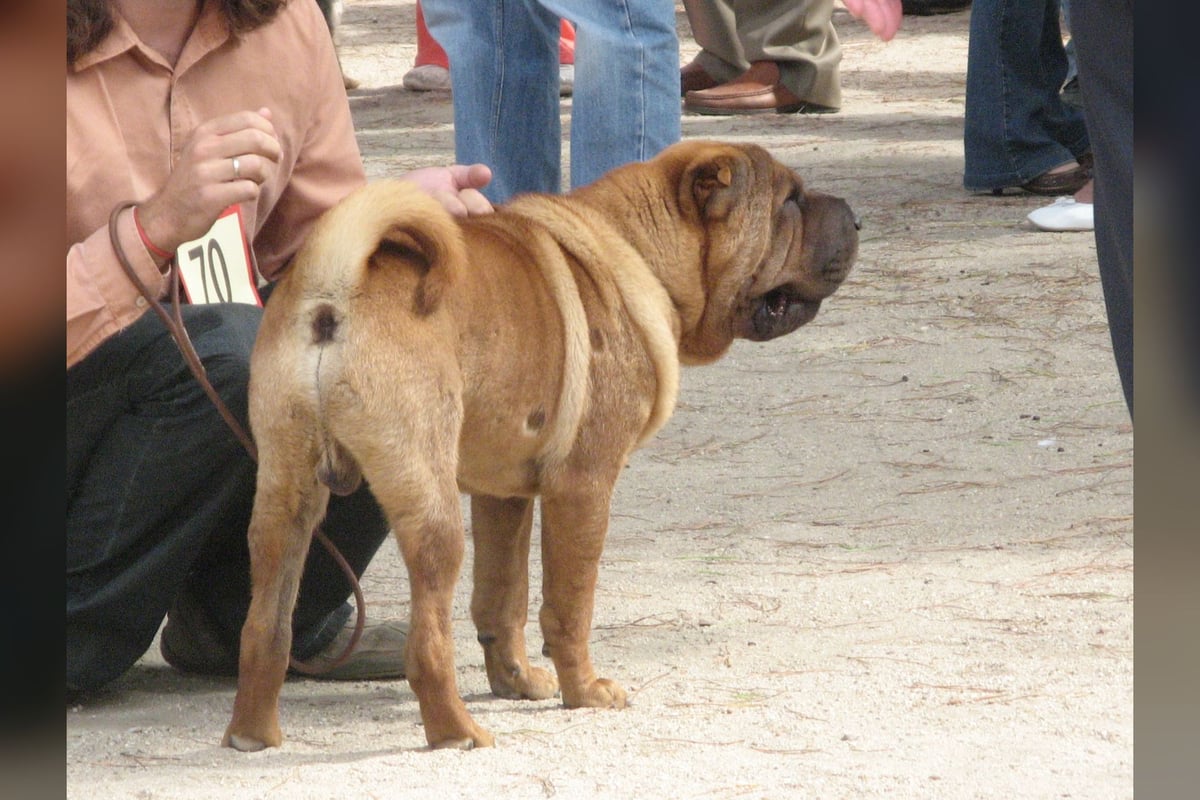
Shar Pei
The Shar Pei (沙皮, "sand skin," FCI 309) is a medium-sized Chinese molosser, 44 to 51 cm at the withers for 18 to 30 kg, originating from Guangdong province, the town of Dialak. Nearly extinct under Mao — estimated at fewer than 60 individuals in 1973 — it was saved by an international appeal relayed from Hong Kong and was listed in the Guinness Book as the "rarest breed in the world" in 1978. Three anatomical traits are unique to it: abundantly wrinkled skin (very pronounced in puppies), a blue-black tongue shared only with the Chow Chow, and small triangular ears pressed forward. Its life expectancy of 8 to 11 years is shortened by severe genetic conditions, including Familial Shar-Pei Fever (FSF), which affects about 25% of individuals.
- Weight
- 18 to 30kg
- Height
- 44 to 51cm
- Life expectancy
- 10years
- Monthly cost
- 90 to 160€
Personality profile
Energy 2/5
Independence 5/5
Trainability 2/5
Good with children 2/5
Barking 2/5
Space needed 2/5
Attachment to home 3/5
Good with strangers 1/5
Good with dogs 1/5
Good with cats 2/5
Coat care 3/5
Exercise needs 2/5
Scores given on measured axes, data confidence: high.
Living with a Shar Pei
Description
A stocky, compact silhouette, covered in abundant skin folds in puppies that loosen partially in adults, persisting mainly on the head, neck, and shoulders. Three coat variants exist: the Horse coat (very short, harsh, bristly like horsehair), the Brush coat (short, up to 2.5 cm, softer), and the Bear coat (long, not recognized by the FCI standard). The coat is solid-colored — cream, fawn, red, brown, black — with no markings or patches. Males reach 25 to 30 kg, females generally stay under 23 kg; its dense build masks its moderate size.

Temperament
Calm and independent: it isn't demonstrative and can go through the day without seeking attention or play. Its attachment goes mainly to a single handler or a narrow family circle — strangers are met with a structural wariness that doesn't fade with socialization alone. With children, caution and constant supervision are essential: its heritage as a fighting dog gives it low tolerance for agitation and abrupt gestures. Its tolerance of other dogs is very limited — confrontations between males in particular are frequent and severe.
Training
It learns slowly, not from a lack of understanding but from a lack of interest in obedience — its independence is inherent, not a flaw to be corrected through coercion. Short, repeated sessions (10 to 15 minutes) with high-value food rewards give better results than long sessions. Socialization from 8 weeks is decisive: a puppy not exposed to urban settings, children, and other animals becomes an unpredictable 25 kg adult. Training at a dog club with an instructor experienced with independent molossoid breeds is strongly advised for novice owners.

Feeding
200 to 300 g of premium medium-breed kibble a day for a 20 kg adult, in two split meals, with a low glycemic index to limit skin inflammation — the breed is predisposed to food allergies, particularly to wheat and corn. A grain-free or single-protein diet (lamb, duck, salmon) is often recommended by veterinary dermatologists. Glucosamine and omega-3 fatty acids from age 4 to prevent joint deterioration. Monitor weight strictly: being overweight worsens dysplasia and increases the breathing difficulties linked to the short face.
Affiliate links, no extra cost to you. Legal notice

Living conditions
It adapts to apartment living if its moderate exercise needs (30 to 45 minutes of daily walking) are met, but heat is a real constraint: temperatures above 25 °C are difficult for it, as its short face and often narrow nostrils limit thermoregulation through panting. It's essential to provide a cool, shaded space in summer, avoid outings during hot hours, and never leave it in a car. Its territorial instinct makes close canine group living (shelters, dog parks) inadvisable.

Grooming and coat care
The skin folds require thorough weekly cleaning between each fold to eliminate residual moisture and prevent bacterial and yeast dermatitis — particularly in summer. The short coat (Horse coat or Brush coat) needs 10 minutes of brushing a week, but full drying after a bath is critical: a damp fold can develop a skin infection within 24 hours. The pressed-forward ears must be checked and cleaned every two weeks. The non-standard Bear coat requires increased upkeep comparable to a long coat.

Health
Life expectancy, at 8 to 11 years, remains below the average for molossers of comparable size, due to several severe genetic conditions. Familial Shar-Pei Fever (FSF) — episodic recurrent fevers with no identified infectious cause — affects about 23 to 25% of individuals and can progress to renal or hepatic amyloidosis, the leading cause of premature death in the breed. Entropion (eyelids folding inward and rubbing against the cornea) has a prevalence of 30 to 40% and frequently requires surgical correction before age one to prevent corneal ulcers. Also present: chronic ear infections (narrow ear canal, pressed-forward ears), demodicosis, and skin allergies (the folds trap moisture and bacteria), hypothyroidism, and hip or elbow dysplasia — regular veterinary follow-up and breeders who run FSF DNA tests are non-negotiable.
Breed history
The Shar Pei is an old Chinese breed from Guangdong province, whose Han funerary statues dating to 200 BC already depict its characteristic wrinkled-skin build. Used for livestock guarding, hunting, and dogfighting, it survived for several centuries in and around the town of Dialak. Under Maoist rule, pet dogs were taxed as a "bourgeois luxury" and massively eliminated: the population was estimated at fewer than 60 individuals in 1973. That year, Matgo Law, a Hong Kong-based breeder, published an urgent appeal in the American magazine Dogs Magazine, triggering a wave of donations and imports to the United States. In 1978, the Guinness Book of World Records listed it as the rarest breed in the world. The world population has been rebuilt since then, but the narrow genetic base explains the high frequency of hereditary conditions still observed today.
Getting ready for your Shar Pei
Five essentials to line up before day one.
Affiliate links, no extra cost to you. Legal notice
FAQ: Shar Pei
Sources
- FCI Standard No 309 — Shar Pei · FCI breed standard 309, Group 2 Pinscher and Schnauzer — Molossoid and Swiss Mountain and Cattledogs
- Société Centrale Canine — Shar Pei · SCC official breed profile, Shar Pei, Group 2
- AKC Breed Profile — Chinese Shar-Pei · AKC Chinese Shar-Pei breed profile, Non-Sporting Group
FCI, Fédération Cynologique Internationale, the world body that has codified breed standards since 1911. FCI number 309 is assigned to the Shar Pei.
Breeds similar to a Shar Pei

Great Dane
Pinscher and Schnauzer - Molossoid and Swiss Mountain and Cattledogs
50 to 90 kg

Bullmastiff
Pinscher and Schnauzer - Molossoid and Swiss Mountain and Cattledogs
41 to 59 kg