


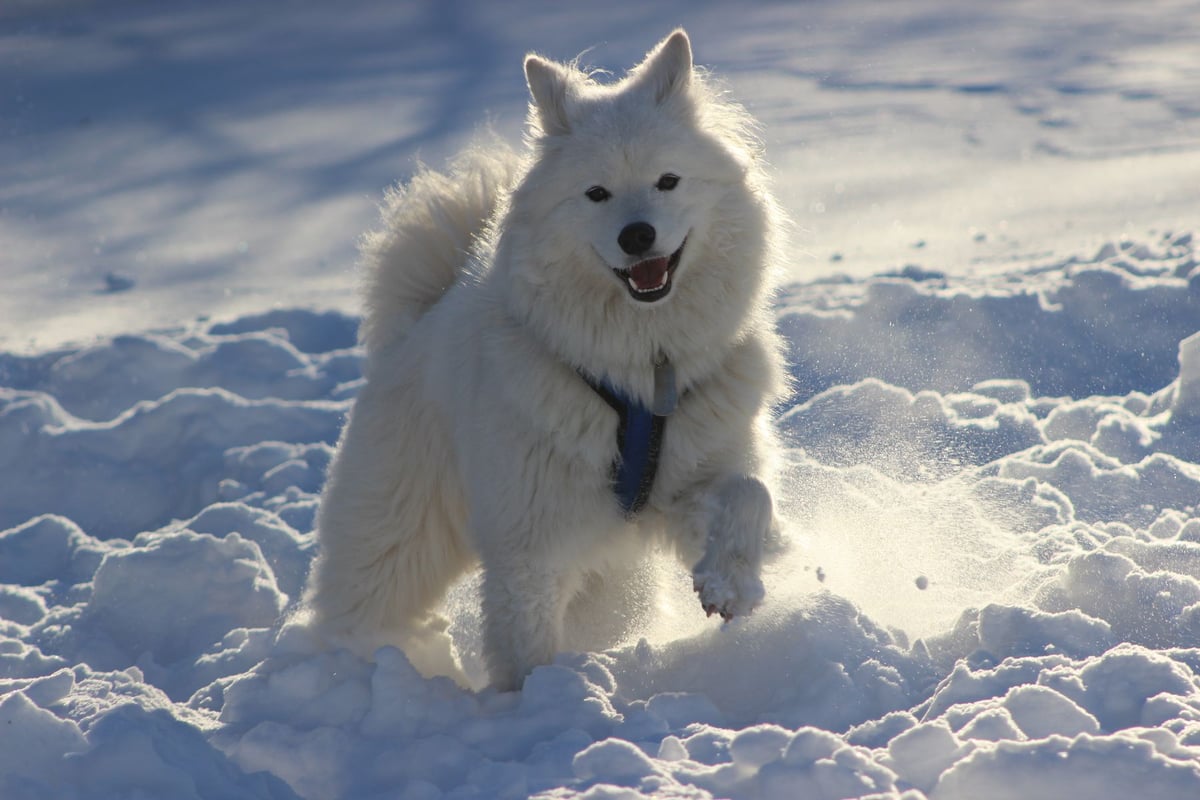
Samoyed
The Samoyed is a Siberian Arctic spitz weighing 17 to 30 kg depending on sex, selected for millennia by the Nenets people (formerly called Samoyed) in Yamalo-Nenets to guard reindeer herds at -50 °C. Recognized by the FCI under number 212, it stands out for its thick white double coat, its smiling expression known as the "Samoyed smile" caused by its upturned mouth corners, and its maximum friendliness (5/5) — which makes it unsuited to any guarding role.
- Weight
- 17 to 30kg
- Height
- 46 to 56cm
- Life expectancy
- 13years
- Monthly cost
- 90 to 140€
Personality profile
Energy 4/5
Independence 4/5
Trainability 3/5
Good with children 5/5
Barking 4/5
Space needed 4/5
Attachment to home 5/5
Good with strangers 5/5
Good with dogs 4/5
Good with cats 3/5
Coat care 5/5
Exercise needs 4/5
Scores given on measured axes, data confidence: high.
Living with a Samoyed
Description
A Nordic spitz build, with males noticeably larger and heavier (20-30 kg) than females (17-25 kg). Pure white or cream-white coat, a spectacular double coat with a dense woolly undercoat and a long, straight outer coat. Expressive dark almond eyes, triangular erect ears set well apart. Plumed tail carried over the back in motion. The upturned mouth corners create the breed's characteristic smiling expression, which sets it apart from all other spitz breeds.

Temperament
Maximum sociability without discrimination: it welcomes strangers, visitors and even intruders with the same enthusiasm — it barks to signal a presence but never shows aggression. A vocal breed that barks regularly (active communication, a legacy of its herd-guarding role), with episodes of the singing howls typical of Nordic breeds. Excellent with children thanks to its very high tolerance threshold and gentle play. Copes poorly with prolonged solitude beyond 4-5 hours — develops anxiety and destructive behavior.
Training
Moderate trainability: intelligent and motivated by play and treats, but with the independence typical of Nordic breeds, which makes precision obedience less natural than with a working herding breed. Responds well to positive reinforcement exclusively; handler impatience triggers an instant shutdown. Excellent for recreational dog sports: canicross, light pulka, agility, nosework. Recall requires constant work and is never as reliable as in herding breeds. Training should begin at 8-10 weeks.

Feeding
280 to 420 g of premium kibble a day depending on weight and activity level, split into 2 meals. Kibble with a good proportion of animal protein (26-30%) and fat (14-18%) to support the active metabolism and coat maintenance. Omega-3 oil supplementation (1 teaspoon of salmon oil/day) recommended for coat shine and skin health. Watch for weight gain during sedentary periods — the breed tends to store reserves when exercise decreases.
Affiliate links, no extra cost to you. Legal notice

Living conditions
Unsuited to small apartments without outdoor access: its energy level (4/5) and need for social stimulation call for an enclosed garden and regular access to open spaces. A house with a garden at minimum; ideally a cold-temperate or mountainous region. Sensitive to heat above 22 °C during activity — in Mediterranean regions, outings only during cool hours, with permanent shade and water mandatory in summer. Its coat makes it a poor fit for very high tropical humidity environments (risk of pyoderma under the coat).

Grooming and coat care
Demanding upkeep: brushing 2 to 3 times a week under normal conditions, daily during the two annual shedding seasons (spring, fall) when the undercoat comes out in large clumps. Professional grooming 2 to 4 times a year to detangle and check the condition of the coat. Do not shave the coat in summer — the double coat insulates against heat as much as cold, and regrowth after shaving can be disrupted for a long time. Monthly bath with a gentle product that does not damage the structure of the outer coat.

Health
Major hereditary condition: Samoyed hereditary nephropathy, an X-linked disorder — DNA testing is mandatory in serious breeding programs, as affected males develop progressive kidney failure before age 3. Progressive retinal atrophy (PRA) is also present in the breed: annual eye exams are recommended. Hip dysplasia occurs at moderate incidence. Life expectancy 12 to 14 years.
Breed history
A breed developed over millennia by the Nenets people (called "Samoyed" in pre-modern Russian sources) in the Yamal Peninsula and Siberian Yamalo-Nenets region. It played a central role in the people's survival: guarding reindeer herds, pulling light sleds, and providing body heat at night. Introduced to Western Europe in the late 19th century by polar explorers — Fridtjof Nansen used them on his Arctic expeditions in the 1890s. FCI standard 212 set; the breed is popular in France today, with 800-1000 LOF births a year.
Getting ready for your Samoyed
Five essentials to line up before day one.
Affiliate links, no extra cost to you. Legal notice
FAQ: Samoyed
Sources
- FCI Standard No 212 — Samoyed · FCI breed standard 212, Group 5 Spitz and Primitive Types, Section 1 Nordic Sledge Dogs
- AKC Breed Profile — Samoyed · AKC Samoyed breed profile, Working Group
FCI, Fédération Cynologique Internationale, the world body that has codified breed standards since 1911. FCI number 212 is assigned to the Samoyed.
Breeds similar to a Samoyed

