


Leonberger
Pinscher and Schnauzer - Molossoid and Swiss Mountain and Cattledogs
45 to 77 kg
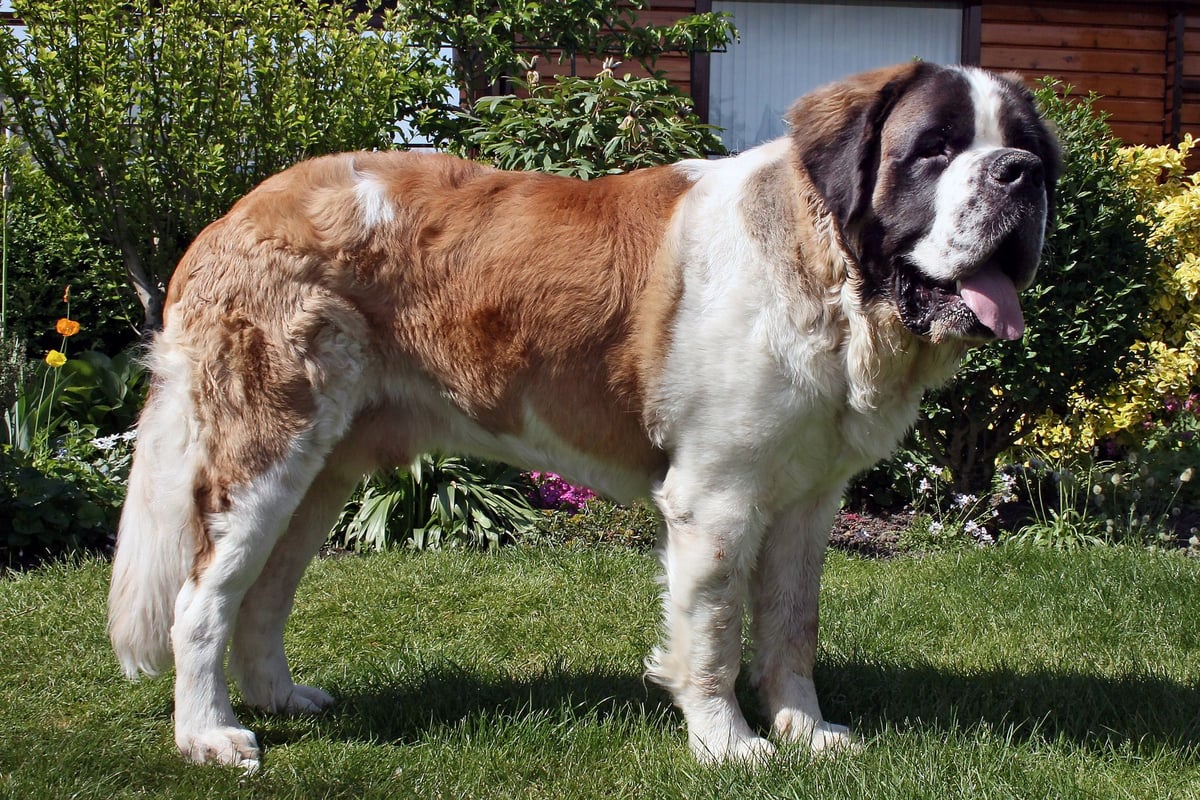
The St. Bernard is an alpine molosser classified as FCI number 61, native to the Great St Bernard Hospice (Switzerland), founded in the 11th century, where Augustinian monks used it as a rescue dog. Weighing 65 to 90 kg for 65 to 90 cm at the withers, it is one of the most massive FCI-recognized breeds. Its life expectancy is short: 8 to 10 years on average.
Scores given on measured axes, data confidence: high.
Living with a St. Bernard
Two official varieties: short-haired (more common in Switzerland) and long-haired. Coat always white with tan and red-brown patches, a dark mask being desirable under the FCI 61 standard. Massive head with a very pronounced stop, broad jaw, drooping lips producing abundant drool. Exceptionally heavy bone structure. Marked sexual dimorphism: males noticeably larger and heavier than females.

A calm, patient temperament — the breed, selected for mountain work in extreme conditions, needed to stay calm under stress. Affectionate with its close family, reserved (without aggression) toward strangers. Barks moderately, with a deep, carrying voice. Its imposing size requires early socialization from 8 weeks so that a clumsy 30 kg puppy doesn't become unmanageable as an adult.
Training should start at 8 weeks: a 6-month-old St. Bernard already weighs 40-50 kg and can knock over an adult. Positive reinforcement mandatory: the breed is sensitive to coercive methods. Trainability sufficient for basic commands and leash walking, but not suited to intense dog sports or long hours of technical exercise. A perfectly mastered leash walk is the main goal — and a public safety concern at this size.

600 to 900 g of premium giant-breed kibble a day for an 80 kg adult, in 2 strict meals (never just 1 meal). 1.5 hours of digestive rest before and after each meal, essential to limit the risk of gastric torsion. Giant-breed kibble up to 24 months (slow growth, do not force: too-heavy bone structure loaded too early = early dysplasia). Glucosamine and chondroitin recommended from age 4.
Affiliate links, no extra cost to you. Legal notice

A house with a spacious garden is mandatory: apartment living is out of the question. Its size (up to 90 cm, 90 kg) makes any configuration without direct outdoor space unworkable. Perfectly suited to harsh winters and freezing temperatures thanks to its dense double coat. Marked heat intolerance: above 25 °C, risk of severe heatstroke — permanent shade and fresh water in summer are non-negotiable.

Short-haired variety: weekly brushing, daily during spring/fall molts. Long-haired variety: brushing 2 to 3 times a week, detangling friction zones (armpits, chest, behind the ears). Quarterly bath with an industrial hair dryer given the volume of coat. Bi-weekly cleaning of the jowls and mouth folds (moisture = chronic skin risks). Optional professional grooming, but logistically complex given the size.

Life expectancy of 8 to 10 years, among the shortest of the large breeds. Hip and elbow dysplasia: high frequency (European studies: 20-30% of dogs without strict radiographic selection). Gastric dilatation-volvulus (GDV): cumulative lifetime risk estimated at 20-25% for giant breeds with deep chests — surgical emergency within <2 hours. Entropion and ectropion (eyelid malpositions linked to the heavy face). Osteosarcoma, as in other giant breeds. Vet budget should be planned accordingly.
Founded in the 11th century on an alpine pass between Switzerland and Italy (altitude 2 469 m), the Great St Bernard Hospice employed molosser-type dogs to guide and rescue travelers caught in snowstorms. Barry, the most famous of them (1800-1814), is credited with rescuing 40 to 100 people depending on the source, and his remains are preserved at the Natural History Museum of Bern. The breed's international standard was set in 1887 at a conference in Zurich — one of the very first international standardizations of a dog breed; the FCI, created in 1911, adopted it under number 61.
Five essentials to line up before day one.
Affiliate links, no extra cost to you. Legal notice
FCI, Fédération Cynologique Internationale, the world body that has codified breed standards since 1911. FCI number 61 is assigned to the St. Bernard.
Pinscher and Schnauzer - Molossoid and Swiss Mountain and Cattledogs
45 to 77 kg

Pinscher and Schnauzer - Molossoid and Swiss Mountain and Cattledogs
45 to 70 kg

Pinscher and Schnauzer - Molossoid and Swiss Mountain and Cattledogs
36 to 50 kg