


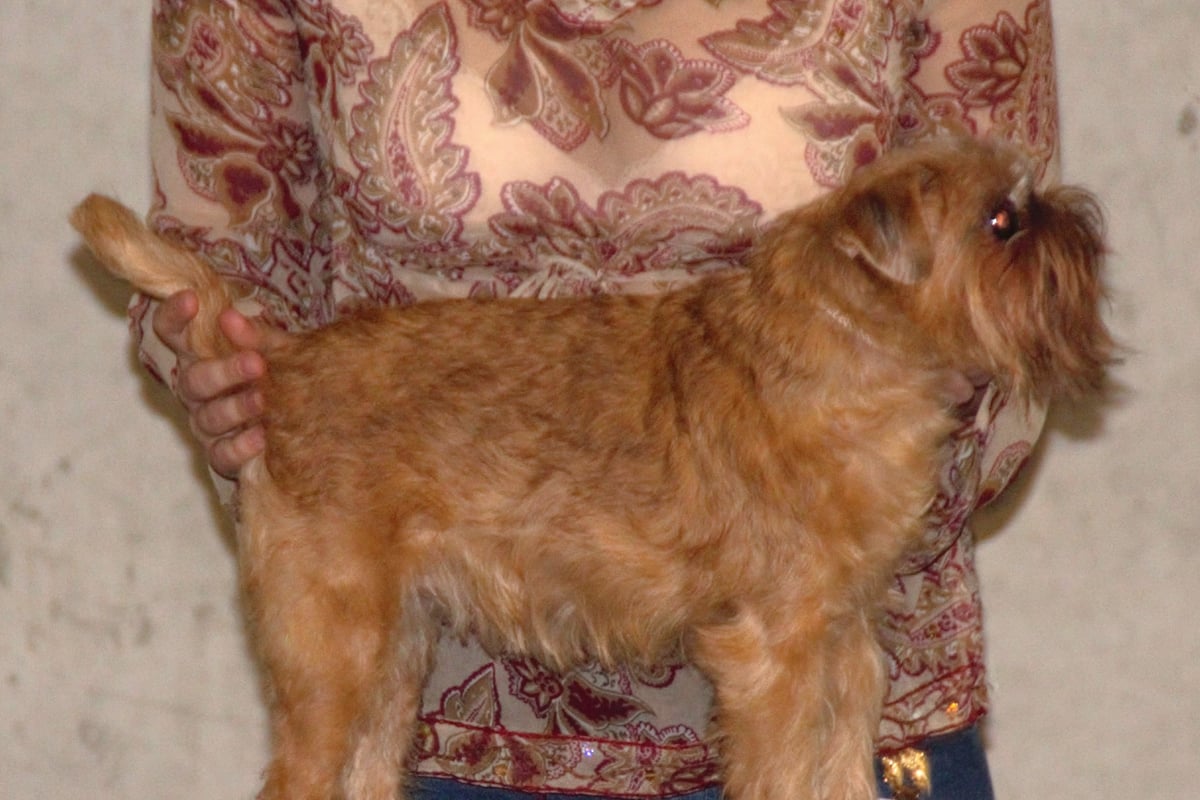
Petit Brabançon
The Petit Brabançon is a brachycephalic Belgian griffon weighing 3 to 6 kg, recognized by the FCI under number 82, group 9 section 3. It shares its standard with the Griffon Bruxellois and the Griffon Belge: three names for the same breed, differentiated only by coat color and type. Born in Brussels in the 19th century from crosses between Affenpinschers, Pugs and King Charles Spaniels, it shows moderate brachycephaly and a documented risk of syringomyelia. Life expectancy 12 to 15 years.
- Weight
- 3 to 6kg
- Height
- 18 to 28cm
- Life expectancy
- 13years
- Monthly cost
- 70 to 130€
Personality profile
Energy 3/5
Independence 2/5
Trainability 3/5
Good with children 3/5
Barking 3/5
Space needed 1/5
Attachment to home 5/5
Good with strangers 3/5
Good with dogs 3/5
Good with cats 3/5
Coat care 2/5
Exercise needs 2/5
Scores given on measured axes, data confidence: medium.
Living with a Petit Brabançon
Description
Round, prominent head, muzzle very short but less extreme than the Pug's, flattened face with a prominent chin, round eyes set well apart. The Petit Brabançon carries a short, hard coat (the smooth variety), unlike the Griffon Bruxellois (hard fawn coat) and the Griffon Belge (hard coat in any color other than fawn). Compact, muscular body for its size, tail carried high. Weight 3 to 6 kg, height at the withers 18 to 28 cm.

Temperament
Lively, devoted and expressive, with an emotional intensity above average for toy breeds. Strongly bonded to one key person, it announces visitors but is not a pathological barker. Copes poorly with repeated absences of more than 4 to 5 hours. Can be stubborn during training sessions — consistency matters more than long repetition. Supervision is required with children under 5 due to its small size.
Training
Intelligence and sensitivity to human cues make the breed receptive to positive reinforcement. Sessions of 5 to 10 minutes, regular rather than long. The breed can act independently on certain recall exercises in open settings — early work in a secure environment is needed. House-training achieved in 4 to 6 weeks with a consistent method.

Feeding
80 to 130 g of premium kibble a day for a 4 to 5 kg adult, in 2 meals. Small kibble or a shape suited to brachycephalic breeds (flat or U-shaped). Obesity should be monitored — every excess kilo worsens the respiratory and joint load. Puppies: 3 meals up to 12 weeks.
Affiliate links, no extra cost to you. Legal notice

Living conditions
An apartment suits its size and moderate exercise needs perfectly. Two daily outings of 20 to 30 minutes are enough for an adult. Sensitive to cold below 10 °C (a coat is recommended), and especially to heat above 25 °C: its moderate brachycephaly slows thermoregulation through panting, making shade and cool spots essential in summer. Air conditioning or a cool room is mandatory during heat waves.

Grooming and coat care
The Petit Brabançon's short coat needs little upkeep: weekly brushing with a rubber grooming glove to limit light shedding. Cleaning the facial wrinkles 1 to 2 times a week with an unscented wipe prevents contact dermatitis. Weekly cornea checks (eyes exposed to trauma). Nails every 3 to 4 weeks, ears monthly.

Health
Moderate brachycephaly: less severe than the Pug's or the Bulldog's, but a functional BOAS exam of the parents remains recommended before purchase — stenotic nostrils and an elongated palate can be surgically corrected. Syringomyelia / Chiari-like malformation: a neurological condition documented in brachycephalic toy breeds (estimated prevalence 20 to 30% on asymptomatic imaging), causing chronic neck pain and atypical scratching. MRI recommended for breeding stock. Patellar luxation common in the toy category. Heat: rapid hyperthermia under direct exposure without ventilation (see FAQ).
Breed history
The Petit Brabançon was developed in Brussels in the second half of the 19th century, initially as a rat-catcher in horse-cab stables. Progressive crossing with the Affenpinscher (for character), the Pug (for the flattened face and short coat) and the King Charles Spaniel (for the ruby coat) produced the three current varieties, genetically identical. Queen Marie-Henriette of Belgium popularized the breed at court in the 1880s, securing its rapid spread across Europe. FCI standard 82, group 9, section 3 (small Belgian dogs).
Getting ready for your Petit Brabançon
Five essentials to line up before day one.
Affiliate links, no extra cost to you. Legal notice
FAQ: Petit Brabançon
Sources
- FCI Standard No 82 · FCI breed standard 82, Group 9 Companion and Toy Dogs, Section 3 — Griffon Bruxellois, Griffon Belge, Petit Brabançon
- AKC Breed Profile — Brussels Griffon · AKC Brussels Griffon breed profile, Toy Group
FCI, Fédération Cynologique Internationale, the world body that has codified breed standards since 1911. FCI number 82 is assigned to the Petit Brabançon.
Breeds similar to a Petit Brabançon


Miniature Pinscher
Pinscher and Schnauzer - Molossoid and Swiss Mountain and Cattledogs
4 to 6 kg