


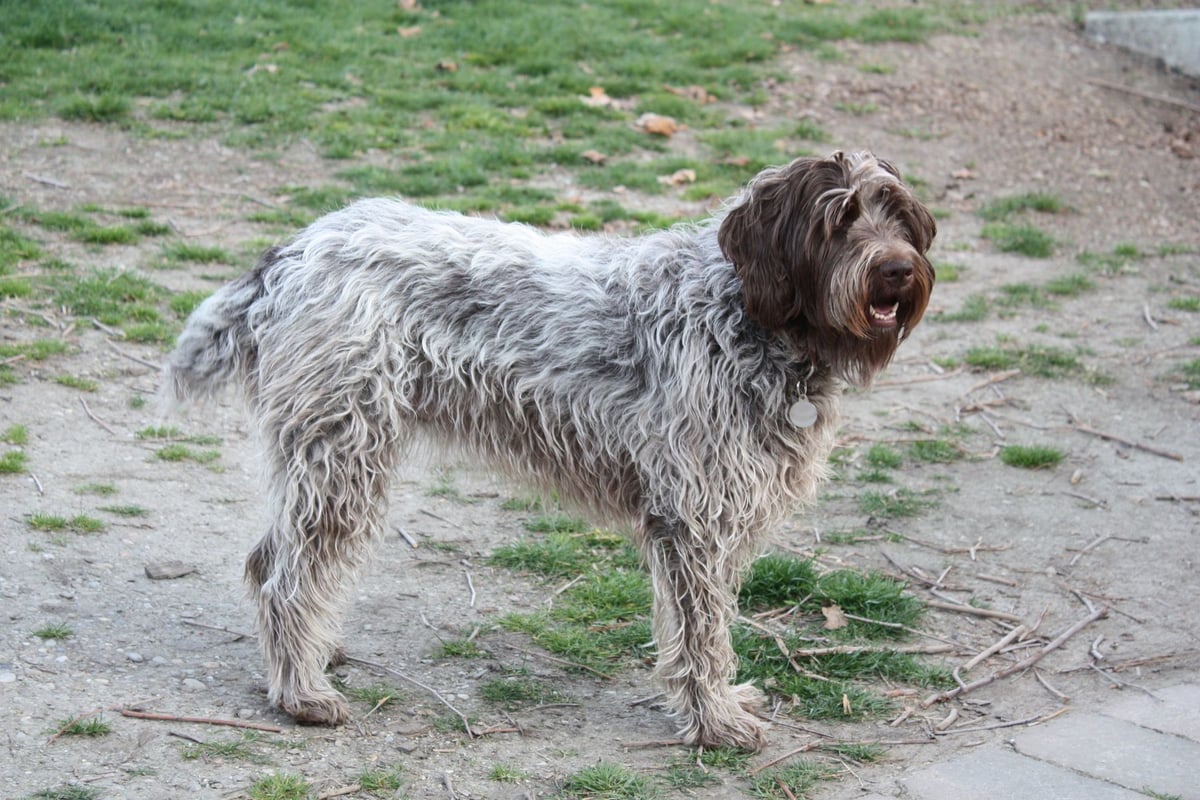
Wirehaired Pointing Griffon
The Wirehaired Pointing Griffon (FCI 107) is the first versatile European pointing breed, selected starting in 1873 by the Dutchman Eduard Karel Korthals from a small nucleus of founding dogs bred from crosses between spaniels, griffons, pointers, and retrievers. Weighing 23 to 32 kg for 50 to 60 cm at the withers, it hunts on any terrain — field, forest, and water — with equal effectiveness. The breed standard was fixed in 1887 in Vienna. Its rough, wiry coat with characteristic eyebrows, mustache, and beard makes it a breed recognizable among all others.
- Weight
- 23 to 32kg
- Height
- 50 to 60cm
- Life expectancy
- 13years
- Monthly cost
- 90 to 160€
Personality profile
Energy 4/5
Independence 2/5
Trainability 4/5
Good with children 5/5
Barking 2/5
Space needed 4/5
Attachment to home 5/5
Good with strangers 4/5
Good with dogs 4/5
Good with cats 3/5
Coat care 3/5
Exercise needs 5/5
Scores given on measured axes, data confidence: high.
Living with a Wirehaired Pointing Griffon
Description
Everything starts with the coat, rough and wiry: the hard outer coat forms a natural armor against brush and cold water, while the dense, waterproof undercoat retains warmth. Recognized coat colors are steel gray mixed with brown, pure chestnut brown, and roan fawn. The bushy eyebrows, mustache, and abundant beard emphasize the dog's serious, determined expression. Solid medium build, 50 to 60 cm for 23 to 32 kg, with a balanced physique that gives it endurance on any terrain without heaviness.

Temperament
A gentle character for a pointing breed — calm at home, sociable with children and visitors, not prone to unnecessary barking. It stays deeply attached to its family and copes poorly with prolonged isolation. In the field, it transforms: methodical, tenacious, a steady trotter at 10-12 km/h, it ranges without ever losing sight of the hunter. This balanced duality — docile at home, driven in the field — makes it a hunting dog popular with active families.
Training
Training is a pleasure: responsive to voice and positive reinforcement, it picks up basic commands quickly and takes well to retrieving and pointing work. Hunting training should start between 6 and 9 months to channel its natural instinct. Intense outings — long walks, swimming, hunting — remain necessary to balance a dog with very high exercise needs: without enough of an outlet, it compensates with unwanted behaviors. It is not recommended for sedentary owners unable to devote several hours of exercise to it each week.

Feeding
250 to 380 g of premium medium-breed kibble a day for a 25 to 30 kg adult, split into two meals. Kibble formulated for sporting dogs (28-32% protein, 18-22% fat) suits dogs in intensive hunting activity. During the winter rest period, cut the ration by 15 to 20% to prevent weight gain. One hour of digestive rest after meals to prevent gastric torsion, a risk present at this size.
Affiliate links, no extra cost to you. Legal notice

Living conditions
A fenced yard or regular access to large open spaces is essential — an apartment doesn't suit a dog whose daily exercise must be sustained. A house with a yard in a rural or semi-rural setting is the optimal environment. Its waterproof coat lets it work in cold, wet weather; it tolerates summer heat less well and needs shade and fresh water in summer.

Grooming and coat care
Moderate upkeep despite the shaggy look: brushing twice a week to remove plant debris picked up on field outings. Stripping (removing dead coat by hand or with a stripping knife) twice a year is enough to maintain the coat's correct texture — unlike long-haired breeds, the wiry coat doesn't tangle. After every outing in water or marshland, drying the ears is essential to limit the risk of ear infections. Professional grooming isn't mandatory but is recommended twice a year.

Health
Life expectancy of 12 to 14 years for a sturdy medium build. Hip dysplasia is the most documented condition in the breed — serious breeders provide OFA or SCC radiograph results for their breeding stock. Ear infections are common, a direct consequence of the drop ears and work in wet environments (prevention detailed in the FAQ). Osteochondritis dissecans (OCD) needs monitoring during the young dog's rapid growth phase; gastric torsion, meanwhile, remains a moderate risk in adults, heightened by intense activity around mealtimes.
Breed history
The breed owes its name to Eduard Karel Korthals, a Dutch breeder who began a rigorous selection program in 1873 from a small nucleus of carefully chosen breeding dogs: French spaniels, continental griffons, English pointers, and retrievers. His stated goal was to create a versatile pointing dog capable of hunting on any terrain and in water — a glaring gap in European dog breeding at the time, which was dominated by specialized dogs. The standard was presented and adopted in 1887 in Vienna at an international conference, making the Korthals the first versatile pointing breed with a fixed standard. The FCI assigned it number 107, and its joint French-Dutch origin was recognized.
Getting ready for your Wirehaired Pointing Griffon
Five essentials to line up before day one.
Affiliate links, no extra cost to you. Legal notice
FAQ: Wirehaired Pointing Griffon
Sources
- FCI Standard No 107 — Korthals Griffon · FCI breed standard 107, Group 7 Pointing Dogs, Section 1 Continental Pointing Dogs
- Société Centrale Canine — Griffon d'arrêt à poil dur Korthals · SCC official breed profile Griffon d'arrêt à poil dur Korthals, Group 7
- AKC Breed Profile — Wirehaired Pointing Griffon · AKC Wirehaired Pointing Griffon breed profile, Sporting Group
FCI, Fédération Cynologique Internationale, the world body that has codified breed standards since 1911. FCI number 107 is assigned to the Wirehaired Pointing Griffon.
Breeds similar to a Wirehaired Pointing Griffon

