


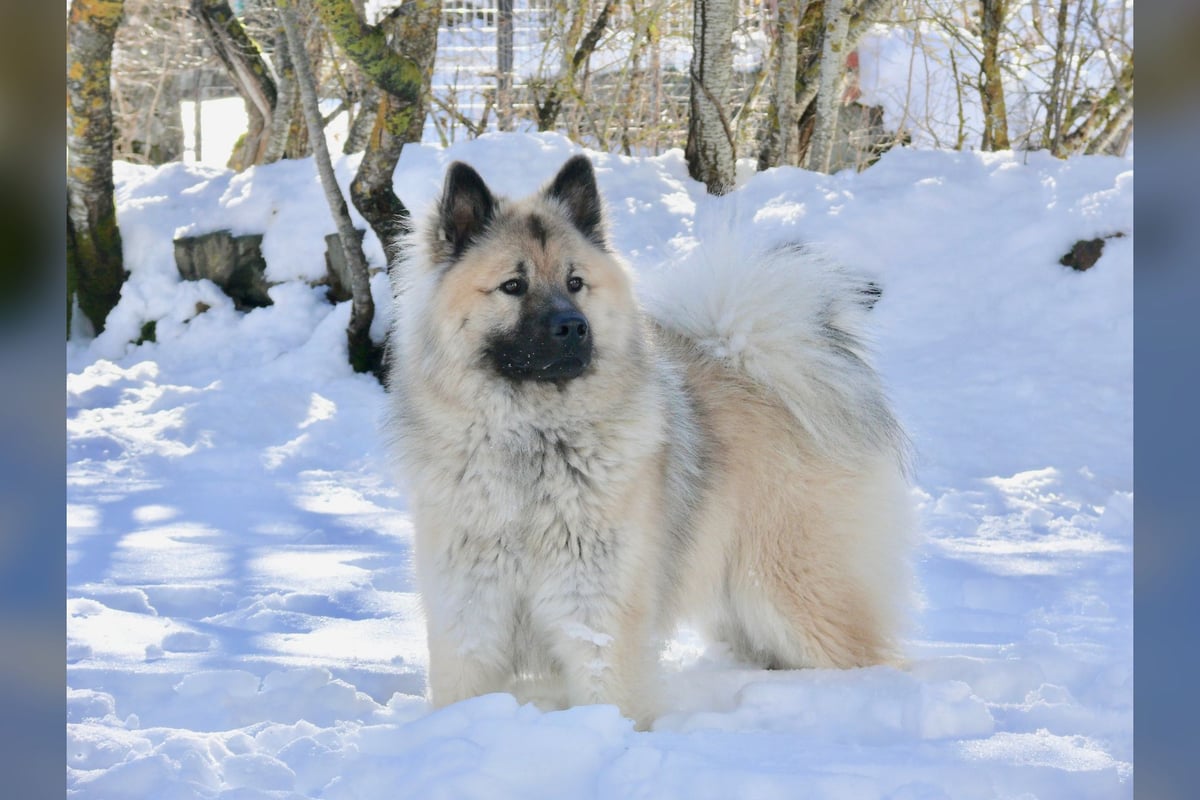
Eurasier
The Eurasier is a modern Germanic spitz weighing 18 to 32 kg, recognized by the FCI under number 291, created in Germany in 1960 by Julius Wipfel by crossing the Wolfsspitz with the Chow Chow, then enriched with a Samoyed infusion in 1972. A breed that has stayed niche — around 150 LOF registrations a year in France — combining a calm presence and strong family loyalty with a natural reserve toward strangers, which calls for early socialization.
- Weight
- 18 to 32kg
- Height
- 48 to 60cm
- Life expectancy
- 13years
- Monthly cost
- 70 to 120€
Personality profile
Energy 3/5
Independence 3/5
Trainability 3/5
Good with children 4/5
Barking 2/5
Space needed 3/5
Attachment to home 4/5
Good with strangers 2/5
Good with dogs 3/5
Good with cats 3/5
Coat care 3/5
Exercise needs 3/5
Scores given on measured axes, data confidence: medium.
Living with a Eurasier
Description
A medium-sized breed, well-built and balanced. Males 52-60 cm for 23-32 kg, females 48-56 cm for 18-26 kg. Medium-length double coat with a dense undercoat, all colors admitted except pure white, liver (brown-red), and white with spotting. The tongue can show blue or marbled patches, a legacy from the Chow Chow. Bushy tail carried curled or coiled over the back.

Temperament
Calm, balanced and not prone to barking (score 2/5): it is a family dog that invests deeply in its close circle without trying to please strangers. Its reserve toward strangers is genetically rooted: it observes, assesses, but doesn't assert itself — not to be confused with a guard dog temperament, a role it is neither selected for nor suited to. Constant family presence is a condition for its psychological balance; long days alone destabilize the breed.
Training
Receptive to positive reinforcement, it learns basic obedience exercises well (sit, down, recall), but it is not a competitive sport-performance dog in the strict sense. Its moderate independence means it cooperates willingly without being servile. Socialization between 8 and 16 weeks is decisive for limiting reserve toward strangers in adulthood: expose it widely to varied people, environments and sounds during this critical window.

Feeding
280 to 420 g of premium kibble a day for a 25 kg adult, in 2 meals. A standard diet suited to its medium size, with no notable metabolic quirk. Watch the weight after age 8, as the breed tends to put on weight if activity drops. Increased hydration in summer due to heat sensitivity.
Affiliate links, no extra cost to you. Legal notice

Living conditions
An apartment or a house suit a Eurasier equally well, provided it is included in family life — it should not be kept penned in a kennel. A garden is appreciated but not required if daily outings are sufficient (45 to 60 minutes). Its Arctic double coat makes it very resistant to cold but sensitive to heat above 25 °C: permanent shade and fresh water in summer, no intense exercise around midday.

Grooming and coat care
Weekly brushing under normal conditions, twice weekly to daily during the two annual sheds (spring/fall) when the undercoat comes out heavily. The coat cleans itself fairly well and does not need regular professional grooming; a quarterly bath is enough without particular dirtiness. Do not clip: the double coat handles thermoregulation in both summer and winter.

Health
Two eye conditions dominate the breed's health profile: entropion (eyelids rolling inward, surgically correctable) and ectropion (eyelids sagging outward, exposing the conjunctiva to irritation). These eyelid malformations most often appear in young dogs: an initial eye exam within the first year, then an annual check, are recommended. Hip dysplasia is monitored at serious kennels: always ask for the HD results of both parents before buying a puppy. Life expectancy 12 to 14 years, in the upper average for breeds of this size.
Breed history
Julius Wipfel, a German dog enthusiast and reader of Konrad Lorenz, began a crossbreeding program in 1960 in Weinheim, Germany, between the Wolfsspitz and the Chow Chow to recreate a dog with a balanced spitz-primitive temperament. The initial breed was called Wolf-Chow. In 1972, an infusion of Samoyed blood stabilized the temperament and rounded out the morphological standard; the breed took the name Eurasier, a contraction of Europe and Asia, its two origins. The Verein Eurasier (VE) obtained provisional FCI recognition the same year, with definitive confirmation in 1973. The breed has been deliberately kept niche by European breeders to preserve its behavioral traits.
Getting ready for your Eurasier
Five essentials to line up before day one.
Affiliate links, no extra cost to you. Legal notice
FAQ: Eurasier
Sources
- FCI Standard No 291 — Eurasier · FCI breed standard 291, Group 5 Spitz and Primitive Types, Section 4 European Spitz
- SCC — Eurasier Breed Profile · Société Centrale Canine, Eurasier breed profile, annual LOF statistics
- AKC Breed Profile — Eurasier · AKC Eurasier breed profile, Foundation Stock Service
FCI, Fédération Cynologique Internationale, the world body that has codified breed standards since 1911. FCI number 291 is assigned to the Eurasier.
Breeds similar to a Eurasier

