


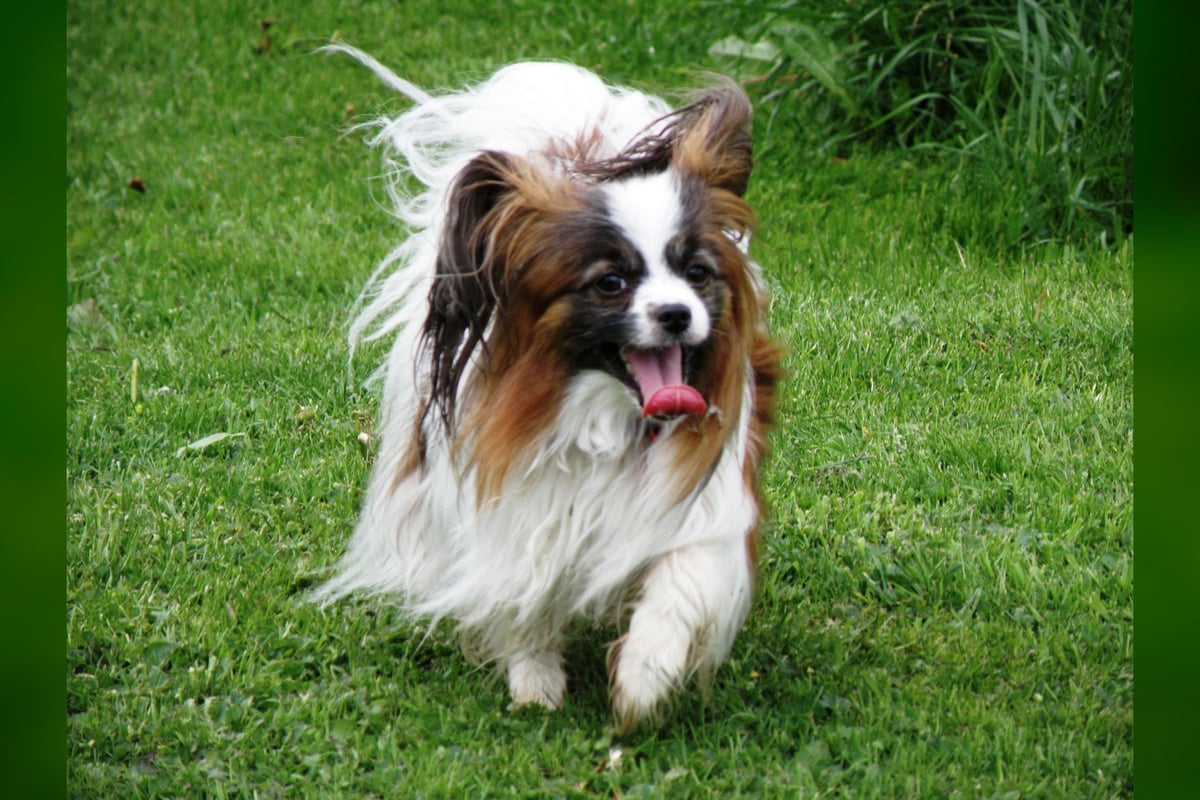
Continental Toy Spaniel
The Continental Toy Spaniel weighs 1.5 to 5 kg for 20 to 28 cm at the withers — a French and Belgian toy breed dating to the Renaissance, FCI number 77, group 9. Two varieties share the same standard: Papillon (ears standing erect like butterfly wings) and Phalene (drop ears). Ranked 8th out of 138 breeds on Stanley Coren's working intelligence test — the most trainable toy breed in dog fancy, with obedience and agility performances that rival working breeds. Life expectancy of 13 to 16 years.
- Weight
- 1.5 to 5kg
- Height
- 20 to 28cm
- Life expectancy
- 14years
- Monthly cost
- 50 to 90€
Personality profile
Energy 4/5
Independence 2/5
Trainability 5/5
Good with children 3/5
Barking 3/5
Space needed 1/5
Attachment to home 4/5
Good with strangers 3/5
Good with dogs 4/5
Good with cats 4/5
Coat care 3/5
Exercise needs 3/5
Scores given on measured axes, data confidence: high.
Living with a Continental Toy Spaniel
Description
A small toy breed with a solid build for its size: a finely proportioned head, a pointed muzzle of moderate length, round, bright eyes set slightly obliquely. Coat long, silky and slightly wavy, never curly — with no dense undercoat (hence moderate shedding). Coat always on a white base with markings of any color except liver. Ears very large relative to the skull, carried at a 45° angle (Papillon) or fully drooping (Phalene). Tail long, well plumed, carried curved over the back. The two varieties — Papillon and Phalene — are judged together in the ring and can be born in the same litter.

Temperament
Curious, quick and always on the move, it does not have the velcro-clingy profile of other toy breeds its size: its exceptional working intelligence (detailed below) shows up day to day in a very fast read of household routines and rules — including the ones you'd rather it didn't learn. A mild wariness instinct toward strangers — it doesn't rush a visitor but watches before approaching. Playful and interactive well into old age. Can show possessiveness toward its humans if poorly socialized when young.
Training
Ranked 8th out of 138 breeds on Stanley Coren's working intelligence test (1994), it sits in the same top tier as far larger working breeds — Golden Retriever (4th), Dobermann (5th), Shetland Sheepdog (6th). In practical terms: a new command learned in 5 to 15 repetitions and a 95% first-command obedience rate. These results open the door to disciplines normally reserved for herding or utility breeds: agility, level-3 obedience, rally obedience, complex tricks. Positive reinforcement only — small treats or play; sensitive but not emotionally fragile. An excellent option for beginner owners who want to practice a dog sport without managing a large dog.

Feeding
60 to 100 g of premium kibble a day for a 3 to 5 kg adult, in 2 to 3 meals. For dogs under 2 kg, split into 4 meals to avoid hypoglycemia. Avoid long stretches without food for puppies under 6 months. A fast-metabolism breed — kibble should show at least 28% protein. Treats counted strictly: 10% of intake maximum; obesity risk is moderate but real in dogs that get little exercise.
Affiliate links, no extra cost to you. Legal notice

Living conditions
A toy breed built for indoor living: a studio, urban apartment or house all suit it equally. Its small size removes any minimum space constraint. Three daily outings of 15 to 20 minutes cover its physical needs; a fourth session of play or mental training satisfies it fully. Sensitive to cold (coat with no dense undercoat) — a coat is recommended below 8 °C. Do not leave it alone for more than 5 to 6 hours: human attachment is present without the extreme separation anxiety of the Cavalier, but prolonged solitude generates barking and frustration. Children under 6: the toy breed's bone fragility calls for constant supervision — a wrong move can cause a fracture.

Grooming and coat care
Moderate grooming despite the long coat: the absence of a dense undercoat limits tangling. Brush 2 to 3 times a week with a soft-bristle brush to keep the shine and prevent tangles around the ears and rear feathering. Monthly bath with a mild shampoo. The Papillon's large, mobile ears ventilate well — fewer ear infections than in drop-eared breeds; a weekly check is still advised. For the Phalene, clean the drop ears twice a week. No professional clipping needed — the natural feathering is not trimmed under the standard.

Health
A robust breed for its toy size, with a life expectancy of 13 to 16 years. Conditions to watch for: patellar luxation (grades 1 to 4 — a clinical exam of the parents is essential), hypoglycemia in puppies under 6 months (minimal size means reduced glycemic reserves — 3 to 4 meals a day mandatory), a persistent fontanelle or molera (a skull opening that normally closes around 3-4 months, to watch closely in dogs expected to stay under 2 kg as adults), PRA-type progressive retinal atrophy (leads to blindness — DNA test available). Unlike other toy breeds, no major cardiac predisposition is documented at the breed level. Teeth: frequent tartar buildup — twice-weekly brushing recommended.
Breed history
European royal and aristocratic portraits of the Renaissance and the following century document it extensively — it appears in works by Titian, Rubens and Van Dyck, alongside figures of the French, Spanish and Italian courts. The Phalene variety (drop ears) is the older of the two, once called the 'squirrel dog' for its curled tail carriage. The erect-eared Papillon variety developed later, likely in the 17th century, and gradually overtook the Phalene in popularity. A unified FCI standard was set under number 77 in 1937, recognizing both varieties within a single standard. The breed benefits from remarkable genetic stability thanks to carefully managed breeding numbers — it has never been subject to the overproduction that has destabilized other companion breeds.
Getting ready for your Continental Toy Spaniel
Five essentials to line up before day one.
Affiliate links, no extra cost to you. Legal notice
FAQ: Continental Toy Spaniel
Sources
- FCI Standard No 77 — Continental Toy Spaniel · FCI breed standard 77, Group 9 Companion and Toy Dogs, Section 9 Continental Toy Spaniels — Papillon and Phalene varieties
- AKC Breed Profile — Papillon · AKC Papillon breed profile, Toy Group — weight 5-10 lbs, height 8-11 inches, lifespan 14-16 years
FCI, Fédération Cynologique Internationale, the world body that has codified breed standards since 1911. FCI number 77 is assigned to the Continental Toy Spaniel.
Breeds similar to a Continental Toy Spaniel

