


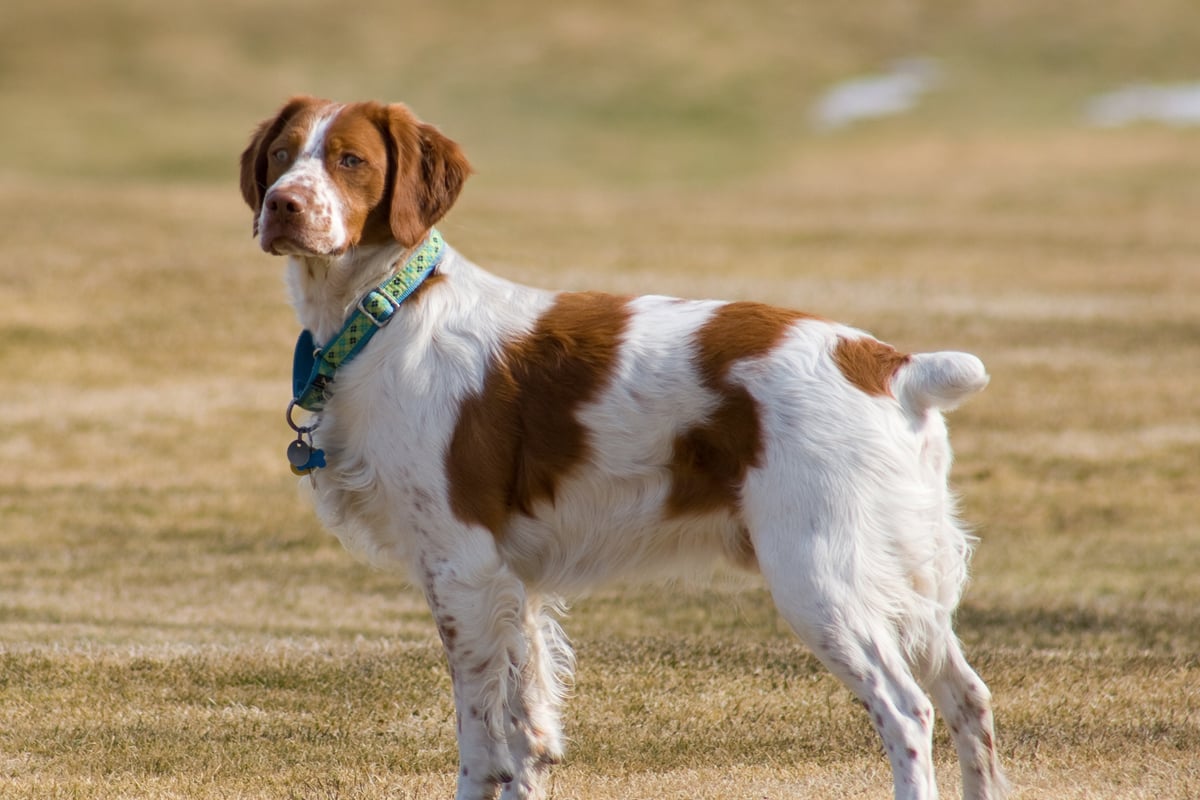
Brittany
The Brittany weighs 14 to 18 kg for 46 to 52 cm at the withers — the most compact of the French pointing breeds. Born in Brittany in the late 19th century, bred notably around Callac and Pontou, it has been recognized by the FCI under number 95 (group 7, section 1.2) since 1954. The top hunting dog in LOF registrations throughout the entire 2010s, and the most exported French pointing breed. Life expectancy 13 to 15 years, with moderate predisposition to hip dysplasia.
- Weight
- 14 to 18kg
- Height
- 46 to 52cm
- Life expectancy
- 14years
- Monthly cost
- 60 to 100€
Personality profile
Energy 5/5
Independence 3/5
Trainability 4/5
Good with children 4/5
Barking 2/5
Space needed 4/5
Attachment to home 4/5
Good with strangers 3/5
Good with dogs 4/5
Good with cats 3/5
Coat care 2/5
Exercise needs 5/5
Scores given on measured axes, data confidence: high.
Living with a Brittany
Description
A square, powerful build despite its medium size: a compact body with a short, muscular back, a rounded skull, medium-length ears set high with light, silky feathering. Coat flat or slightly wavy, never curly, semi-short, with feathering on the legs and ears. Accepted colors: orange and white, black and white, liver and white, tricolor, as well as roan patterns. A notable morphological trait: the so-called 'tailless' trait (a spontaneously absent or shortened tail) is FCI-recognized and common in the breed. Unlike British spaniels, which are flushing dogs, it belongs to group 7 of pointing breeds: it points and freezes the game before the shot.

Temperament
High working energy inherited from centuries of hunting selection: deprived of a daily physical outlet, it quickly develops anxiety and substitute behaviors (chewing, persistent restlessness). Sociable with children and other dogs if properly socialized before 12 weeks. Sensitive to tone of voice — coercive methods are counterproductive with this breed. It seeks human contact and copes poorly with long absences, but shows greater functional independence than the English Cocker Spaniel during hunting days.
Training
Solid trainability: a breed used for generations to work with partial independence at a distance from the hunter, which gives it good decision-making ability but requires a foundation of obedience laid down from the first weeks at home. Instinctive pointing develops naturally in dogs from working lines. Suitable dog sports: field trials, snipe hunting, obedience, agility. For a non-hunting owner, nosework (competitive scent detection) channels the instinct in a controlled setting. The breed has regularly placed in French field trial rankings since the 1970s.

Feeding
350 to 450 g of premium kibble a day for an active 16 kg adult, split into 2 meals. The ration should be adjusted to activity level: a dog working several hunting days a week may need 20 to 30% more during the season. Avoid meals right before intense exercise sessions to prevent the risk of gastric torsion, lower in this breed than in larger ones but not nonexistent.
Affiliate links, no extra cost to you. Legal notice

Living conditions
Unsuited to an apartment without daily access to wide open spaces: a house with a garden is strongly recommended. Physical activity needs estimated at a minimum of 90 minutes a day, split into two sessions — ideally combining free running and scent work. A breed built to hunt 'all game, all terrain' (snipe, pheasant, partridge, duck depending on the region): the tracking instinct is powerful, and recall must be trained intensively outside a secure enclosure. Good tolerance of Breton cold and humidity thanks to its dense coat.

Grooming and coat care
Light upkeep compared with long-coated breeds: weekly brushing with a natural-bristle brush to remove dirt and prevent small tangles in the feathering. No mandatory professional grooming — the coat cleans itself naturally between baths (a bath every 6 to 8 weeks is enough). Systematically check the ears and between the toes after every outing in the forest or tall grass to spot ticks and invasive seeds. Moderate seasonal shedding, twice a year.

Health
Hip dysplasia: present at a moderate level in the breed — OFA or FCI X-rays recommended for breeding stock. Idiopathic epilepsy documented in certain lines: check the parents' history before acquiring a puppy. Progressive retinal atrophy (PRA): DNA test available, should be required from the breeder for both parents. No dominant condition compared with other hunting breeds of similar size; life expectancy 13 to 15 years, among the longest in group 7. The semi-drop ears carry a moderate risk of ear infections, to watch for after outings in dense vegetation.
Breed history
The breed took shape from the late 19th century in Brittany, around Callac and Pontou (Côtes-d'Armor), through crosses believed to be between local Breton spaniels and foreign pointers brought over through Franco-English and Franco-Welsh hunting exchanges. The Club de l'Épagneul Breton was founded in 1907; the first standard was approved by the SCC in 1908, then revised into its current form in 1938. The FCI assigned it number 95 upon international recognition in 1954. Over the course of the 2010s, the breed consistently held first place in LOF registrations among hunting dogs, surpassing the Labrador Retriever in some years, with several thousand puppies registered each year according to SCC records.
Getting ready for your Brittany
Five essentials to line up before day one.
Affiliate links, no extra cost to you. Legal notice
FAQ: Brittany
Sources
- FCI Standard No 95 — Brittany · FCI breed standard 95, Group 7 Pointing Dogs, Section 1.2 Continental Pointing Dogs, recognized 1954
- SCC — Club de l'Épagneul Breton · Société Centrale Canine, official Brittany breed profile, standard approved 1908, revised 1938
- AKC Breed Profile — Brittany · AKC Brittany breed profile, Sporting Group, originally registered as Brittany Spaniel
FCI, Fédération Cynologique Internationale, the world body that has codified breed standards since 1911. FCI number 95 is assigned to the Brittany.
Breeds similar to a Brittany

