


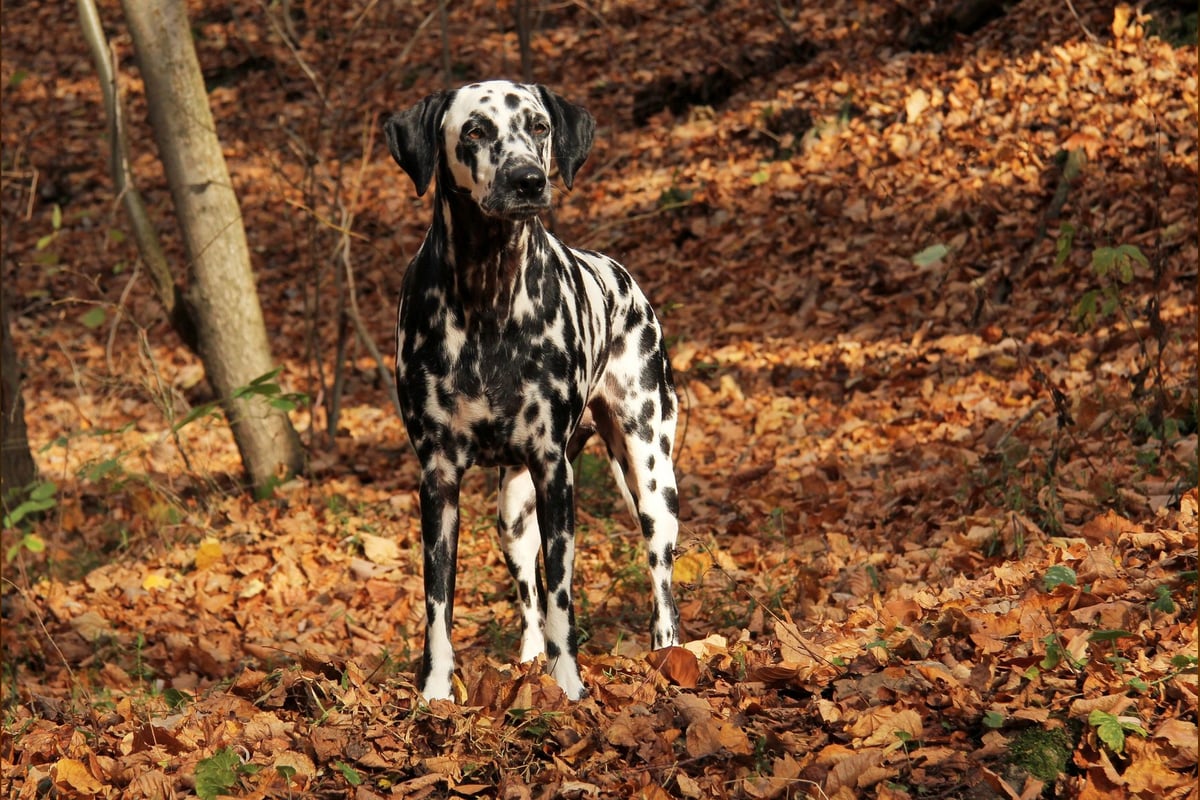
Dalmatian
The Dalmatian (Dalmatinski Pas, FCI 153, Group 6) is a Croatian breed weighing 24 to 32 kg for 54 to 61 cm at the withers, native to Dalmatia (the Adriatic coast of present-day Croatia). Its white coat spotted with black or liver is unique in the canine world: puppies are born entirely white, and the spots appear progressively from the second week of life onward. The breed carries two documented physiological particularities: 100% of individuals show a mutation in uric acid metabolism leading to a high risk of urinary stones, and about 30% show unilateral deafness (5% bilateral) linked to the genetics of white pigmentation.
- Weight
- 24 to 32kg
- Height
- 54 to 61cm
- Life expectancy
- 12years
- Monthly cost
- 80 to 140€
Personality profile
Energy 5/5
Independence 3/5
Trainability 3/5
Good with children 4/5
Barking 3/5
Space needed 3/5
Attachment to home 4/5
Good with strangers 3/5
Good with dogs 3/5
Good with cats 2/5
Coat care 2/5
Exercise needs 5/5
Scores given on measured axes, data confidence: high.
Living with a Dalmatian
Description
A lean, muscular silhouette, typical of an enduring athletic dog: 54 to 61 cm at the withers, 24 to 32 kg, fine bone structure and a straight back. The short, dense coat, pure white, is marked with round, well-defined spots — black in individuals with a black nose, liver brown in individuals with a brown nose. Spots vary from 2 to 3 cm in diameter, distributed without overlapping. The short coat provides little insulation, which explains the breed's cold sensitivity — temperatures below 5 °C require protection for extended outings.

Temperament
An energetic, playful temperament, loyal to its family — it forms deep bonds with its owners and copes poorly with long periods of solitude. It is reserved without being aggressive with strangers, and caution is warranted in introductions to strangers until trust is established. A breed historically selected to run alongside horse-drawn carriages over several dozen kilometers, it has remarkable cardiovascular endurance and a need for intense daily physical exertion. Without long, athletic outings, it develops destructive behaviors out of frustration.
Training
Consistency, play, and positive rewards: coercive methods generate anxiety and are counterproductive on a sensitive breed. Its great endurance capacity predisposes it to intensive dog sports: agility, canicross, bikejoring, dock diving — activities that let it cover several kilometers of daily exercise while stimulating its intelligence. Early socialization before 12 weeks is decisive for calibrating its natural reserve toward strangers. For unilaterally deaf individuals (30% of the population), adapt training signals by including hand commands from the start.

Feeding
240 to 340 g of premium medium-breed kibble a day for a 28 kg adult, in 2 meals. An absolute dietary constraint linked to the genetic uricase mutation: choose a low-purine diet (avoid organ meat, high-density poultry, sardines, foods rich in concentrated animal protein). Fresh water must be freely available and refreshed several times a day to dilute urinary uric acid and prevent crystals. Consult a vet for an annual urinary check-up from age 2.
Affiliate links, no extra cost to you. Legal notice

Living conditions
Apartment living is possible provided it gets at least 2 hours of intense exercise a day — jogging, cycling, swimming, canicross. An apartment without a garden is a demanding setting: the breed needs an athletic owner available morning and evening. Its short, poorly insulating coat makes it sensitive to cold and winter drafts: a dog coat is useful below 5 °C for long walks. On the other hand, its heat tolerance is moderate — avoid intense exercise in direct summer sun and ensure permanent access to shade and fresh water.

Grooming and coat care
The short, dense coat needs little upkeep under normal conditions: weekly brushing with a grooming glove is enough to remove dead hair and stimulate skin circulation. Shedding is, however, heavy and nearly constant — the short white hairs embed themselves in fabrics and carpets more deeply than those of long-coated breeds. Brushing 2 to 3 times a week during seasonal shedding periods (spring and fall) is recommended. No professional grooming necessary; occasional baths with a mild shampoo suited to sensitive skin, given the predisposition to atopy.

Health
Life expectancy of 11 to 13 years. Two genetic particularities specific to the breed. First, a uricase mutation, present in 100% of individuals, causes hyperuricosuria — Dalmatians excrete uric acid instead of allantoin, with a high risk of urinary stones (urolithiasis). A low-purine diet and abundant hydration (fresh water permanently available) are mandatory throughout life. Second, about 30% of individuals show unilateral deafness and 5% bilateral deafness, detectable with the BAER test (Brainstem Auditory Evoked Response) — this test must be performed before adoption. Skin atopy (allergic dermatitis) is also common in the breed.
Breed history
The breed originates in Dalmatia, a coastal region of present-day Croatia on the Adriatic, where depictions of white and black spotted dogs appear as early as the 17th century in frescoes of Croatian churches. Recognized by the FCI under the official name Dalmatinski Pas (FCI standard 153), it entered English popular culture in the 18th century as a 'coach dog' — a carriage dog trotting continuously under the axles of London's aristocratic carriages, capable of covering 50 to 80 km per stage. In the United States, it became in the 19th century the mascot of firehouses (NYC Fire Dogs), running alongside the horses pulling fire pumps. Walt Disney's 1961 animated film, adapted from Dodie Smith's novel (1956), propelled the breed to the rank of a global cultural phenomenon.
Getting ready for your Dalmatian
Five essentials to line up before day one.
Affiliate links, no extra cost to you. Legal notice
FAQ: Dalmatian
Sources
- FCI Standard No 153 — Dalmatian (Dalmatinski Pas) · FCI breed standard 153, Group 6 Scent hounds and related breeds, Section 3 Related breeds
- Société Centrale Canine — Dalmatian · SCC official breed profile for the Dalmatian, Group 6
- AKC Breed Profile — Dalmatian · AKC Dalmatian breed profile, Non-Sporting Group
FCI, Fédération Cynologique Internationale, the world body that has codified breed standards since 1911. FCI number 153 is assigned to the Dalmatian.
Breeds similar to a Dalmatian

