


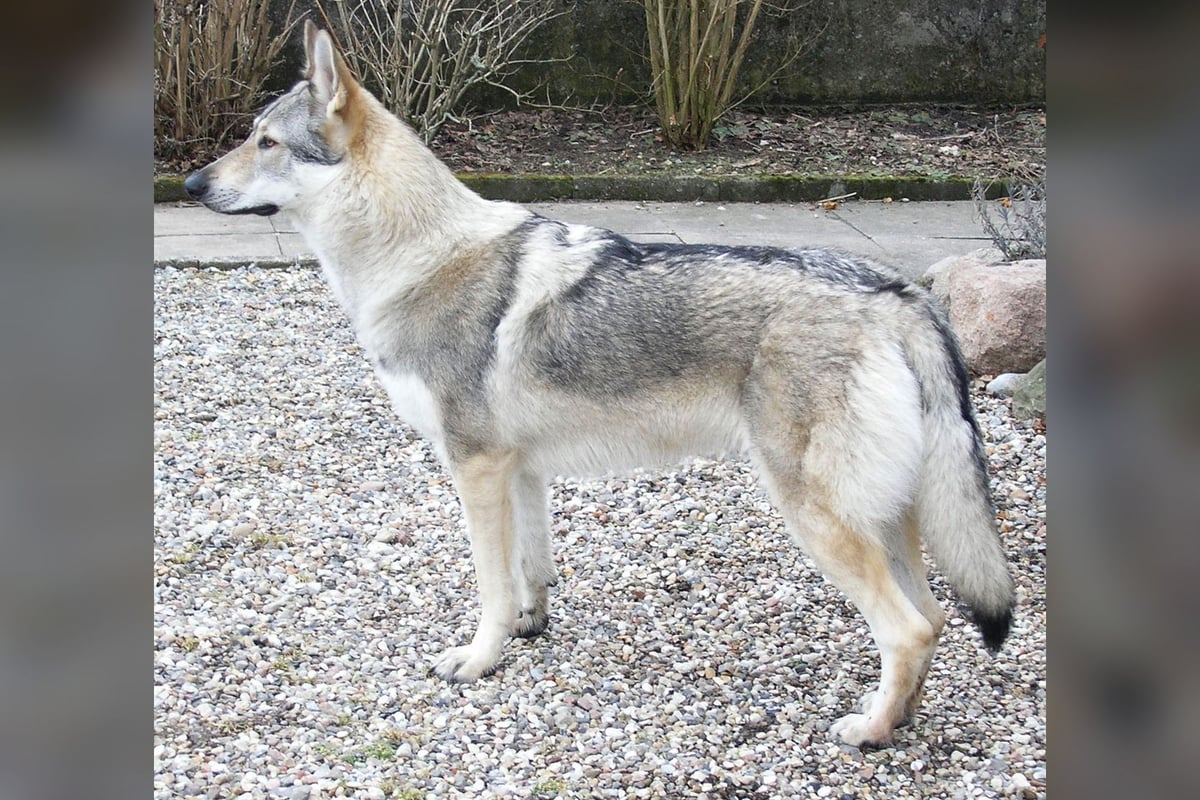
Czechoslovakian Wolfdog
The Czechoslovakian Wolfdog is a hybrid created in 1955 in Czechoslovakia by Karel Hartl, crossing German Shepherd Dogs with the Carpathian she-wolf Brita for border guard units. Recognized by the FCI under number 332 in 1989, it weighs 20 to 29 kg and retains around 11% wolf genome according to current genetic analyses. Its behavior remains deeply primitive: reflexive flight from strangers, near-total absence of barking, nighttime howling, energy 5/5.
- Weight
- 20 to 29kg
- Height
- 60 to 65cm
- Life expectancy
- 13years
- Monthly cost
- 110 to 180€
Personality profile
Energy 5/5
Independence 5/5
Trainability 2/5
Good with children 2/5
Barking 1/5
Space needed 5/5
Attachment to home 3/5
Good with strangers 1/5
Good with dogs 2/5
Good with cats 1/5
Coat care 2/5
Exercise needs 5/5
Scores given on measured axes, data confidence: high.
Living with a Czechoslovakian Wolfdog
Description
A large-sized breed, athletic and muscular, with a build very close to that of the gray wolf. Males stand at least 65 cm at the withers for 26-29 kg, females 60 cm for 20-25 kg. The coat is yellow-gray to silver-gray, identical to that of the Carpathian wolf. Slanted amber or yellow-brown eyes, triangular erect ears carried forward. Elongated muzzle, deep chest, long limbs built for tireless trotting. National standard published in 1982, definitive FCI recognition in 1989.

Temperament
Primitive behavior with pronounced flight reflexes: wary of strangers, immediate bolting under any unfamiliar pressure. It almost never barks — it howls (intra-pack communication typical of wild canids), which makes urban cohabitation difficult with neighbors next door. Exclusive bond with its reference handler, indifference or wariness toward third parties. Mandatory supervision with children due to predatory instinct and reactivity to fast movements.
Training
Very low trainability for classic obedience: the Czechoslovakian Wolfdog does not seek to please and refuses repetitive commands without strong motivation. Requires a handler experienced with primitive breeds, exclusively positive reinforcement (prey play, food), and slow progression over several months. Recall is never reliable outside an enclosed area — the flight instinct overrides conditioning. Suitable activities: mantrailing, canicross, long-distance hiking, scent work.

Feeding
350 to 500 g of premium kibble a day for a 26 kg adult, split into 2 meals. High needs in animal protein (30-35%) to support dense musculature and an endurance metabolism. Some owners practice BARF feeding (20-25% of body weight in raw meat) with good results — the breed handles unprocessed animal protein well, consistent with its heritage. Fresh water at all times, watch hydration in summer.
Affiliate links, no extra cost to you. Legal notice

Living conditions
Not suited to apartment life without a garden: its 5/5 energy and territorial instinct require an enclosed domain with a high, buried fence (it digs under wire fencing). Ideal in rural or peri-urban areas, with daily access to large wild spaces. It withstands harsh winters down to -20 °C thanks to its double coat inherited from the Carpathian wolf. Heat-sensitive above 25 °C during activity — morning and evening outings are mandatory in summer.

Grooming and coat care
Weekly brushing is enough outside the two annual shedding seasons (spring, fall), during which twice-daily brushing for 3 to 4 weeks is necessary. No professional grooming required: the coat cleans itself naturally and resists dirt like the wolf's. Very infrequent baths (2-3 times a year) to preserve protective skin secretions.

Health
A recent population (selection began in 1955) with a narrow genetic base but few bottlenecks: prevalence of hip and elbow dysplasia lower than the average for large breeds according to the Czech breed club of origin. No specific genetic pathology documented at a high rate. Life expectancy 12 to 15 years — long for a dog of this size. Annual eye check recommended, and hip/elbow X-rays of the parents mandatory in serious breeding programs.
Breed history
Project initiated in 1955 by biologist Karel Hartl at the military kennel of Libějovice in Czechoslovakia. The goal: combine the obedience of the German Shepherd Dog with the endurance and cold resistance of the Carpathian wolf to equip Czechoslovakian border guard units. The founding cross used the she-wolf "Brita," captured in the Slovak Carpathians. The F1 generation showed a strong primitive instinct but superior tracking abilities and performance on difficult terrain. The breed was recognized in Czechoslovakia in 1982, then by the FCI under number 332 in 1989. Today it is represented in 30 countries, with about 1 200 annual registrations in Europe.
Getting ready for your Czechoslovakian Wolfdog
Five essentials to line up before day one.
Affiliate links, no extra cost to you. Legal notice
FAQ: Czechoslovakian Wolfdog
Sources
- FCI Standard No 332 — Czechoslovakian Wolfdog · FCI breed standard 332, Group 1 Sheepdogs and Cattledogs, Section 1 Sheepdogs
- SCC — Czechoslovakian Vlcak (Club France) · Société Centrale Canine, official breed profile for the Czechoslovakian Wolfdog, LOF Group 1
FCI, Fédération Cynologique Internationale, the world body that has codified breed standards since 1911. FCI number 332 is assigned to the Czechoslovakian Wolfdog.
Breeds similar to a Czechoslovakian Wolfdog


Belgian Shepherd Dog (Malinois)
Sheepdogs and Cattledogs (except Swiss Cattledogs)
20 to 30 kg