


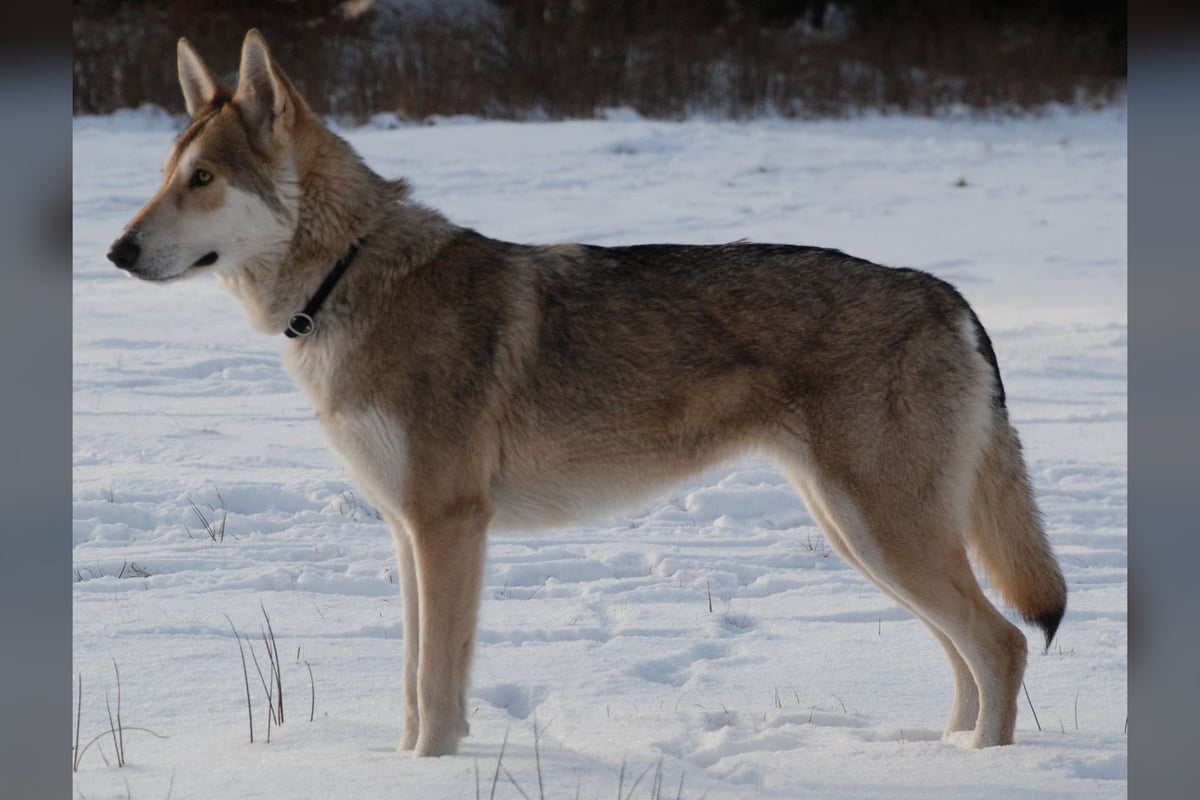
Saarloos Wolfdog
The Saarloos Wolfdog is a Dutch wolf hybrid of 36 to 41 kg at 60 to 75 cm, recognized FCI number 311, created in 1935 by Leendert Saarloos (Netherlands) by crossing a male German Shepherd with a wild European she-wolf named Fleuri. Genetically one of the breeds closest to the wolf, it retains primitive flight and wariness behaviors that restrict it strictly to experienced owners, outside urban settings, and never as a first dog.
- Weight
- 36 to 41kg
- Height
- 60 to 75cm
- Life expectancy
- 11years
- Monthly cost
- 120 to 200€
Personality profile
Energy 5/5
Independence 5/5
Trainability 2/5
Good with children 2/5
Barking 2/5
Space needed 5/5
Attachment to home 3/5
Good with strangers 1/5
Good with dogs 3/5
Good with cats 2/5
Coat care 2/5
Exercise needs 5/5
Scores given on measured axes, data confidence: medium.
Living with a Saarloos Wolfdog
Description
A large, athletic breed with a clearly wolf-like appearance. Males 65-75 cm at 36-41 kg, females 60-70 cm at slightly less. Short to medium coat with a dense undercoat, wolf-gray (gray to tan-brown), wolf-white (cream to white), and forest-wolf (russet brown) colors. Almond-shaped eyes ranging from yellow to brown, an intense and alert gaze. A long body, solid bone structure, supple movement close to a wolf's trot. The build is markedly less domestic-looking than that of the German Shepherd.

Temperament
The Saarloos shows a primitive flight response — its reaction to fear or uncertainty is retreat, not attack. This structural shyness makes it unpredictable in environments with many stimuli (city, transport, crowds): it can panic and bolt if the situation overwhelms it. Reluctant to obey on command despite a physical energy level of 5/5: the Saarloos chooses how and when to spend its energy, rarely on demand. Pronounced wariness of strangers, mandatory caution around visiting children whose unpredictable movements can trigger panic or a sudden flight reaction — constant supervision required in all cases. Low vocalization (wolf-like grunts and whines rather than barking). A strong bond with its narrow family pack.
Training
Training a Saarloos requires a behavior specialist experienced with wolf-type breeds. Coercive methods are counterproductive and worsen the primitive shyness: positive reinforcement only, ultra-short sessions (5-10 minutes), pace set by the dog. Recall is never reliable outside a secure enclosure. Tracking, scent work, and trailing activities suit its psychology best — they engage instinct without imposing frontal obedience. Do not attempt to enroll a Saarloos in classic obedience clubs or ring sports.

Feeding
450 to 600 g of premium kibble a day for a 38 kg adult, in 2 meals. Kibble rich in animal protein (35-40%) suited to a large, very active dog. Some breeders recommend a partial BARF diet to match a digestive profile closer to the wolf's, but this requires close veterinary monitoring. Watch for weight gain: an underexercised Saarloos can put on weight despite its apparently active build.
Affiliate links, no extra cost to you. Legal notice

Living conditions
A rural or semi-rural setting is mandatory, with a large, securely fenced outdoor space (minimum 2 m high, buried 50+ cm to prevent digging). Unsuited to an apartment, the city, or tight spaces. Resistant to cold thanks to its dense undercoat, sensitive to heat above 25 °C. Cannot live alone or tethered: it needs constant contact with its pack mates or family. Prolonged isolation triggers severe anxious behaviors (destruction, self-harm, continuous vocalizing).

Grooming and coat care
Minimal upkeep compared with most working breeds. Monthly brushing under normal conditions, weekly during the two seasonal sheds. The short to medium coat does not mat. Bathe at most twice a year: excessive grooming strips the coat's natural oils and damages the trust relationship with a dog that copes badly with imposed handling. Regularly check the paw pads, which see heavy use on natural terrain.

Health
A genetically fairly healthy breed, benefiting from a wider genetic base thanks to the wolf contribution, which limits the inbreeding seen in purebred lines. Hip dysplasia is documented: ask for the parents' HD test results (ideally A/B). Hereditary degenerative myelopathy (DM) is reported in the line, with a DNA test available. Life expectancy 10 to 12 years. The major health challenges are often indirect: chronic stress in an unsuitable environment, injuries linked to bolting or panic, conditions caused by a diet poorly matched to its active build.
Breed history
Leendert Saarloos, a Dutch breeder, began a crossbreeding program in 1935 in Dordt (Netherlands) between a male German Shepherd (Gerrit van de Fransenum) and a wild European she-wolf caught alive, whom he named Fleuri. His stated goal was to restore to the German Shepherd the hardiness and instinct he believed had been lost through show selection. Subsequent generations revealed a more wolf-like temperament than expected, notably the shyness and reluctance toward conditioned obedience. Saarloos died in 1969 without seeing official recognition; the Dutch Kennel Club (Raad van Beheer) recognized the breed in 1975, with FCI confirmation in 1981. An attempt to use it as a guide dog for the visually impaired was abandoned in the 1970s due to a flight behavior incompatible with that role.
Getting ready for your Saarloos Wolfdog
Five essentials to line up before day one.
Affiliate links, no extra cost to you. Legal notice
FAQ: Saarloos Wolfdog
Sources
- FCI Standard No 311 — Saarloos Wolfdog · FCI breed standard 311, Group 1 Sheepdogs and Cattledogs, Section 1 Sheepdogs
- SCC — Saarloos Wolfdog Breed Profile · Société Centrale Canine, breed profile, Saarloos Wolfdog
- AKC — Saarloos Wolfdog Breed Profile · AKC Saarloos Wolfdog breed profile, Foundation Stock Service
FCI, Fédération Cynologique Internationale, the world body that has codified breed standards since 1911. FCI number 311 is assigned to the Saarloos Wolfdog.
Breeds similar to a Saarloos Wolfdog

Czechoslovakian Wolfdog
Sheepdogs and Cattledogs (except Swiss Cattledogs)
20 to 29 kg
