


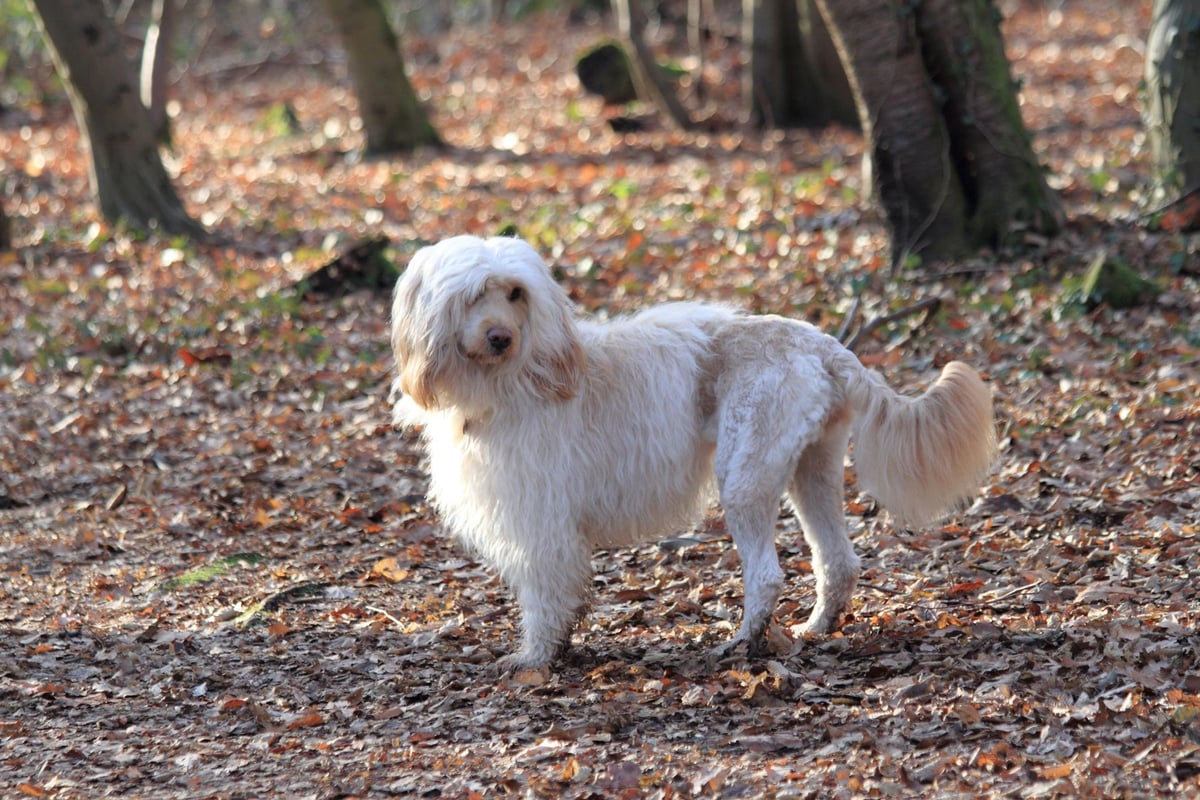
Portuguese Water Dog
The Portuguese Water Dog (Cão de Água Português, FCI 37, Group 8) is an old breed from the Algarve coast, a helper to Portuguese fishermen since the Middle Ages. It came close to extinction in the 20th century, was reconstituted starting in 1937, and was then recognized by the FCI in 1955. It stands 43 to 57 cm at the withers for 16 to 25 kg and is marked by webbed feet, a curly or wavy coat, and the traditional lion clip.
- Weight
- 16 to 25kg
- Height
- 43 to 57cm
- Life expectancy
- 12years
- Monthly cost
- 90 to 160€
Personality profile
Energy 5/5
Independence 3/5
Trainability 5/5
Good with children 4/5
Barking 3/5
Space needed 3/5
Attachment to home 5/5
Good with strangers 3/5
Good with dogs 4/5
Good with cats 3/5
Coat care 4/5
Exercise needs 5/5
Scores given on measured axes, data confidence: high.
Living with a Portuguese Water Dog
Description
Two coat varieties are recognized: the curly variety, with tight, shiny curls, and the wavy variety, with slightly longer, smooth-wavy hair. Accepted colors are black, white, brown, and black-and-white or brown-and-white parti patterns. The webbed feet are a functional anatomical trait directly tied to its sea work — they give it remarkable propulsion and endurance in cold water. The long, tapered tail acts as a rudder while swimming. The traditional lion clip — the front half of the body left long, the rear half clipped short — is not decorative at all: it meets the demands of working in cold water.

Temperament
A breed of constant liveliness: it is always looking for an activity, a challenge, or a game, and gets bored quickly in a too-static environment. With family, it develops a strong, expressive attachment; with children, it is playful and tolerant though its high energy calls for supervision with very young ones. Toward strangers, it stays reserved without being fearful — it observes before accepting. Its barking level is moderate, nothing like a scenthound. It gets along well with other dogs and adapts well to household cats.
Training
One of the most responsive breeds to training: it learns quickly, retains well, and actively seeks to interact with its owner. Dog sport disciplines (agility, obedience, rally obedience, dock diving) suit it perfectly. As with any high-energy breed, sessions must be mentally stimulating enough — an understimulated dog will redirect its intelligence into unwanted behaviors. Hours of intense daily exercise are needed for it to settle into a calm state at home.

Feeding
280 to 380 g of premium kibble a day for a 20 kg adult, in two meals. An active breed with a high metabolism: medium-breed kibble with high protein density suits it better than standard formulas. Periods of intense activity (swimming, agility, work) may call for a temporary increase in rations. Avoid excess weight, which needlessly loads the joints — such an active breed should stay in athletic condition.
Affiliate links, no extra cost to you. Legal notice

Living conditions
Apartment living remains possible provided two hours of intense exercise a day are guaranteed — a short walk is not enough for this breed. Access to water (lake, river, sea, pool) is a considerable bonus for its physical and mental wellbeing. It tolerates cool temperate climates thanks to its insulating coat, but excessive heat should be avoided for intense exercise sessions. A fenced garden is a plus, not an absolute necessity, as long as exercise needs are met through regular outings.

Grooming and coat care
The curly or wavy coat sheds practically nothing — low shedding is a notable feature — but it needs regular brushing and detangling to prevent matting. Professional grooming every 6 to 8 weeks is recommended to keep the coat in good condition, with a clip suited to the chosen variety (traditional lion clip or uniform retriever clip). Drop ears need regular cleaning to prevent ear infections, especially in dogs that swim often.

Health
Life expectancy of 11 to 14 years. Hip dysplasia is the orthopedic condition to watch — serious breeders provide OFA or SCC X-rays. Progressive retinal atrophy (PRA-prcd) is genetically transmissible; a DNA test before breeding is essential. GM-1 gangliosidosis, an autosomal recessive lysosomal storage disease, is also DNA-testable: it is fatal in affected individuals, born from the mating of two carriers. Addison's disease (adrenal insufficiency) is reported in the breed. Responsible breeders systematically test for PRA-prcd and GM-1 before any mating.
Breed history
The presence of water dogs on the Algarve coast is documented from the Middle Ages in the chronicles of Portuguese fishermen, who used them to retrieve nets that fell into the sea, bring back escaped fish, and relay messages between boats up to several hundred meters from shore. With the gradual mechanization of fishing in the early 20th century, the breed nearly disappeared entirely — only a handful of individuals remained by the 1930s. Portuguese industrialist Vasco Bensaude began a methodical reconstitution program in 1937 from a few dogs on the Algarve coast. The Portuguese Water Dog was recognized by the FCI in 1955 under number 37. The breed gained a surge of worldwide recognition between 2009 and 2017: Bo and Sunny, the two Portuguese Water Dogs belonging to the Obamas at the White House, were chosen in part because of Malia Obama's allergies.
Getting ready for your Portuguese Water Dog
Five essentials to line up before day one.
Affiliate links, no extra cost to you. Legal notice
FAQ: Portuguese Water Dog
Sources
- FCI Standard No 37 — Portuguese Water Dog · FCI breed standard 37, Group 8 Retrievers — Flushing Dogs — Water Dogs, Section 3 Water Dogs
- Société Centrale Canine — Portuguese Water Dog · SCC official breed profile, Portuguese Water Dog, Group 8
- AKC Breed Profile — Portuguese Water Dog · AKC Portuguese Water Dog breed profile, Working Group
FCI, Fédération Cynologique Internationale, the world body that has codified breed standards since 1911. FCI number 37 is assigned to the Portuguese Water Dog.
Breeds similar to a Portuguese Water Dog

