


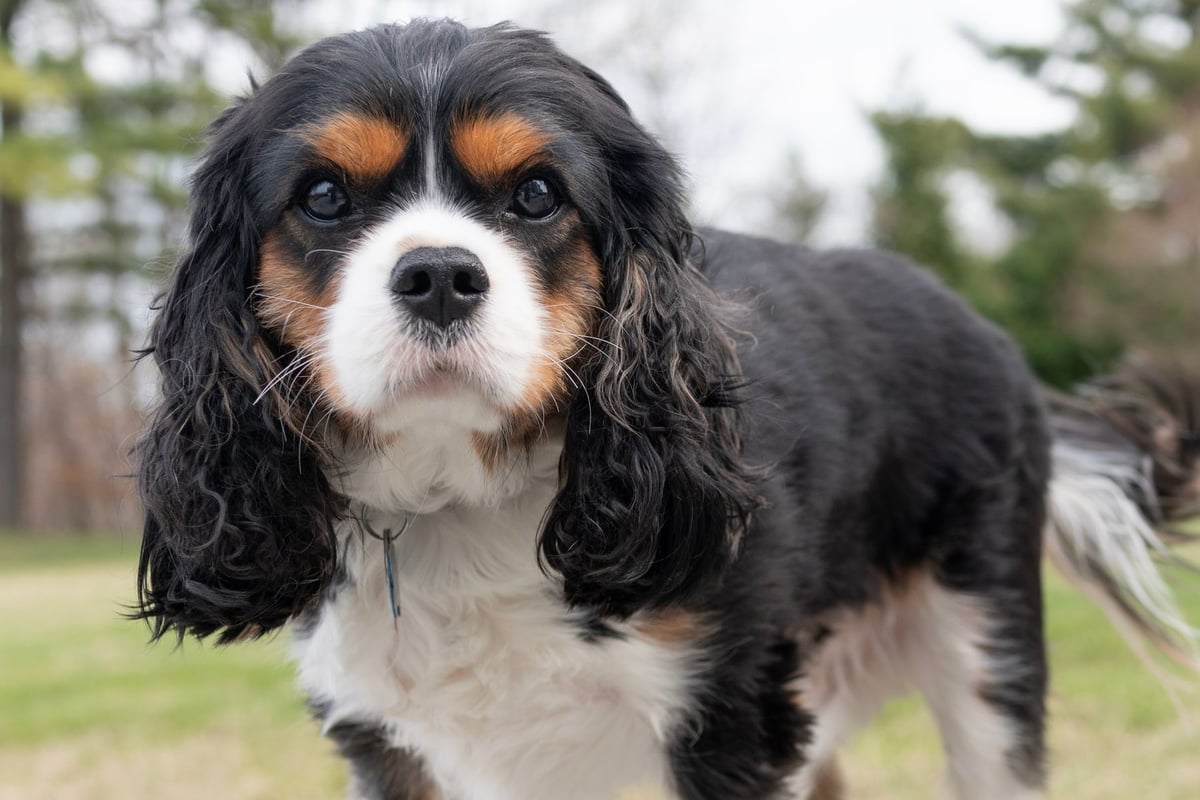
Cavalier King Charles Spaniel
The Cavalier King Charles Spaniel is a British toy spaniel reconstituted in the 1920s, weighing 5.4 to 8.2 kg at 30 to 33 cm at the withers. Recognized FCI number 136, it combines an extreme velcro attitude — it is one of the breeds most prone to separation anxiety — with a median life expectancy shortened to 10-11 years due to hereditary mitral valve disease, which affects 100% of individuals past age 10.
- Weight
- 5.4 to 8.2kg
- Height
- 30 to 33cm
- Life expectancy
- 11years
- Monthly cost
- 70 to 120€
Personality profile
Energy 3/5
Independence 1/5
Trainability 4/5
Good with children 5/5
Barking 2/5
Space needed 1/5
Attachment to home 5/5
Good with strangers 5/5
Good with dogs 5/5
Good with cats 5/5
Coat care 4/5
Exercise needs 3/5
Scores given on measured axes, data confidence: high.
Living with a Cavalier King Charles Spaniel
Description
A toy breed with a moderately long silky coat, official colors are Blenheim (chestnut-white), tricolor, ruby (solid red), or black-and-tan. Rounded head with large expressive dark eyes, long high-set ears, tail carried gaily and horizontally. Noticeably more athletic than its appearance suggests: it descends from hunting spaniels and retains an instinct to chase birds and butterflies.

Temperament
Hyper-attached to one reference person, it follows its owner from room to room. Separation anxiety is present in 60-70% of individuals from as little as 4 hours alone. Barks little but may signal a doorbell. Sociable with absolutely everyone: children, dogs, cats, strangers — a poor guard dog by design. Playful up to 8-10 years old, not particularly energetic but enjoys short play sessions.
Training
Good trainability (top 50 according to Coren), eager to please and motivated as much by food as by human contact. Positive reinforcement exclusively: it shuts down completely under any pressure. Short sessions of 5-10 minutes, 2-3 times a day. Housetraining learned quickly (3-4 weeks on average). Not suited to technical disciplines (agility, IGP) but excellent for pet therapy.

Feeding
120 to 180 g of premium kibble a day for a 7 kg adult, split into 2 meals. A breed with a strong propensity for obesity — always weigh the ration, treats strictly counted (10% of calories max). Excess weight dramatically worsens MVD and shortens life expectancy by 1 to 2 years.
Affiliate links, no extra cost to you. Legal notice

Living conditions
A breed built for indoor life: a studio, urban apartment, or house all suit it equally, as long as it is with its people. Suited to apartments under 30 m² thanks to its modest size. Avoid temperature extremes: a medium coat protects it neither from cold below 5 °C (a coat is helpful) nor from heat, being sensitive above 28 °C.

Grooming and coat care
Brush 2 to 3 times a week to prevent tangles in the feathering (ears, culottes, belly, tail). Optional professional grooming every 2-3 months to even things out. Bathe monthly at most, with a gentle shampoo for sensitive skin. Bi-weekly inspection of the closed long ears (frequent ear infections) and the facial folds.

Health
A breed heavily marked by 2 severe hereditary conditions. Mitral valve disease (MVD): 50% of individuals have a murmur by age 5, 100% past age 10, the leading cause of death. Syringomyelia (Chiari-like malformation, CM/SM): 70% of Cavaliers show an occipital malformation, 30-50% develop chronic neurological pain. Annual cardiac ultrasound from age 3 plus a brain MRI recommended if scratching-at-air behavior or unexplained yelping occurs.
Breed history
The breed was reconstituted in the 1920s-1930s by American breeder Roswell Eldridge, who in 1926 offered a prize of 25 pounds sterling to the British breeder presenting a King Charles Spaniel most closely resembling the dogs in 17th-century royal portraits (a longer muzzle, without the brachycephaly introduced in the 19th century). The FCI standard was set in 1955 under the name Cavalier King Charles Spaniel to distinguish it from the original King Charles Spaniel (FCI 128). Imported to France in the 1970s, it ranked in the top 20 of LOF registrations in 2025.
Getting ready for your Cavalier King Charles Spaniel
Five essentials to line up before day one.
Affiliate links, no extra cost to you. Legal notice
FAQ: Cavalier King Charles Spaniel
Sources
- FCI Standard No 136 · FCI breed standard 136, Group 9 Companion and Toy Dogs
- AKC Breed Profile · AKC Cavalier King Charles Spaniel breed profile, Toy Group
FCI, Fédération Cynologique Internationale, the world body that has codified breed standards since 1911. FCI number 136 is assigned to the Cavalier King Charles Spaniel.
Breeds similar to a Cavalier King Charles Spaniel

