


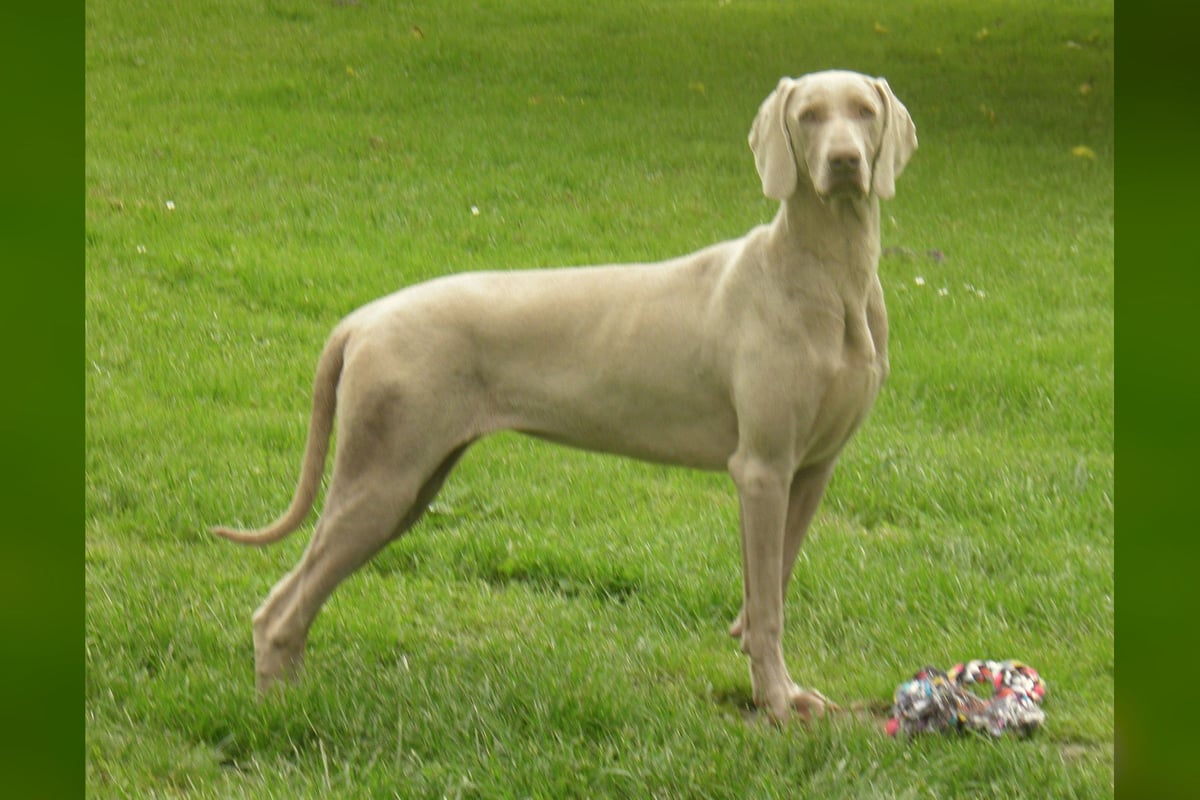
Weimaraner
The Weimaraner weighs 25 to 40 kg for 57 to 70 cm at the withers — a German pointing dog with a unique silver-gray coat, FCI number 99, Group 7. Bred exclusively in the duchy of Weimar in the early 19th century under Grand Duke Karl August von Sachsen-Weimar-Eisenach, initially for hunting big game (deer, wild boar, bear). The Weimaraner Club of Germany kept a closed studbook until 1929, banning any export without approval. Life expectancy is 11 to 14 years; gastric dilatation-volvulus is a risk to watch closely, with an estimated lifetime prevalence of 20-25%.
- Weight
- 25 to 40kg
- Height
- 57 to 70cm
- Life expectancy
- 12years
- Monthly cost
- 90 to 150€
Personality profile
Energy 5/5
Independence 3/5
Trainability 4/5
Good with children 4/5
Barking 3/5
Space needed 5/5
Attachment to home 4/5
Good with strangers 3/5
Good with dogs 3/5
Good with cats 2/5
Coat care 1/5
Exercise needs 5/5
Scores given on measured axes, data confidence: high.
Living with a Weimaraner
Description
A large, compact and powerful pointing dog with a silhouette unlike any other hunting breed. A unique color: uniform mouse-gray to silver-gray — the back sometimes slightly darker than the flanks. Almond-shaped eyes, blue-gray to slate blue in puppies, turning amber or hazel in adults — no other pointing breed shows this color shift. A long, noble head with a moderate stop, wide ears of medium length. Short, dense, glossy coat (the common variety); a long-haired variety recognized by the FCI also exists (3-5 cm coat, feathering on the legs and tail). Pronounced sexual dimorphism: males 30-40 kg (62-70 cm), females 25-35 kg (57-65 cm).

Temperament
A working dog with high operational intelligence — it actively seeks a job, and without structured activity it invents its own (methodical destruction, planned escapes). Courageous when facing big game, with a natural guarding instinct more developed than in most pointing breeds: wary of strangers, it checks them out before accepting them. Good with the household's children, but its size (up to 40 kg) and energy level call for supervision with children under 8. Its potential dominance toward other male dogs requires rigorous early socialization from 8 weeks.
Training
Solid trainability (score 4/5) but requires a consistent, experienced handler — it tests limits and capitalizes on the slightest inconsistency in training. Learns a new command in 15 to 25 repetitions with food or play-based positive reinforcement. Recall is the critical exercise: the big-game hunting instinct remains strong and can override verbal commands within range of a fresh scent. Practice recall on a long line in environments rich in scent stimuli during the first 12 months. Excellent results in Ring sport, agility, canicross and tracking sports — its physical strength and endurance allow it long, intense efforts.

Feeding
400 to 550 g of premium kibble (28-32% animal protein) a day for a 30-35 kg adult, split strictly into 2 meals. GDV prevention: never feed right before or within 2 hours after intense exercise. Avoid elevated food bowls — the 1995-2004 studies by Dr. Larry Glickman (Purdue University) identify raised bowls as a factor that worsens GDV risk in large, deep-chested breeds. Controlled growth until 18-24 months: large-breed junior kibble limits the risk of joint problems.
Affiliate links, no extra cost to you. Legal notice

Living conditions
Not suited to apartment life: its exercise needs reach at least 2 hours a day, including at least one session of intense effort (galloping, swimming, structured dog sport). A house with a fenced garden is essential; a large free-running space is recommended (countryside or urban outskirts). A fence at least 2 m high is advised — an excellent jumper, and a formidable climber once a scent trail motivates it. A breed created for work in forests and dense terrain: it tolerates moderate cold thanks to its build, but stays sensitive to temperatures below 0 °C because of its short coat.

Grooming and coat care
Very low maintenance thanks to the short coat with no dense undercoat. Weekly brushing with a rubber grooming glove is enough to remove dead hair and keep the silver sheen of the coat. Bathe every 4 to 6 weeks, or after each work session in wet terrain. Check the ears after every outing — the medium-sized ears slightly reduce ventilation; weekly preventive cleaning is recommended. Trim nails every 4 weeks if the dog does not wear them down naturally on hard ground. The long-haired variety needs brushing 2-3 times a week to untangle the feathering.

Health
Gastric dilatation-volvulus (GDV) is the most well-documented life-threatening risk in the breed: its deep chest places it among the breeds with high prevalence (estimated at 20-25% over a lifetime). Two split meals are mandatory, with strict 2-hour rest before and after exercise. Hip and elbow dysplasia are screenable via OFA/PennHIP X-rays — require results from both parents. A skin condition to watch: amelanotic melanoma, a pigment-free tumor that is therefore harder to spot on a gray coat — monthly skin inspection recommended. Recessive hereditary hypotrichosis (puppies with abnormally sparse coat, fragile skin) — rare but documented in the breed.
Breed history
The breed owes its name and existence to the duchy of Weimar: Grand Duke Karl August von Sachsen-Weimar-Eisenach (1757-1828) is said to have developed the first breeding standard, selecting gray dogs for hunting large forest game — deer, wild boar and the declining brown bear. Its genetic origins remain debated: presumed crosses with the German Bloodhound, the German Shorthaired Pointer, and gray sighthounds for the coat color. The Weimaraner Club of Germany, founded in 1897, kept a tightly closed studbook until 1929 — every export required the club's approval, preserving the breed's unique build for more than thirty years. The breed took root in the United States starting in 1929 thanks to sportsman Howard Knight, admitted to the German club, who obtained the first dogs authorized to leave the country and founded the American line. Recognized by the FCI under number 99, Group 7 (Pointing Dogs, Section 1.1 — Continental Pointing Dogs, Braque type).
Getting ready for your Weimaraner
Five essentials to line up before day one.
Affiliate links, no extra cost to you. Legal notice
FAQ: Weimaraner
Sources
- FCI Standard No 99 — Weimaraner · FCI breed standard 99, Group 7 Pointing Dogs, Section 1.1 Continental Pointing Dogs, type Braque, recognized 1960, last revision 1998
- AKC Breed Profile — Weimaraner · AKC Weimaraner breed profile, Sporting Group — weight 55-90 lbs, height 23-27 inches, lifespan 10-13 years, recognized AKC 1943
- Société Centrale Canine — Weimaraner · SCC breed profile, Group 7, Section 1, Weimaraner, FCI number 99
FCI, Fédération Cynologique Internationale, the world body that has codified breed standards since 1911. FCI number 99 is assigned to the Weimaraner.
Breeds similar to a Weimaraner

