


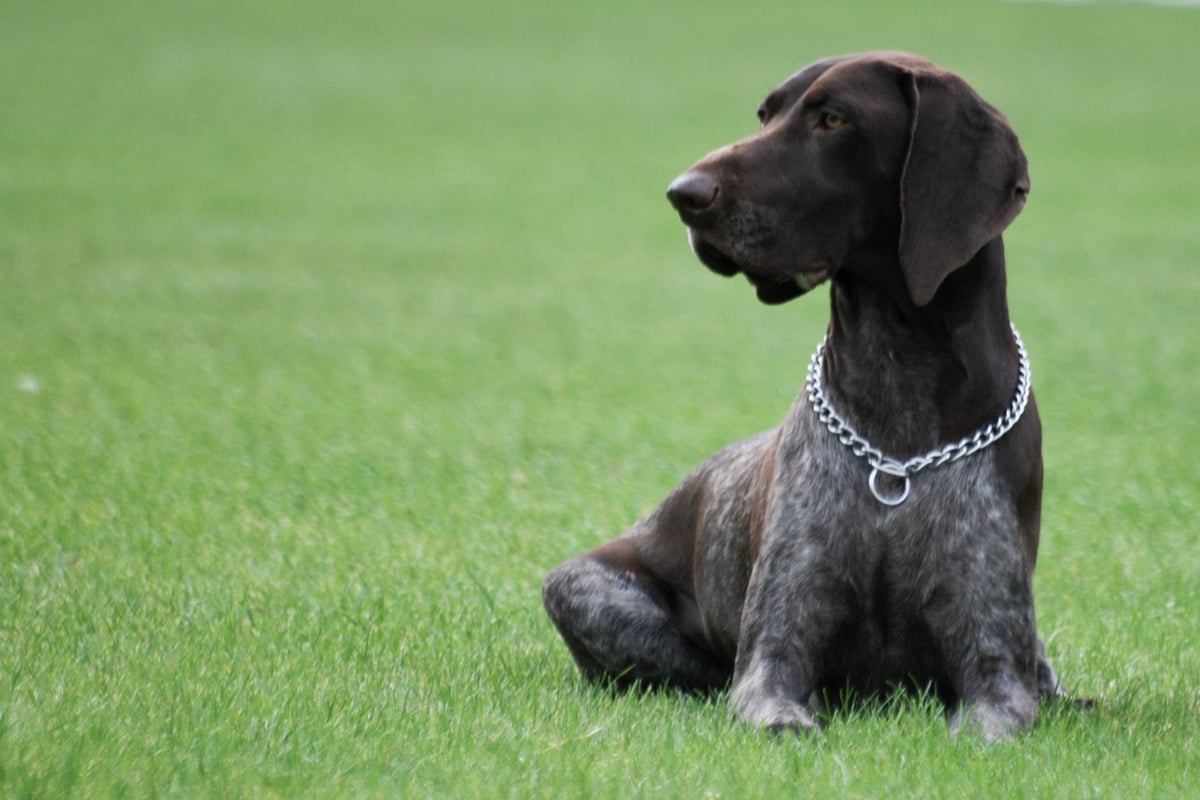
German Shorthaired Pointer
The German Shorthaired Pointer (Deutsch Kurzhaar, FCI 119, Group 7) is a versatile German pointing breed weighing 25 to 32 kg for 58 to 66 cm at the withers, with a life expectancy of 12 to 14 years. Developed in the late 19th century according to the German concept of 'Vollgebrauchshund' (all-purpose utility dog), it hunts feathered game, furred game and waterfowl alike. Its first standard dates to 1879, and it has regularly ranked in the top 10 most popular breeds in the United States since the 2010s. It is the short-haired branch of a trio that also includes the Drahthaar (FCI 98, wire-haired) and the Langhaar (FCI 117, long-haired).
- Weight
- 25 to 32kg
- Height
- 58 to 66cm
- Life expectancy
- 13years
- Monthly cost
- 90 to 160€
Personality profile
Energy 5/5
Independence 3/5
Trainability 5/5
Good with children 5/5
Barking 3/5
Space needed 4/5
Attachment to home 5/5
Good with strangers 4/5
Good with dogs 4/5
Good with cats 2/5
Coat care 1/5
Exercise needs 5/5
Scores given on measured axes, data confidence: high.
Living with a German Shorthaired Pointer
Description
The coat is short, dense and smooth, lying close to the body — making it one of the lowest-maintenance breeds among pointing dogs. Recognized colors are solid liver, liver roan, white-liver and solid or roan black. An athletic, balanced build: a deep chest, a short, muscular back, and sturdy limbs suited to both swimming and running on varied terrain. Its versatile build — a Pointer's speed, ease in water, a keen nose — is the direct result of a methodical selection program.

Temperament
Tireless both at work and at home, it displays one of the highest energy levels among pointing breeds. Deeply attached to its family, it shows a pronounced velcro-dog side and tolerates prolonged isolation poorly. It is a strong swimmer and readily seeks out water, making it an effective marsh dog. Its hunting instinct is strong and directed: small fleeing animals — unfamiliar cats, rabbits, squirrels — trigger an instinctive chase that is hard to interrupt without solid recall training.
Training
It is one of the most receptive pointing breeds to training: its high motivation and attachment to humans make learning basic commands easy from the first weeks. Regular sporting sessions — dog sport, tracking, retrieving, long walks of several kilometers on varied terrain — are needed to maintain behavioral balance. Without enough physical and mental exertion, unwanted behaviors (destruction, barking, hyperactivity) appear quickly. Its strong hunting instinct requires solid, reliable recall training before any off-leash outing in an unenclosed area.

Feeding
An active adult of 28 to 30 kg eats between 280 and 360 g of premium large-breed kibble a day, split into two meals. For individuals used for hunting or intensive dog sport (canicross, agility), caloric needs can rise by 20 to 30% in season. Large-breed junior kibble with a suited calcium-phosphorus ratio is recommended during growth, up to 18-20 months, to support bone development. The one-hour digestive rest after meals is non-negotiable to limit the risk of gastric dilatation-volvulus.
Affiliate links, no extra cost to you. Legal notice

Living conditions
A house with a garden and regular access to large spaces are essential to cover its exercise needs — at least two hours of intense physical activity a day. An apartment, even a spacious one, is unsuited without a very strong commitment to daily outdoor outings. Canicross, bikejoring, or hunting in season are natural outlets to channel its energy. Its short coat offers limited thermal protection in severe cold: a coat may be useful below 0 °C for prolonged outings.

Grooming and coat care
Coat upkeep is minimal: weekly brushing with a rubber brush or grooming glove is enough to remove dead hair and stimulate skin circulation. Shedding is moderate but steady — plan for more frequent vacuuming during the spring shed. The drop ears must be inspected and cleaned weekly to prevent ear infections, especially after swimming or outings on wet terrain. Nails grow quickly in dogs with little activity on hard ground — a monthly trim is recommended.

Health
Life expectancy is 12 to 14 years. Hip dysplasia and elbow dysplasia are the most frequently reported orthopedic conditions — responsible breeders provide an official X-ray reading of breeding stock (FCI rating A to E, or OFA score). Progressive retinal atrophy (PRA) is a hereditary eye degeneration for which a DNA test is available. Exfoliative lupoid dermatosis, an autoimmune disease specifically described in the Deutsch Kurzhaar, causes scaling and recurring skin lesions. Gastric torsion is a real risk at this size: two strict daily meals and an hour's rest after each meal are essential.
Breed history
The breed emerged from a methodical selection program carried out in Germany in the second half of the 19th century, with the goal of creating a universal pointing dog able to hunt all types of game on all types of terrain. Documented crosses combine the Spanish Pointer (morphological base) with the Bracco Italiano, the Hanoverian Hound (for tracking) and the English Pointer (for speed and airborne scent). The first breed standard was set in 1879. The 'Vollgebrauchshund' concept — all-purpose utility dog — still guides German breeders' selection today, who evaluate their breeding stock on combined trials covering hunting, water, tracking and obedience.
Getting ready for your German Shorthaired Pointer
Five essentials to line up before day one.
Affiliate links, no extra cost to you. Legal notice
FAQ: German Shorthaired Pointer
Sources
- FCI Standard No 119 — German Shorthaired Pointing Dog · FCI breed standard 119, Group 7 Pointing Dogs
- Société Centrale Canine — Braque Allemand à Poil Court · SCC official breed profile Braque Allemand à Poil Court, Group 7
- AKC Breed Profile — German Shorthaired Pointer · AKC German Shorthaired Pointer breed profile, Sporting Group
FCI, Fédération Cynologique Internationale, the world body that has codified breed standards since 1911. FCI number 119 is assigned to the German Shorthaired Pointer.
Breeds similar to a German Shorthaired Pointer

