


Bernese Mountain Dog
Pinscher and Schnauzer - Molossoid and Swiss Mountain and Cattledogs
36 to 50 kg
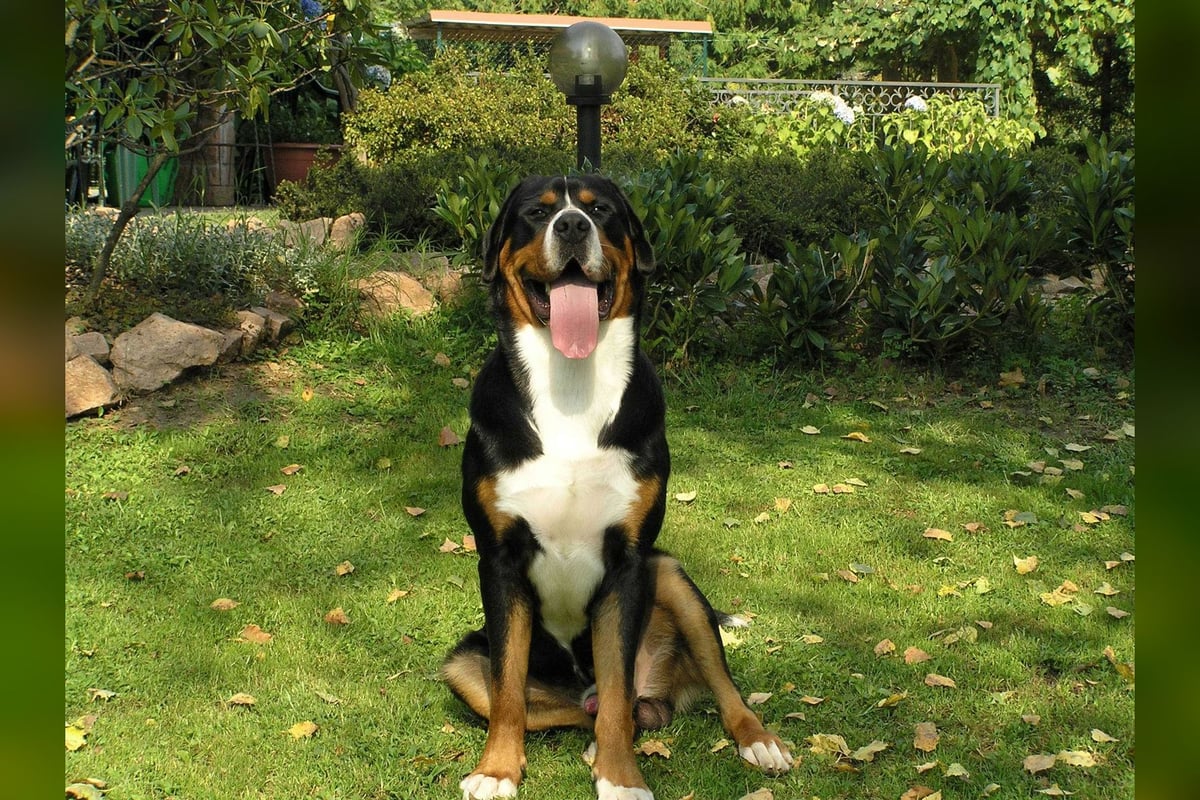
The Great Swiss Mountain Dog (Großer Schweizer Sennenhund, FCI 58) is the largest and oldest of the four Swiss Sennenhunds — ahead of the Bernese Mountain Dog, the Appenzeller and the Entlebucher. Males 60-72 cm for 55-70 kg, females 60-69 cm for 50-60 kg: it is a giant, short-coated breed, recognizable by its tricolor black/tan/white coat identical to the Bernese Mountain Dog's but without the long hair. Nearly extinct in the early 20th century, it owes its survival to the cynologist Albert Heim, who rediscovered it in 1908 at a show in Langenthal and secured its official recognition in 1909. A rare breed in France, with an estimated 50 to 100 LOF births a year.
Scores given on measured axes, data confidence: high.
Living with a Great Swiss Mountain Dog
A massive, balanced silhouette: broad bone structure, a powerful head, a deep chest and a well-muscled back. The short, dense coat contrasts with the long-coated Bernese Mountain Dog — a clear advantage for upkeep despite a comparable size. The tricolor coat is distributed with black covering the back and head, tan markings above the eyes and on the legs, and white on the muzzle, chest and paw tips. The gaze is gentle and attentive, reflecting a calm temperament developed for herding work and pulling carts on Swiss alpine farms.

Calm, steady and solidly anchored in its family: it forms a deep attachment to its household, patient with children of all ages and tolerant of other animals in the domestic group. Its deep, powerful bark serves as a natural alert signal when faced with a stranger — it is not a nervous or aggressive dog, but a guardian that signals. Toward strangers, it is reserved without being hostile, and softens with early socialization carried out before the 14th week.
A receptive breed, eager to work with its owner — its low independence (2/5) translates into more natural obedience than in independent guarding breeds. Positive methods applied consistently give solid results from the first weeks; basic recall and leash walking are learned without difficulty. Early socialization (puppies between 8 and 14 weeks) is decisive to calibrate its natural reserve toward strangers. 45 to 60 minutes of daily active walking is enough for a balanced adult.

400 to 600 g of premium giant-breed kibble a day for a 60 kg adult, in 2 strict meals — never a single meal for a dog prone to gastric torsion. Giant-breed feeding up to 24 months to support slow, controlled bone growth. Glucosamine and chondroitin introduced from age 5 as preventive joint support. Food budget estimated between 60 and 90 €/month depending on kibble quality.
Affiliate links, no extra cost to you. Legal notice

A giant breed of 50 to 70 kg that needs a house with generous space and, ideally, an enclosed garden of at least 500 m² — an apartment is unsuited to an animal of this size and this moderate energy level. Its cold tolerance is excellent thanks to its alpine origins, but its low heat tolerance requires constant access to shade, fresh water and limited exertion in summer. During heatwaves (>28 °C), long outings should be avoided.

The short coat clearly simplifies upkeep compared with long-coated breeds of equivalent size: weekly brushing is enough in quiet periods. The spring seasonal shed intensifies over 3 to 4 weeks and requires brushing 2 to 3 times a week to manage dead hair. No professional grooming required — a quarterly bath, or one after a messy activity, is sufficient. Nail check roughly every 6 weeks, given that its weight wears them down unevenly.

Life expectancy of 8 to 11 years, short even compared with other giant breeds — a point to factor in before adopting. The main conditions are hip and elbow dysplasia (OFA X-ray screening recommended for breeding stock), gastric dilatation-volvulus (split meals into 2 servings with an hour's rest after eating mandatory at this size), osteochondritis dissecans of the shoulder (OCD), and idiopathic epilepsy reported in certain lines. Growth is slow until 18-24 months — intense exercise should be limited in puppies.
Its origins are thought to trace back to Roman mastiffs crossed with local alpine farm dogs during the conquest of Gaul and Helvetia — common ancestors of the four Swiss Sennenhunds. Nicknamed 'Metzgerhund' (butcher's dog), it pulled butcher carts and drove cattle to market in the Swiss Alps until the 19th century. Industrialization nearly erased it: by the early 20th century, it was almost impossible to find. Swiss cynologist Albert Heim rediscovered it in 1908 at a dog show in Langenthal, distinguished it from the short-coated Bernese Mountain Dog, and secured its official recognition as a distinct breed in 1909; the FCI, created in 1911, would register it under number 58. The breed remains rare outside of Switzerland and Germany.
Five essentials to line up before day one.
Affiliate links, no extra cost to you. Legal notice
FCI, Fédération Cynologique Internationale, the world body that has codified breed standards since 1911. FCI number 58 is assigned to the Great Swiss Mountain Dog.
Pinscher and Schnauzer - Molossoid and Swiss Mountain and Cattledogs
36 to 50 kg

Pinscher and Schnauzer - Molossoid and Swiss Mountain and Cattledogs
65 to 90 kg

Pinscher and Schnauzer - Molossoid and Swiss Mountain and Cattledogs
45 to 70 kg