


Bernese Mountain Dog
Pinscher and Schnauzer - Molossoid and Swiss Mountain and Cattledogs
36 to 50 kg
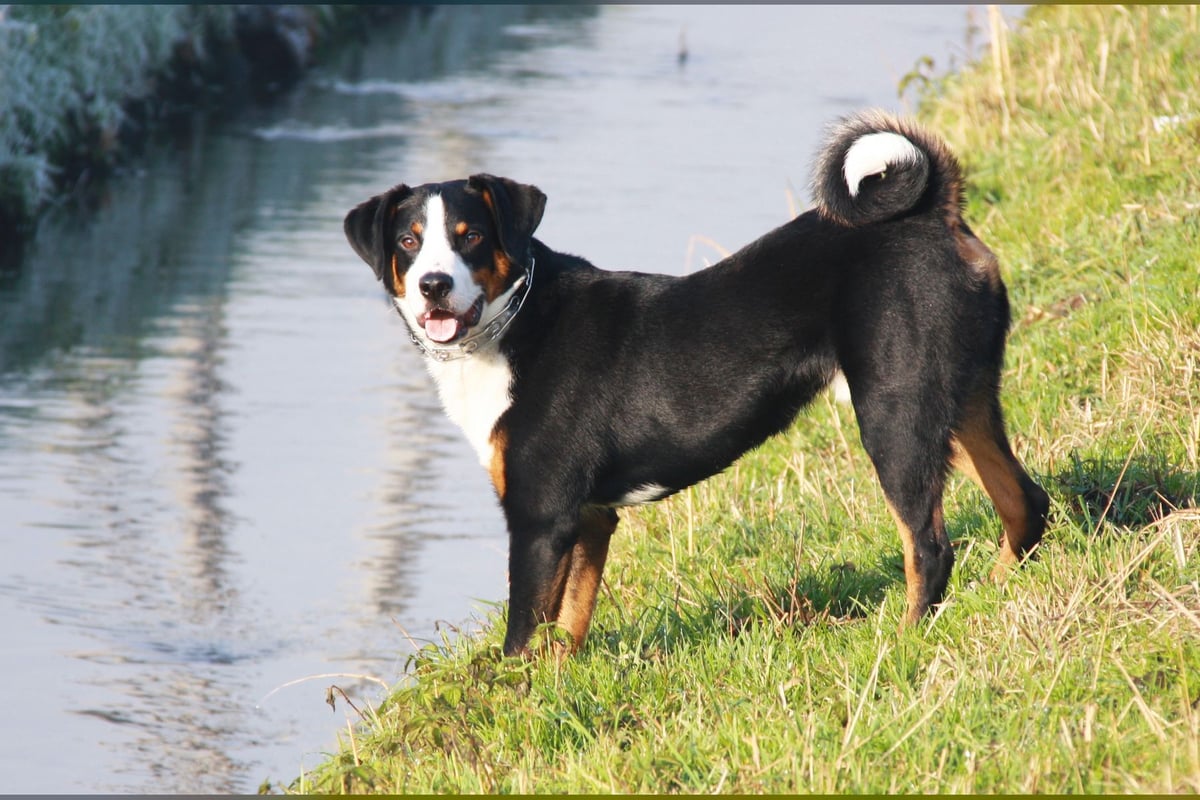
The Appenzell Cattle Dog (Appenzeller Sennenhund, FCI 46) occupies the medium size class among the four Swiss Sennenhunds, between the Entlebucher and the Bernese Mountain Dog, weighing 22 to 32 kg for 48 to 58 cm at the withers. Originally from the canton of Appenzell in northeastern Switzerland, for centuries it was the cattle-driving dog of the alpine pastures, also used for guarding and light draft work. Its tricolor black-tan-white coat and its tail tightly curled over its back are its distinctive visual traits. Life expectancy is remarkable: 12 to 15 years. A rare breed outside Switzerland — around 150 annual LOF registrations in France.
Scores given on measured axes, data confidence: high.
Living with an Appenzell Cattle Dog
Tricolor coat mandatory: a black base with tan (rust) and white markings arranged symmetrically — a chocolate-tan-white variant is also recognized by the FCI standard. Short to medium-length coat, dense and close-lying, without excessive undercoat. The tail is carried tightly curled over the back, a morphological trait typical of the breed. Compact bone structure and developed musculature on a medium frame; lighter and more mobile than the Bernese Mountain Dog, stockier than the Border Collie. Males 52-58 cm for 25-32 kg, females 48-54 cm for 22-28 kg.

An extremely lively and energetic breed, far removed from the placid temperament of the Bernese Mountain Dog, with which it is sometimes wrongly confused. The Appenzeller is an active working dog, vocal and alert — it barks to signal any suspicious movement on its territory and maintains constant vigilance. Very attached to its family, it is wary and distant with strangers without being fearful; its guarding instinct is naturally pronounced and expresses itself from a very young age. With the children of the household it is playful and affectionate, though its intense energy calls for supervision around very young children.
An intelligent, responsive breed, but one that needs an owner able to channel an extreme energy level. Learning the basics (sit, down, recall, leash walking) is fast if sessions are short — 10 to 15 minutes maximum — and varied. Without prior intense physical exercise (long walks, sport, ball games), it arrives at a session too worked up to concentrate. The Appenzeller excels at agility, herding and canicross — disciplines that combine physical exertion and mental stimulation, and in which it naturally performs well.

220 to 320 g of premium medium-breed kibble a day for a 26 kg adult, in two meals. Medium-breed kibble suited up to 15-18 months to support growth. Its high energy expenditure may justify a slightly larger ration during periods of intense activity (agility, canicross, alpine grazing season). Glucosamine and chondroitin recommended from 6-7 years for joint prevention.
Affiliate links, no extra cost to you. Legal notice

A breed unsuited to apartment life: its energy level and vocal guarding instinct make it a problematic tenant in dense urban settings. A house with an enclosed garden is essential, ideally in a rural or semi-rural area where it can freely express its need for movement. It demands several hours of intense exercise a day — simple leash walks are not enough. Its double coat lets it live outdoors in cold weather, but summer heat above 28 °C is hard on it: access to shade and fresh water is mandatory in summer, with exercise limited to cooler hours.

Minimal upkeep: the short to medium coat requires only weekly brushing outside of shedding season. The spring seasonal shed causes moderate hair loss for two to three weeks — twice-weekly brushing with a bristle brush is enough. No professional grooming required. Ears to be checked monthly. The dark-based tricolor coat hides mud and light dirt, reducing bathing needs: two to three baths a year are generally sufficient.

Life expectancy of 12 to 15 years — among the longest of the Swiss mountain dogs. Hip and elbow dysplasia: recommended monitoring, moderate prevalence; serious breeders provide X-rays of breeding stock. Progressive retinal atrophy (PRA) documented in certain lines — a genetic test is available. Hearing loss has been reported in the breed without precise identification of the underlying genetic mechanism. Occasional skin allergies. The overall health profile remains robust, with few serious genetic diseases.
Four breeds make up the family of Swiss mountain dogs (Sennenhunds), in ascending order of size: the Entlebucher, the Appenzeller, the Bernese Mountain Dog, and the Great Swiss Mountain Dog. A versatile working dog from the canton of Appenzell since the Middle Ages, it drove cattle in the alpine pastures, guarded farms and helped pull small carts. The first written mention dates to 1853 in a work by Friedrich von Tschudi on Swiss alpine wildlife. The breed club was founded in 1906, and the FCI recognized the Appenzeller Sennenhund under number 46. The breed has remained rare outside Switzerland — the AKC has placed it in its Foundation Stock Service (FSS) program pending full recognition.
Five essentials to line up before day one.
Affiliate links, no extra cost to you. Legal notice
FCI, Fédération Cynologique Internationale, the world body that has codified breed standards since 1911. FCI number 46 is assigned to the Appenzell Cattle Dog.
Pinscher and Schnauzer - Molossoid and Swiss Mountain and Cattledogs
36 to 50 kg

Pinscher and Schnauzer - Molossoid and Swiss Mountain and Cattledogs
50 to 70 kg

Sheepdogs and Cattledogs (except Swiss Cattledogs)
14 to 23 kg