


Picardy Sheepdog
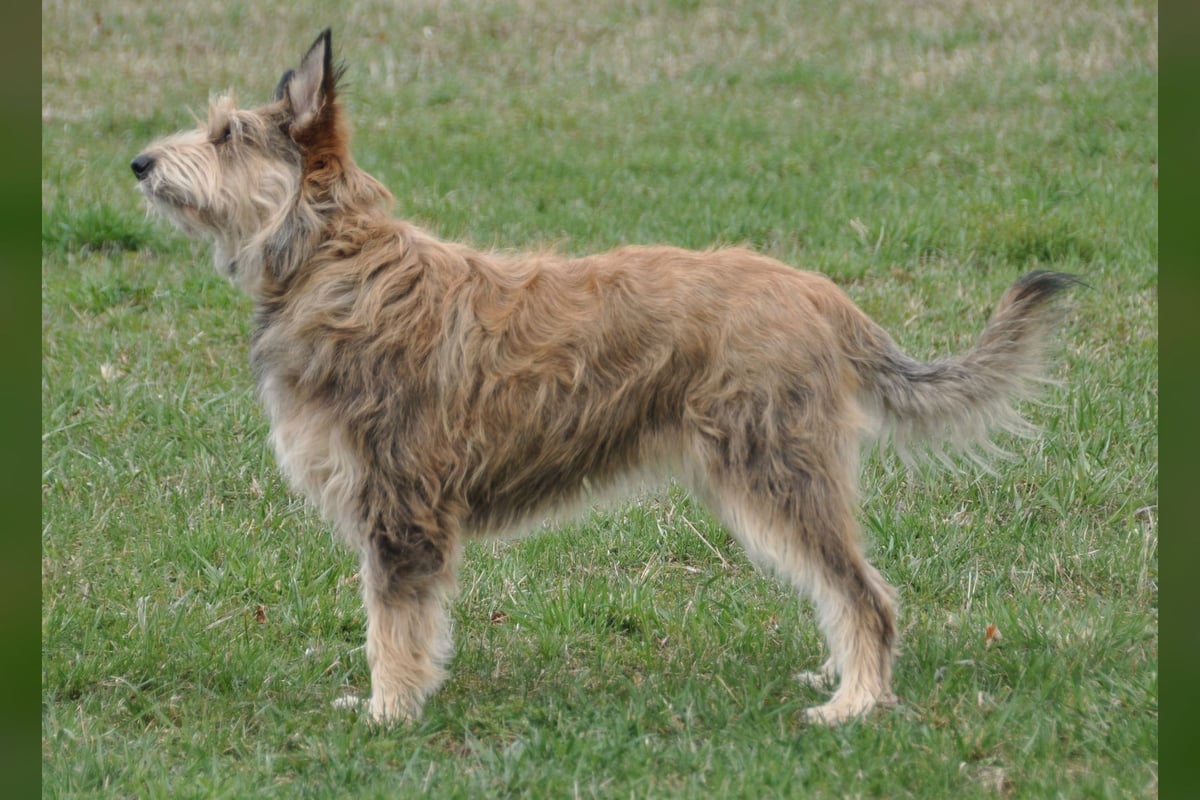
The Picardy Sheepdog is the rarest of the French shepherd breeds: about 3 500 dogs recorded in France (SCC 2023 data), compared with tens of thousands for the Beauceron and hundreds of thousands for the German Shepherd Dog. Recognized by the FCI under number 176 (Group 1), it weighs 22 to 32 kg for 55 to 65 cm. Its medium-length, harsh, crimped coat, described as "fawn charcoal-tipped," is the breed's most distinctive visual signature — neither smooth nor long, with an almost wiry texture to the touch.
- Weight
- 22 to 32kg
- Height
- 55 to 65cm
- Life expectancy
- 13years
- Monthly cost
- 80 to 130€
Personality profile
Energy 4/5
Independence 3/5
Trainability 4/5
Good with children 3/5
Barking 2/5
Space needed 4/5
Attachment to home 4/5
Good with strangers 2/5
Good with dogs 3/5
Good with cats 3/5
Coat care 2/5
Exercise needs 4/5
Scores given on measured axes, data confidence: medium.
Living with a Picardy Sheepdog
Description
A medium-sized breed with a sturdy, unheavy build and a slightly elongated, rectangular silhouette. Males stand 60-65 cm for 25-32 kg, females 55-60 cm for 22-28 kg. Medium-length outer coat (5-6 cm), harsh, crimped, described as "fawn charcoal-tipped" (fawn with darker tips) — also accepted in gray or charcoal gray. Short, dense undercoat. Naturally erect ears, large expressive dark eyes, a sickle tail slightly curved at the tip. Not to be confused with the Briard, whose coat is long and wavy: it is the texture of the harsh coat that sets it apart.

Temperament
The Picardy Sheepdog is reserved with strangers — a structural, non-aggressive wariness that requires early socialization before 3 months to avoid excessive shyness. Deeply attached to its reference family, it tolerates solitude moderately well (4-5 hours max) and may develop anxiety if left alone beyond that. Its low tendency to bark (2/5) makes it a quiet dog compared with other French shepherds. Curious, expressive, capable of initiative in work — a practical intelligence inherited from its role herding flocks across the open terrain of Picardy.
Training
The Picardy Sheepdog is a herding dog from the plains of the Somme and Oise, working with relative autonomy over long distances. It responds well to positive reinforcement and short 15-to-20-minute sessions. Intense dog sport (agility, canicross, herding): the breed excels in disciplines demanding speed and initiative. Poorly calibrated pressure leads to shutdown; consistency and play are the effective levers. Natural aptitude for tracking and mantrailing is documented in breed clubs.

Feeding
300 to 420 g of premium medium-breed kibble a day for a 27 kg adult, in 2 meals. Medium-breed kibble until 15 months. Glucosamine recommended from age 5 for dogs doing intensive dog sports. High activity level (4/5): adjust rations during periods of intense activity (multi-day hikes, canicross training) to maintain a body condition score of 4-5 on the Purina scale.
Affiliate links, no extra cost to you. Legal notice

Living conditions
A house with a closed garden is the reference setup for a dog with high activity needs (4/5). A minimum of 1.5 hours of daily exercise is required: hiking, cycling, dog sports (agility, canicross). An apartment is unsuited without daily access to open space: without enough physical outlet, the Picardy develops anxiety or destructive behavior. Excellent tolerance to cold and harsh weather thanks to the harsh coat and dense undercoat — Picardy, its home region, has severe winters. Intense exercise should be limited above 28 °C.

Grooming and coat care
Among the simplest coats to maintain of the medium-length shepherds: weekly brushing with a pin brush is enough to air out and loosen the crimped coat. The undercoat sheds twice a year (spring and fall shedding season): brush twice a week during these periods. Bathe quarterly at most — too-frequent bathing softens the characteristic harsh coat. No professional grooming needed: the FCI standard forbids artificial trimming of the coat, which must keep its natural, slightly tousled appearance.

Health
Life expectancy of 12 to 14 years, solid for its size. The population went through a severe genetic bottleneck after the First World War (the Picardy battlefields), then again after 1945: this paradoxically eliminated many recessive defects, and the breed today shows few identified genetic diseases. Documented predispositions: hip dysplasia (LOF radiographs recommended for breeding stock) and progressive retinal atrophy (PRA, screening available). No mandatory DNA test exists in France to date, but serious breeders do screen for PRA.
Breed history
The Picardy Sheepdog appears in medieval Picardy tapestries, but the official standard was set in 1898 by the French breed club. Recognized by the FCI under number 176 in 1925. The breed nearly disappeared twice: after the First World War, the trenches of the Somme and Oise decimated the population and its breeders; then again after 1945, through the same rural depopulation. In 2005, a Picardy Sheepdog played the dog Winn-Dixie in the American film "Because of Winn-Dixie," driving up demand in the United States. The breed remains uncommon in France, with about 3 500 active LOF-registered dogs.
Getting ready for your Picardy Sheepdog
Five essentials to line up before day one.
Affiliate links, no extra cost to you. Legal notice
FAQ: Picardy Sheepdog
Sources
- FCI Standard No 176 — Picardy Sheepdog · FCI breed standard 176, Group 1 Sheepdogs and Cattledogs, Section 1 Sheepdogs
- Société Centrale Canine — Picardy Sheepdog · SCC — official standard, LOF data and breeding statistics for the Picardy Sheepdog in France
- AKC Breed Profile — Berger Picard · AKC Berger Picard breed profile, Herding Group, FSS recognition 2015
FCI, Fédération Cynologique Internationale, the world body that has codified breed standards since 1911. FCI number 176 is assigned to the Picardy Sheepdog.
Breeds similar to a Picardy Sheepdog

