


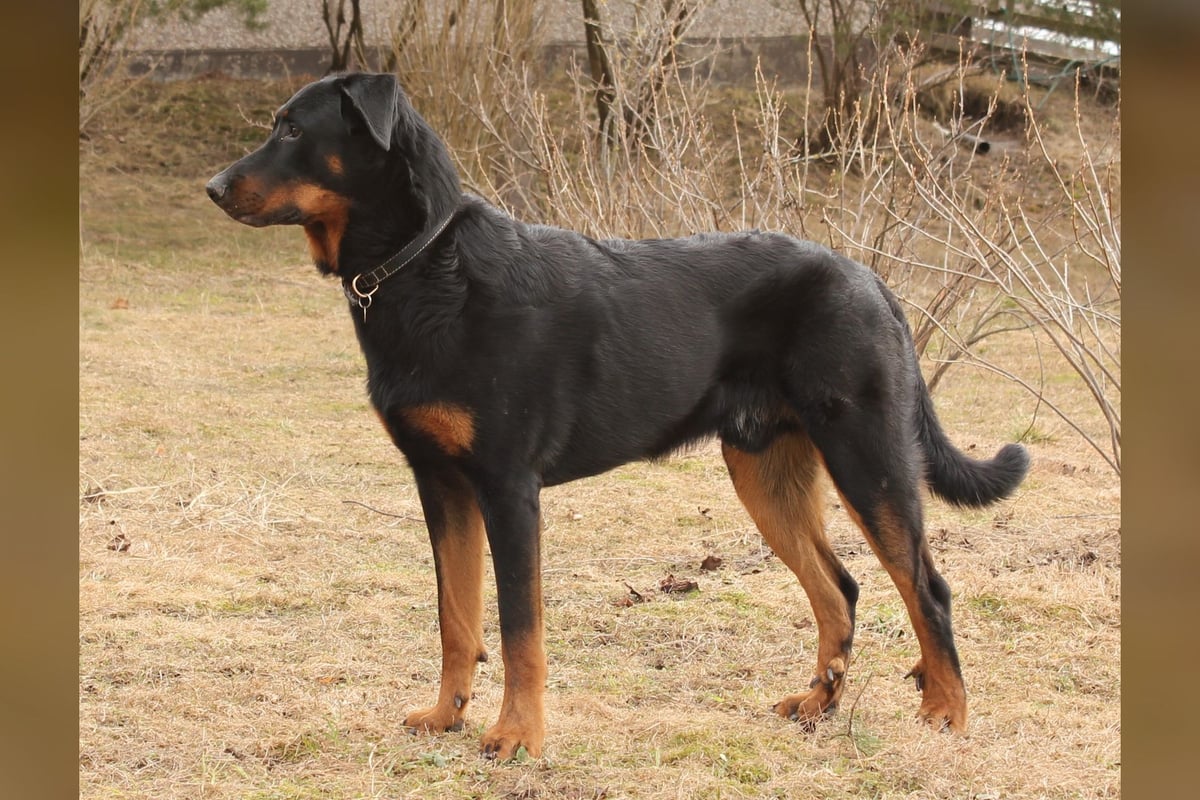
Beauceron
The Beauceron, or Berger de Beauce, is one of the oldest French plains sheepdogs, first mentioned in writing in 1578 in a manuscript on agriculture by Charles Estienne. Recognized by the FCI under number 44 (Group 1), it weighs 30 to 45 kg for 61 to 70 cm. Its double rear dewclaws — two extra toes on each hind leg — are a mandatory feature of the standard, unique among French sheepdogs.
- Weight
- 30 to 45kg
- Height
- 61 to 70cm
- Life expectancy
- 11years
- Monthly cost
- 100 to 160€
Personality profile
Energy 5/5
Independence 3/5
Trainability 4/5
Good with children 3/5
Barking 3/5
Space needed 5/5
Attachment to home 4/5
Good with strangers 1/5
Good with dogs 2/5
Good with cats 2/5
Coat care 2/5
Exercise needs 5/5
Scores given on measured axes, data confidence: high.
Living with a Beauceron
Description
A large sheepdog breed, with powerful bone and lean muscling. Males stand 65-70 cm for 35-45 kg, females 61-68 cm for 30-39 kg. Coat short, harsh, dense, in black and tan ('bas-rouge'), or harlequin (gray merle with tan markings). The short coat gives it minimal upkeep compared with other French sheepdogs. Double rear dewclaws present on both sides: not optional under the FCI standard — any dog lacking them can be disqualified in the show ring.

Temperament
The character of a working dog with a pronounced instinct: structural wariness of strangers, high dog reactivity, and a need for a clear hierarchy. This is not a first-time owner's dog — the BAT (Beauceron Aptitude Test), a behavioral assessment offered in France, helps gauge the level of training support needed. Unwavering attachment to its close family. Its instinctive combativeness calls for intensive socialization before 4 months and an experienced trainer for its whole life.
Training
A versatile working breed with natural aptitude for herding, protection, and intensive dog sports. The BAT (Beauceron Aptitude Test) assesses dogs on neutrality, sociability, and balance; a below-par result calls for specialized training support. Suited to ring sport, mondioring, RCI, herding, tracking, and mantrailing. Positive reinforcement is essential: the breed does not forget an injustice, and mismanaged pressure creates a lasting block. An experienced owner is mandatory.

Feeding
350 to 500 g of premium large-breed kibble a day for a 38 kg adult, in 2 mandatory meals (dilatation-volvulus prevention). Large-breed kibble up to 18 months. Glucosamine and chondroitin are advised from age 4 for active dogs. High activity level (5/5): adjust rations according to work intensity or sporting activities, or risk undernutrition in very active dogs.
Affiliate links, no extra cost to you. Legal notice

Living conditions
A house with a large plot of land is the standard setup. An apartment is not suited to a dog with a maximum energy level (5/5): without 1.5 to 2 hours of sustained daily physical activity, it develops destructive behaviors or hyper-reactivity. Excellent resistance to cold and bad weather thanks to its dense short coat and woolly undercoat. Decent heat tolerance, but intense exercise should be avoided above 28 °C.

Grooming and coat care
Among the simplest sheepdogs to maintain: weekly brushing with a rubber curry glove or short brush is enough under normal conditions. During the two seasonal molts (spring and fall), brush 2 to 3 times a week to manage undercoat shedding. Bathe at most quarterly. Weekly inspection of the rear dewclaws: these clawed appendages do not wear down naturally and must be trimmed regularly to prevent injuries and infections.

Health
Life expectancy is 10 to 12 years, good for its size. Main predispositions: hip dysplasia (LOF radiographs of breeding stock recommended) and gastric dilatation-volvulus syndrome (2 meals a day, with 1 hour of digestive rest around exertion). An incidence of progressive retinal atrophy (PRA) is documented in the breed. A harlequin dog should never be bred harlequin × harlequin: the double merle (MM) genotype causes congenital blindness and deafness.
Breed history
The first description of the Berger de Beauce appears in 1578 in 'L'Agriculture et Maison Rustique' by Charles Estienne and Jean Liébault, under the term 'plains shepherd.' It was in 1863 that French dog expert Pierre Mégnin formally distinguished the Beauceron (short coat) from the Briard (long coat). Used during the First World War to carry messages and detect mines. Recognized by the FCI in 1954 under number 44, Group 1.
Getting ready for your Beauceron
Five essentials to line up before day one.
Affiliate links, no extra cost to you. Legal notice
FAQ: Beauceron
Sources
- FCI Standard No 44 — Beauceron · FCI breed standard 44, Group 1 Sheepdogs and Cattledogs
- AKC Breed Profile — Beauceron · AKC Beauceron breed profile, Herding Group
- Société Centrale Canine — Beauceron · SCC — official standard and LOF registration data for the Beauceron in France
FCI, Fédération Cynologique Internationale, the world body that has codified breed standards since 1911. FCI number 44 is assigned to the Beauceron.
Breeds similar to a Beauceron

Belgian Shepherd Dog (Malinois)
Sheepdogs and Cattledogs (except Swiss Cattledogs)
20 to 30 kg
