


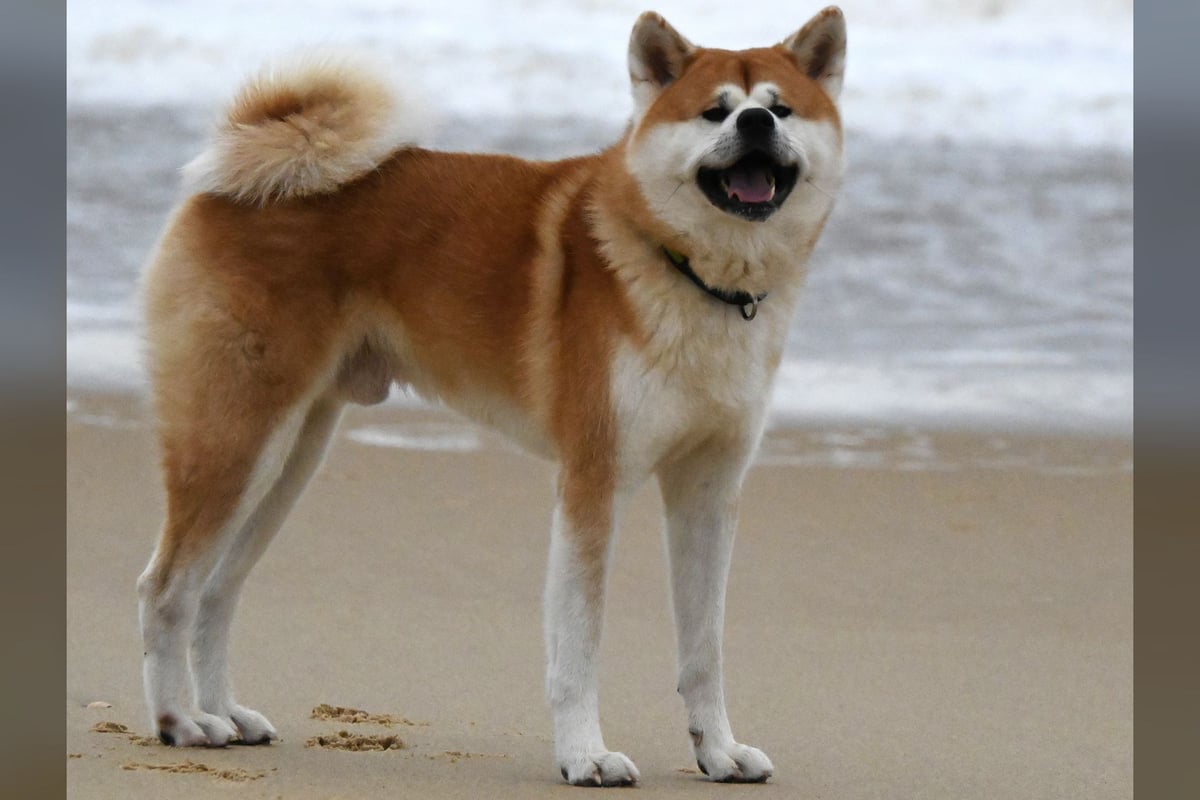
Akita
The Akita is a large Japanese spitz weighing 35 to 50 kg for 58 to 70 cm, recognized by the FCI under number 255 (not to be confused with the American Akita, FCI 344, which is more massive). A breed used to hunt bear and deer, declared a Japanese natural monument in 1931, it combines absolute loyalty to its household with deep wariness of anything unfamiliar. Suited only to experienced owners, without ambiguity.
- Weight
- 35 to 50kg
- Height
- 58 to 70cm
- Life expectancy
- 11years
- Monthly cost
- 100 to 160€
Personality profile
Energy 3/5
Independence 4/5
Trainability 2/5
Good with children 2/5
Barking 2/5
Space needed 4/5
Attachment to home 3/5
Good with strangers 1/5
Good with dogs 1/5
Good with cats 1/5
Coat care 3/5
Exercise needs 3/5
Scores given on measured axes, data confidence: high.
Living with an Akita
Description
An imposing, muscular, and well-proportioned breed. Males stand 64-70 cm for 40-50 kg, females 58-64 cm for 35-45 kg. A dense double coat with abundant undercoat, in fawn, sesame, brindle, or pure white with urajiro markings. Triangular, erect ears, and a spiral tail carried high. A calm, composed expression that contrasts with the breed's constant vigilance.

Temperament
Quiet and composed day to day, the Akita barks little but constantly watches over its territory. Marked wariness toward strangers: it does not tolerate unsolicited approaches and can appear threatening without prior verbal warning. Resource guarding is documented in the breed (food, toys, bedding) — children and unfamiliar adults should keep their distance. Intolerant of dogs of the same sex: multi-dog cohabitation is not advised without strict management. Its predatory instinct is intact, making it incompatible with cats and small animals. With its immediate family, it can be affectionate and protective, but without excessive displays. Supervision with children is mandatory, particularly unfamiliar children or visitors.
Training
Trainability is low to moderate: the Akita learns quickly but chooses when to obey. Traditional punishment-based training is counterproductive and can trigger aggression. Positive reinforcement only, short sessions (10-15 min), with an owner who commands respect without direct confrontation. Intensive early socialization between 7 and 16 weeks is mandatory — critical for limiting wariness of strangers in adulthood. Physical activity: 45 minutes to 1 hour of walking or trotting per day, spread out regularly rather than in prolonged endurance efforts.

Feeding
400 to 600 g of premium kibble a day for a 45 kg adult, in 2 meals. Kibble high in animal protein (30-35%) suits its muscular build. Keep food bowls out of reach of children and visitors given the breed's resource guarding. Watch its weight after age 7, as the breed tends toward weight gain if exercise decreases.
Affiliate links, no extra cost to you. Legal notice

Living conditions
A house with an enclosed garden is required — not advisable in an apartment and unsuited to dense urban living. Enough space to move around freely, with a solid fence at least 1.8 m high. It copes very well with cold (a double coat built for northern Japanese winters) but is sensitive to heat: avoid intense exercise above 22 °C, and provide constant shade and fresh water in summer. Not advisable in households with young children or with other animals already present.

Grooming and coat care
Weekly brushing under normal conditions, daily during the two annual shedding seasons (spring/fall) when the undercoat sheds in significant quantity. The breed is naturally clean and grooms itself in a cat-like manner. Bathe at most once a month — more often in case of sebaceous adenitis (a specific protocol prescribed by the veterinarian). No clipping: the double coat plays a thermoregulatory role.

Health
The breed is predisposed to three specific conditions: sebaceous adenitis (an autoimmune inflammation of the sebaceous glands causing hair loss, scaling, and recurrent skin infections — lifelong treatment with medicated oils and shampoos), VKH syndrome or uveodermatologic syndrome (an autoimmune reaction attacking melanocytes in the eye and nervous system — uveitis, nasal depigmentation, possible meningitis), and entropion (eyelids rolling inward, correctable surgically). Hip dysplasia is possible in heavier dogs, and osteosarcoma has been reported to be on the rise. Life expectancy is 10 to 12 years. An annual eye exam and skin checkup are recommended from age 2.
Breed history
Originally from Akita Prefecture in northern Honshu, the breed traditionally hunted black bear and deer there. Proclaimed a Japanese natural monument in 1931. Nearly wiped out during the Second World War (the dogs were killed for their fur), the breed was rebuilt from the few survivors after 1945. The Japanese line (Akita Inu, FCI 255) and the American line (American Akita, FCI 344) diverged to the point of being recognized as two distinct standards. Hachiko, the Akita who waited for his owner at Shibuya Station for nearly ten years after his owner's death (1925-1935), remains the breed's worldwide symbol of loyalty.
Getting ready for your Akita
Five essentials to line up before day one.
Affiliate links, no extra cost to you. Legal notice
FAQ: Akita
Sources
- FCI Standard No 255 · FCI breed standard 255, Group 5 Spitz and Primitive Types, Section 5 Asian Spitz
- AKC Breed Profile · AKC Akita breed profile, Working Group
FCI, Fédération Cynologique Internationale, the world body that has codified breed standards since 1911. FCI number 255 is assigned to the Akita.
Breeds similar to an Akita

