


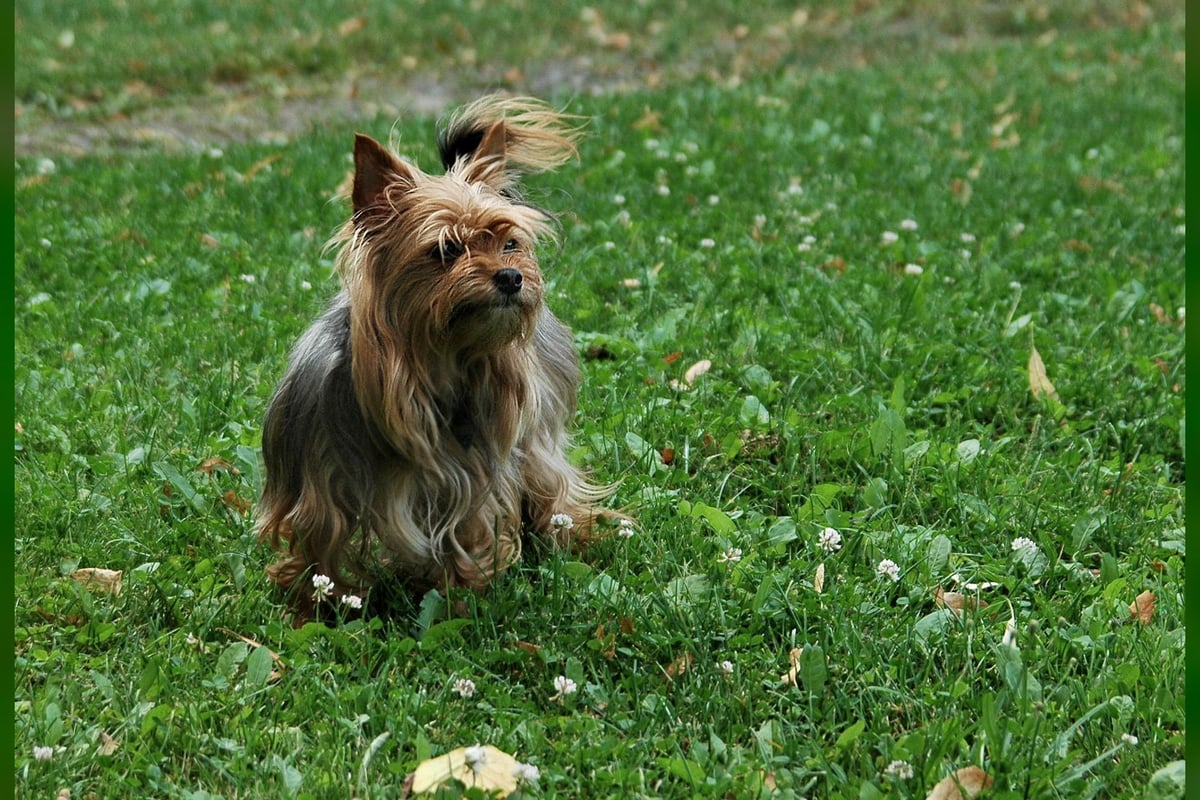
Yorkshire Terrier
The Yorkshire Terrier weighs 2 to 3.2 kg for 19 to 23 cm at the withers. Recognized by the FCI under number 86, Group 3 Terriers, originating in the English county of Yorkshire, where it hunted rodents in the mines in the 19th century. Life expectancy 13 to 16 years, but 30 to 50% of adults develop tracheal collapse — a progressive respiratory complication, to be screened for by X-ray between ages 3 and 5.
- Weight
- 2 to 3.2kg
- Height
- 19 to 23cm
- Life expectancy
- 14years
- Monthly cost
- 60 to 100€
Personality profile
Energy 3/5
Independence 2/5
Trainability 3/5
Good with children 2/5
Barking 4/5
Space needed 1/5
Attachment to home 4/5
Good with strangers 2/5
Good with dogs 2/5
Good with cats 2/5
Coat care 5/5
Exercise needs 2/5
Scores given on measured axes, data confidence: high.
Living with a Yorkshire Terrier
Description
A toy-format terrier breed, the Yorkshire Terrier has a long, silky, fine coat, steel blue on the body, vivid tan on the head and legs. The hair's texture resembles human hair: it grows continuously, sheds almost not at all, but requires daily brushing or a shortened "puppy cut." Moderate muzzle, V-shaped erect ears, small dark eyes. Despite its 2 to 3.2 kg size, it retains a terrier temperament: a hunter, headstrong, territorial.

Temperament
Lively and vocal: barks as an alert signal at the slightest sound trigger, a barking tendency to manage from the first weeks through desensitization. Very attached to its main human reference point, it copes poorly with entire days without contact. Wary, even nippy, with strangers and larger dogs; supervision is required with young children — a child under 6 can injure it unintentionally, and the Yorkshire may react by snapping its jaws.
Training
Moderate trainability: intelligent but headstrong by terrier nature, it can decide not to cooperate if the session is too long or the reward insufficient. Sessions of 5 to 10 minutes maximum with positive reinforcement — small treats or affectionate contact. Leash walking is the first critical lesson: always on a harness, never a collar. Early socialization to urban noise, children, and other dogs is essential before 16 weeks to reduce reactive barking.

Feeding
60 to 90 g of premium kibble a day for a 3 kg adult, in 3 meals up to 6 months then 2 meals as an adult. Mini-sized kibble (diameter <8 mm) is mandatory: the narrow jaw rules out standard sizes. Avoid large treats — risk of choking and caloric excess (obesity comes quickly at 3 kg). Puppies under 3 months: closely spaced snacks to prevent hypoglycemia.
Affiliate links, no extra cost to you. Legal notice

Living conditions
Well suited to urban apartment life thanks to its minimal size and moderate exercise needs: two 20 to 30 minute outings a day are enough. Sensitive to cold below 5 °C (coat recommended in winter) and to drafts. Avoid a standard collar: risk of worsening tracheal collapse — always prefer a chest harness.

Grooming and coat care
The most demanding grooming of all toy breeds: daily brushing of the long coat to prevent tangles, or a short "puppy cut" every 6 to 8 weeks at a professional groomer. Comparable to human hair, this coat has no seasonal shedding: grooming is a permanent commitment. Weekly or biweekly bath with mild shampoo. Daily inspection of the eye corners (staining tear stains), weekly cleaning of the erect ears. Monthly nail trim — the fine paws show wear quickly.

Health
Three dominant conditions to know before adopting. Tracheal collapse affects 30 to 50% of adult Yorkshires: the tracheal rings progressively flatten, causing a chronic dry cough with a "goose-honk" sound, worsened by exertion, excitement, or heat — X-ray screening recommended between ages 3 and 5. Patellar luxation (grade I to IV) is common: watch for any limping during walks. Congenital portosystemic shunt (hepatic) affects 0.6% of Yorkshire births, above the breed average: stunted growth, seizures, and disorientation are the signs — plan a liver panel at the first blood draw. Puppy hypoglycemia is common in the first months (birth weight <500 g): frequent, closely spaced meals are mandatory. Narrow jaws predispose to retained baby teeth and periodontal disease — annual dental scaling from age 3.
Breed history
Born in the mid-19th century in the county of Yorkshire (England), the Yorkshire Terrier descends from crosses between Scottish terriers (Clydesdale Terrier, Paisley Terrier) brought over by migrant weavers. Its original function was eliminating rats in coal mines and textile mills. First shown at a dog show under the name Yorkshire Terrier in 1870, officially recognized by the British Kennel Club in 1886. The FCI registers it under number 86 in Group 3, Section 4 Toy Terriers. Arriving in France in the 1970s, it regularly ranks in the top 10 of LOF registrations.
Getting ready for your Yorkshire Terrier
Five essentials to line up before day one.
Affiliate links, no extra cost to you. Legal notice
FAQ: Yorkshire Terrier
Sources
- FCI Standard No 86 · FCI breed standard 86, Group 3 Terriers, Section 4 Toy Terriers, Country of origin Great Britain
- AKC Breed Profile · AKC Yorkshire Terrier breed profile, Toy Group, weight up to 7 lbs (3.2 kg)
FCI, Fédération Cynologique Internationale, the world body that has codified breed standards since 1911. FCI number 86 is assigned to the Yorkshire Terrier.
Breeds similar to a Yorkshire Terrier

