


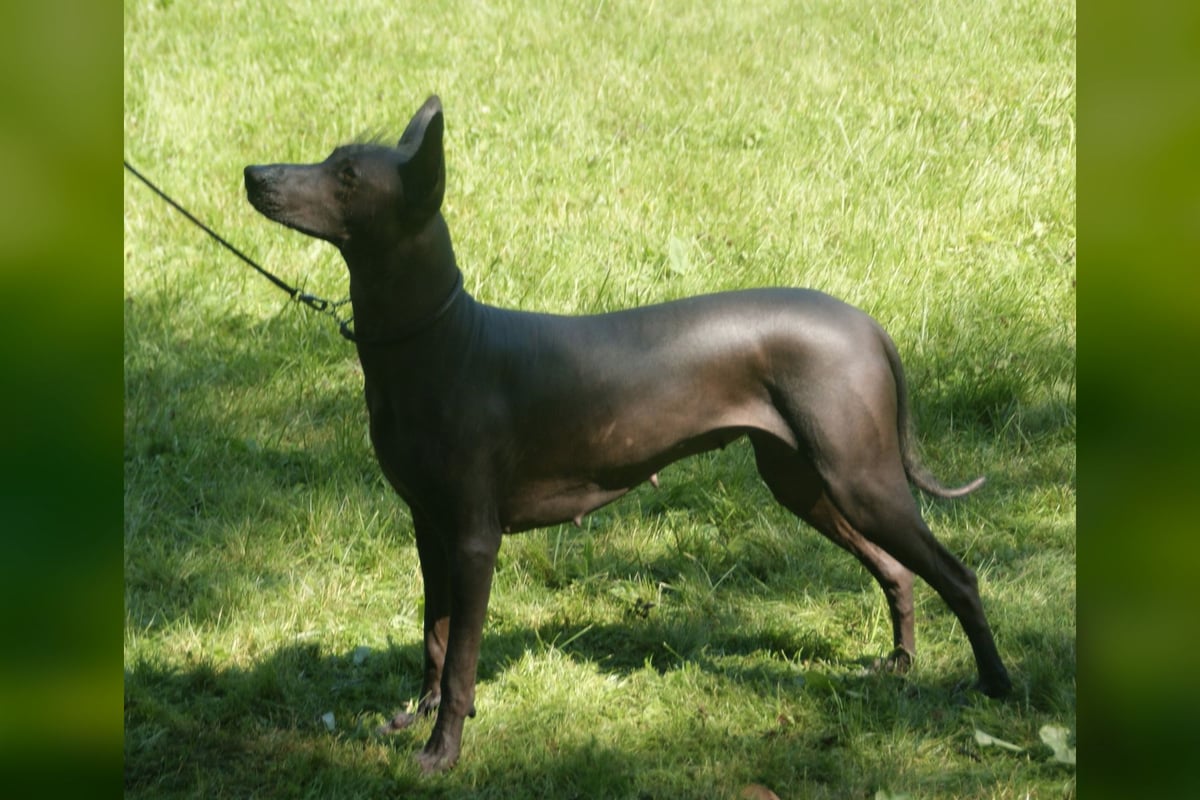
Xoloitzcuintle
The Xoloitzcuintle (FCI 234, Group 5) is the oldest dog breed in the Americas, documented in Aztec, Mayan, Toltec, and Zapotec sculptures, with a presence attested over more than 3 000 years. Named after the psychopomp god Xolotl and the Nahuatl word "itzcuintli" (dog), it was regarded as a guide for souls into the afterlife in Aztec mythology. The breed comes in three sizes (Standard 46-60 cm, Intermediate 36-45 cm, Toy 25-35 cm) and two coat varieties — hairless and coated — which can appear in the same litter. Nearly wiped out after the Spanish conquest, it was rebuilt by the Mexican Kennel Club under the direction of Norman Pelham Wright starting in 1956.
- Weight
- 4 to 18kg
- Height
- 25 to 60cm
- Life expectancy
- 15years
- Monthly cost
- 60 to 130€
Personality profile
Energy 3/5
Independence 4/5
Trainability 4/5
Good with children 4/5
Barking 2/5
Space needed 2/5
Attachment to home 5/5
Good with strangers 2/5
Good with dogs 3/5
Good with cats 3/5
Coat care 1/5
Exercise needs 3/5
Scores given on measured axes, data confidence: high.
Living with a Xoloitzcuintle
Description
The hairless variety is the most common: smooth, exposed skin, the result of a dominant mutation of the FOXI3 gene — individuals homozygous for this mutation are not viable at birth. A few short hairs sometimes persist on the skull, tail, and legs. The coated variety has a short, dense coat and occurs naturally in hairless litters. Common colors are black, slate gray, bronze, and red. The build is lean and muscular, with erect ears, a straight profile, and an alert expression — a primitive silhouette close to the Pharaoh Hound or the Cirneco dell'Etna.

Temperament
The Xoloitzcuintle forms a deep attachment to a small family circle, and can seem distant or reserved toward strangers — this caution is constitutional, not a character flaw. Indoors, it is calm and not prone to barking, present without being intrusive. Unlike breeds with a high prey drive, it tolerates cats and other small household animals it has grown up with. Its thermal sensitivity shapes daily life: the hairless variety is prone to hypothermia and needs a coat for any cool outing.
Training
The breed responds well to positive reinforcement and picks up obedience basics quickly, which sets it apart from more closed-off primitive breeds like the Basenji. Its selective attachment to a reference owner eases communication but can make sessions with outside handlers less effective. Early socialization before 12 weeks is decisive for softening its natural reserve toward strangers — a poorly socialized Xolo grows into an adult that freezes or flees new situations. Exercise needs are moderate: two 30-minute daily walks are enough for the Intermediate or Standard size.

Feeding
80 to 250 g of kibble sized to the variety (Toy, Intermediate, or Standard) in two daily meals. Weight monitoring is more visible than in dense-coated breeds — the lack of coat makes any weight loss or gain immediately observable, which makes dietary adjustments easier. Toy dogs (4-8 kg) are prone to hypoglycemia at a young age: frequent meals for puppies. Avoid foods high in fast sugars, which throw off the already sensitive skin of the hairless variety.
Affiliate links, no extra cost to you. Legal notice

Living conditions
An apartment suits this moderately sized breed perfectly: even at Standard size (46-60 cm, up to 18 kg), its energy level and low need for indoor space adapt without difficulty. Cold sensitivity requires concrete precautions once temperatures drop below 15 °C, extending even to bedding arrangements. Conversely, the Xolo handles intense heat perfectly well, consistent with its Mexican origins. Sunburn is possible on exposed skin in summer: a dog-safe sunscreen is recommended for prolonged sun exposure.

Grooming and coat care
The hairless variety is considered hypoallergenic and sheds almost no hair — a major advantage for people allergic to dog dander or hair. The absence of a coat removes the need for brushing but calls for specific skin care: cleaning the skin once or twice a week with a mild product, regular moisturizing with a non-comedogenic cream in winter, and applying sun protection during summer sun exposure. The coated variety only needs weekly brushing. Ear cleaning stays twice a month for both varieties.

Health
A life expectancy of 13 to 18 years is remarkable and stands as one of the breed's medical strengths. Incomplete dentition is a direct consequence of the hairless gene: hairless dogs frequently have missing teeth or absent premolars, considered normal under the standard. Solar dermatitis is the main skin risk for light-colored individuals — an annual dermatology check is advisable for exposed dogs. Few serious genetic diseases are documented; natural selection over millennia under tropical conditions has preserved a robust constitution.
Breed history
Sculpted depictions of the Xoloitzcuintle have been found at Aztec, Mayan, Toltec, and Zapotec archaeological sites, evidence of a presence spanning more than 3 000 years — making it one of the oldest documented dog breeds on the American continent. In Aztec cosmology, Xolotl — a dog-headed psychopomp god — guided the souls of the dead to Mictlan, the underworld; the Xolo embodied that sacred role and was sometimes buried with its owner to serve as a guide. The 16th-century Spanish conquest brought the breed to near extinction: stripped of its sacred status by evangelization and consumed as a food source by colonists, the population collapsed. In 1956, the Mexican Kennel Club launched a restoration program under the direction of Norman Pelham Wright, who identified surviving specimens in remote rural regions of Mexico and stabilized the current standard.
Getting ready for your Xoloitzcuintle
Five essentials to line up before day one.
Affiliate links, no extra cost to you. Legal notice
FAQ: Xoloitzcuintle
Sources
- FCI Standard No 234 — Mexican Hairless Dog · FCI breed standard 234, Group 5 Spitz and Primitive Types
- Société Centrale Canine — Xoloitzcuintle · SCC official breed record, Xoloitzcuintle, Group 5
- AKC Breed Profile — Xoloitzcuintli · AKC Xoloitzcuintli breed profile, Non-Sporting Group
FCI, Fédération Cynologique Internationale, the world body that has codified breed standards since 1911. FCI number 234 is assigned to the Xoloitzcuintle.
Breeds similar to a Xoloitzcuintle

