


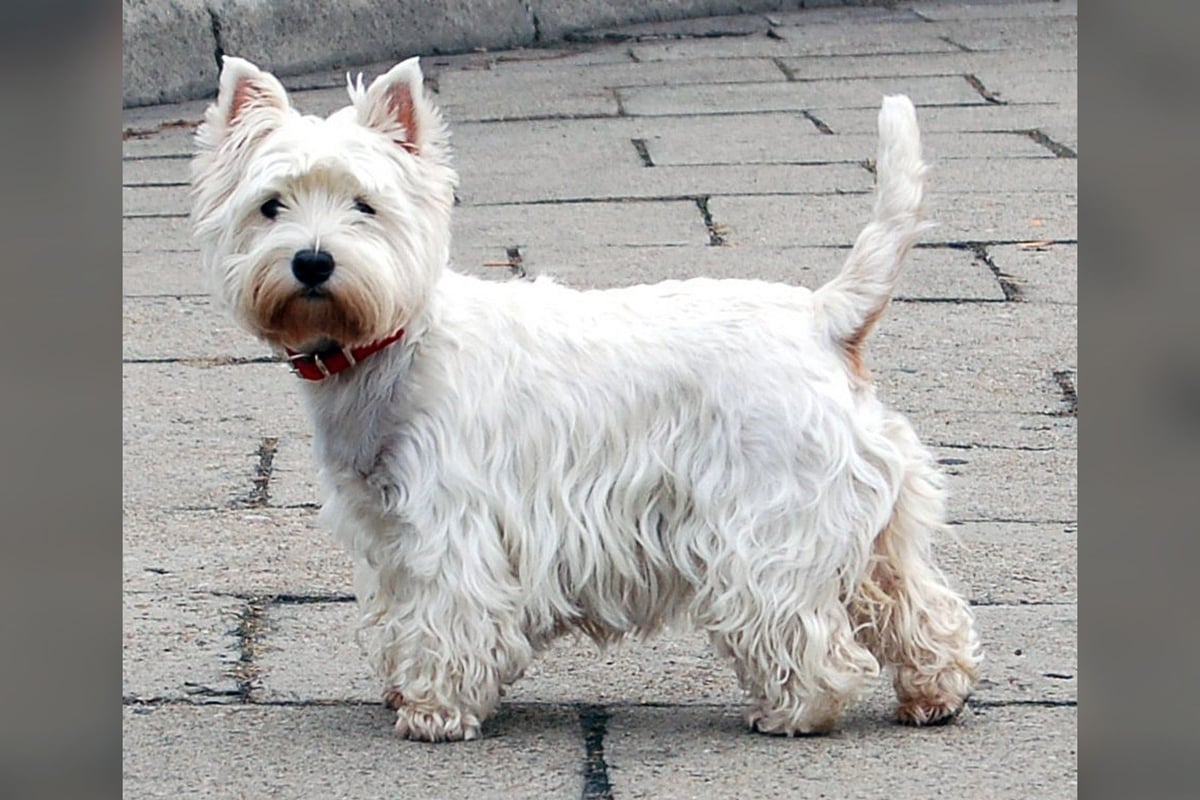
West Highland White Terrier
The West Highland White Terrier (Westie) is a Scottish terrier of 7 to 10 kg and 25 to 30 cm, recognized by the FCI under number 85. High energy, a functional hunting instinct, and atopic dermatitis affecting up to 40% of individuals make it a demanding breed both physically and veterinarily. Life expectancy 12 to 16 years.
- Weight
- 7 to 10kg
- Height
- 25 to 30cm
- Life expectancy
- 14years
- Monthly cost
- 60 to 110€
Personality profile
Energy 4/5
Independence 4/5
Trainability 3/5
Good with children 3/5
Barking 4/5
Space needed 2/5
Attachment to home 3/5
Good with strangers 2/5
Good with dogs 2/5
Good with cats 2/5
Coat care 4/5
Exercise needs 4/5
Scores given on measured axes, data confidence: high.
Living with a West Highland White Terrier
Description
The West Highland White Terrier is distinguished by its exclusively white double coat — a dense woolly undercoat and a hard, straight topcoat 5 to 7 cm long. The FCI 85 standard specifies a round head with fur forming a ruff framing the face, small pricked ears, and a tail carried straight with no curl. Heavy bone for its size, short powerful legs suited to working the rugged terrain of the Scottish Highlands. The coat's whiteness was functional: it let hunters tell the dog apart from the quarry among the rocky scree.

Temperament
A terrier in every sense of the word: tenacious, vocal, an instinctive hunter, and not inclined toward passive obedience. It takes initiative and handles situations independently — a direct legacy of den work without direct human guidance. It barks to signal, to hunt, and to get attention — often repetitively and hard to interrupt. Toward strangers: wary, not spontaneously aggressive, but reserved and slow to trust. With children: tolerant if socialized early, but the defensive bite reflex kicks in with rough handling or a startling gesture. Cohabitation with other animals is risky — active predatory instinct toward small cats, rodents, and rabbits.
Training
Moderate trainability: learning capacity is present, but motivation is conditional on the perceived value of the command. Responds to positive reinforcement and high-value food rewards. Sessions should be short (8 to 12 minutes), varied, and unpredictable to hold attention — mechanical repetition breeds boredom and refusal. Punishment produces stubbornness or regression. Agility, nose work, and long outings of 60 minutes or more channel its intense energy and intelligence while reinforcing cooperation — a Westie that hasn't burned off enough physical energy is a Westie that's impossible to train.

Feeding
150 to 220 g of premium kibble a day depending on weight and activity, in 2 meals. Feed high in omega-3 fatty acids (EPA/DHA) is advisable to reduce skin inflammation in atopic individuals. Some Westies show food hypersensitivity to chicken or grains — if atopy is diagnosed, a protein elimination diet may be prescribed by the vet.
Affiliate links, no extra cost to you. Legal notice

Living conditions
Apartment or house, with or without a garden, provided its exercise needs are met: a minimum of 45 to 60 minutes of sustained activity a day, splittable into 2 outings. A fenced garden is essential — it digs under fences if they are not anchored deep enough (50 cm minimum). Recall is unreliable on any trail or in the presence of small wildlife. It tolerates Scottish weather conditions well — handles cold and rain without difficulty. In an apartment without adequate outings, frustration shows up as persistent barking and destructive behavior.

Grooming and coat care
Significant, regular upkeep. The wiry double coat needs stripping (hand-pulling the dead hair) every 6 to 8 weeks to maintain texture and whiteness — clipping is the common alternative. Twice-weekly brushing with a slicker brush to prevent mats in the undercoat. The white coat immediately reveals any dirt, grass stains, or yellowing fur — upkeep between two strippings exceeds that of a colored-coat breed. Monthly ear cleaning, nail trims every 3 to 4 weeks.

Health
Atopic dermatitis: estimated prevalence of 25-40% of individuals according to British veterinary epidemiological studies — the breed regularly ranks at the top of the list of most affected breeds. Atopy begins between 1 and 3 years old with itching of the paws, abdomen, and face; it is incurable and managed for life. Craniomandibular osteopathy (CMO): painful bone overgrowth of the jaws and temporal bones between 4 and 7 months — usually resolves at skeletal maturity but can leave lasting effects. Progressive retinal atrophy (PRA), with night vision loss first. Hereditary deafness reported in some lines. Patellar luxation documented sporadically.
Breed history
The West Highland White Terrier descends from the terriers of the Scottish Highlands, bred since the 17th century to hunt fox, badger, and rodents across the rugged terrain of the Cairngorms. Standardization of the white coat is credited to Malcolm of Poltalloch (Argyllshire) in the 19th century: after accidentally shooting one of his fawn-colored terriers, mistaken for a fox, he began selecting exclusively for white dogs. Recognized by the Kennel Club under the name West Highland White Terrier in 1907, FCI number 85, Group 3, Section 2. Peak commercial popularity in Europe came in the 1990s-2000s, fueled by Black & White whisky advertising campaigns.
Getting ready for your West Highland White Terrier
Five essentials to line up before day one.
Affiliate links, no extra cost to you. Legal notice
FAQ: West Highland White Terrier
Sources
- FCI Standard No 85 · FCI breed standard 85, Group 3 Terriers, Section 2 Small-sized Terriers
- AKC Breed Profile · AKC West Highland White Terrier breed profile, Terrier Group
FCI, Fédération Cynologique Internationale, the world body that has codified breed standards since 1911. FCI number 85 is assigned to the West Highland White Terrier.
Breeds similar to a West Highland White Terrier

