


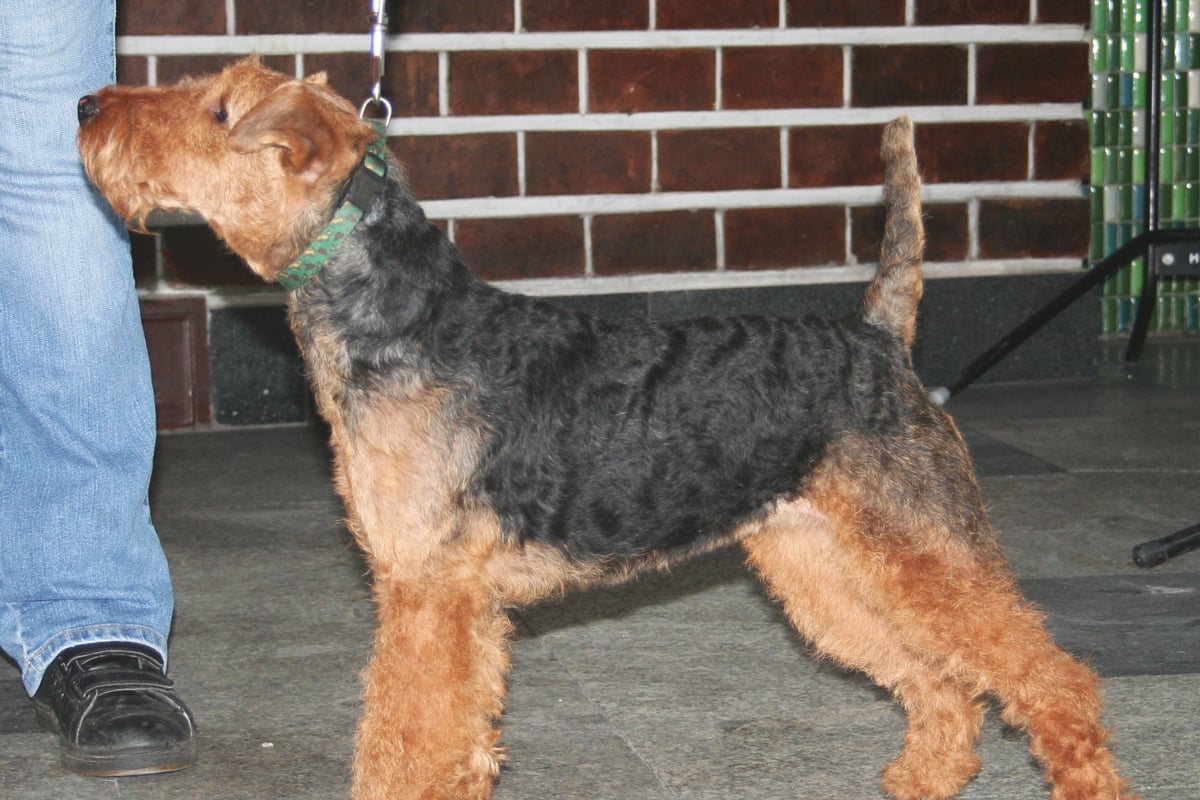
Welsh Terrier
The Welsh Terrier weighs 9 to 10 kg for 36 to 39 cm at the withers, recognized by the FCI under number 78 (Group 3, Section 1). A descendant of the Old English Black and Tan Terrier — an ancestral breed now extinct — it was formally recognized by the British Kennel Club in 1885. Its black-and-tan marking, known as a "blanket bicolor" pattern (black saddle on the back, tan mask and legs), is the only pattern allowed by the standard. About 70 puppies are registered with the Livre des Origines Français (LOF) each year.
- Weight
- 9 to 10kg
- Height
- 36 to 39cm
- Life expectancy
- 13years
- Monthly cost
- 60 to 90€
Personality profile
Energy 4/5
Independence 3/5
Trainability 3/5
Good with children 4/5
Barking 3/5
Space needed 2/5
Attachment to home 4/5
Good with strangers 3/5
Good with dogs 3/5
Good with cats 2/5
Coat care 3/5
Exercise needs 4/5
Scores given on measured axes, data confidence: medium.
Living with a Welsh Terrier
Description
It is often mistaken for a scaled-down Airedale Terrier: the same black-and-tan coat pattern and the same wiry coat structure, but the Welsh does not exceed 10 kg where the Airedale reaches 30 kg. The topcoat is hard, dense, and tight against a soft undercoat — a trait common to the wire-coated Welsh terriers. The head is elongated, the skull flat, with a powerful jaw suited to work in a terrier's den. The current standard dates from March 26, 2008; the breed falls under Group 3, Section 1 (large and medium-sized terriers).

Temperament
Lively, brave, and well-balanced for a hunting terrier: less domineering than the Fox Terrier, less independent than the Airedale. Its Welsh selection for hunting otter, fox, and badger over difficult mountainous terrain produced a tenacious dog that is nonetheless willing to cooperate with humans. Its tolerance of children exceeds that of most hunting terriers — it puts up with lively play without a marked defensive reflex. Predatory instinct toward small animals is still present; cohabitation with rodents is not advisable.
Training
Decent trainability for a terrier: it grasps exercises quickly but weighs the point of a request before obeying. Sessions should stay short (10-15 minutes), varied, and centered on positive reinforcement with high-value food rewards. Its tolerance for monotony is lower than a Border Collie's — mechanical repetition loses its attention in under five repetitions. Dog sports (agility, nose work, rally obedience) that combine intense physical output with cognitive engagement give the best results with this breed.

Feeding
150 to 200 g of premium kibble a day for a 9-10 kg adult, split into 2 meals. Kibble with a protein content suited to active terrier breeds (26-30%). Watch for weight gain after spaying/neutering, common in fixed terriers whose activity drops without a ration adjustment.
Affiliate links, no extra cost to you. Legal notice

Living conditions
Tolerates apartment life if exercise needs are met — 45 minutes to 1 hour of activity a day, splittable into 2 outings. Its manageable size (9-10 kg) and moderate barking level make it a workable terrier for urban living. A garden is appreciated but not required; if available, a sturdy fence is needed, since digging under fences is an inherited terrier behavior. The double coat gives it decent cold resistance for outings in rainy or cold Welsh weather.

Grooming and coat care
The wiry coat needs stripping 2 to 4 times a year to remove dead hair and maintain the protective texture as well as the crisp black color of the coat. Scissor clipping is possible but softens the coat's hardness and dulls the characteristic black shade. Weekly brushing is enough between stripping sessions. Shedding is minimal — the wiry coat holds onto dead hair rather than scattering it around the home.

Health
Life expectancy 12 to 15 years. The relatively small French LOF population (~70 registered/year) benefits from careful health-focused selection pressure: few hereditary conditions documented at high prevalence in the breed. Mild predisposition to glaucoma (elevated intraocular pressure) to watch from age 5. Atopic skin allergy reported sporadically — watch the belly and armpits for any recurring itching. On screening: annual eye exam, and eye check for breeding dogs before any mating.
Breed history
The Welsh Terrier descends directly from the Old English Black and Tan Terrier, a British working breed now extinct, documented as early as the 18th century. It was used in the Welsh valleys and on steep hillsides to hunt otter, fox, and badger, often alongside mounted hunting parties. The British Kennel Club officially recognized it in 1885 under its current name; the FCI assigned it number 78 with definitive recognition. Gradually imported into France starting in the 1970s, it now accounts for about 70 LOF registrations a year — a niche status that preserves its targeted selection.
Getting ready for your Welsh Terrier
Five essentials to line up before day one.
Affiliate links, no extra cost to you. Legal notice
FAQ: Welsh Terrier
Sources
- FCI Standard No 78 — Welsh Terrier · FCI breed standard 78, Group 3 Terriers, Section 1 Large and medium sized Terriers, definitively accepted 26 March 2008
- AKC Breed Profile — Welsh Terrier · AKC Welsh Terrier breed profile, Terrier Group, recognized 1888
- Société Centrale Canine — LOF Welsh Terrier · SCC LOF database, Welsh Terrier, about 70 registrations annually
FCI, Fédération Cynologique Internationale, the world body that has codified breed standards since 1911. FCI number 78 is assigned to the Welsh Terrier.
Breeds similar to a Welsh Terrier

