


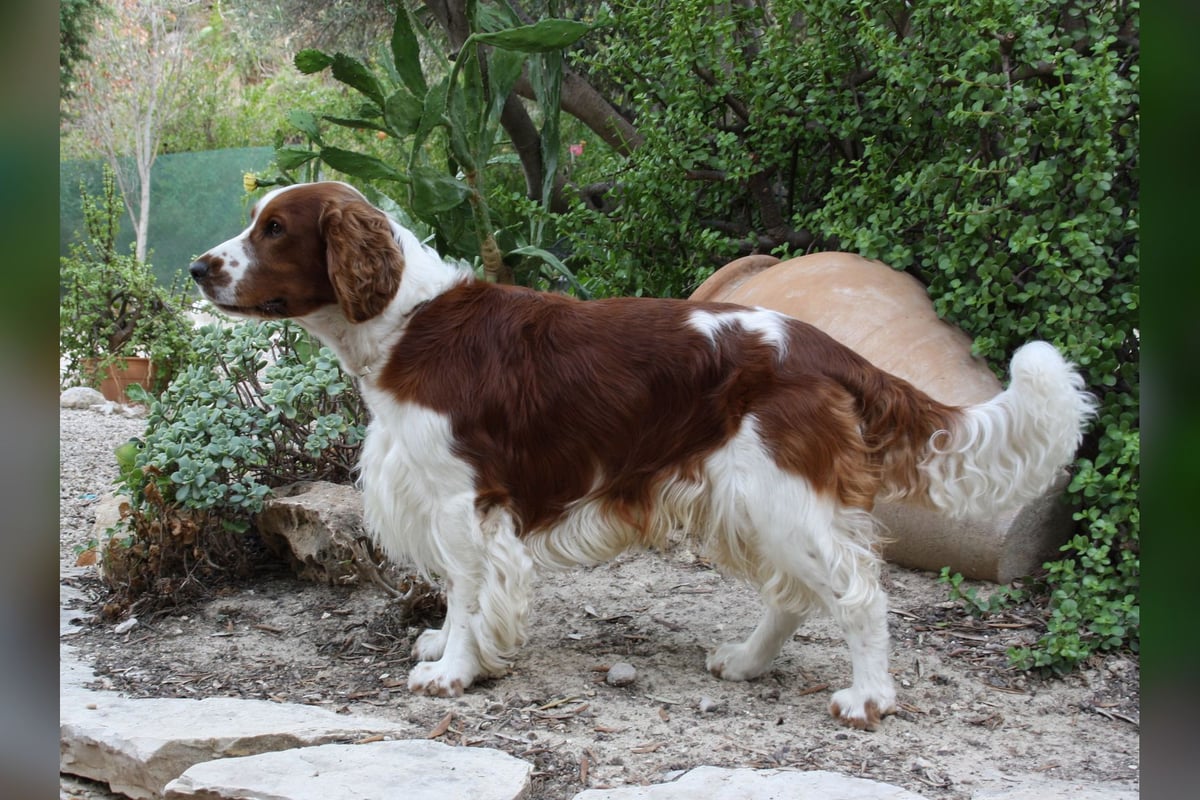
Welsh Springer Spaniel
The Welsh Springer Spaniel weighs 16 to 25 kg for 43 to 48 cm at the withers — a build intermediate between the English Cocker Spaniel and the English Springer. An old Welsh breed whose type is attested as early as the 15th century, recognized as a distinct breed by the British Kennel Club in 1902 alongside the English Springer. Exclusively red-and-white coat, with no variation allowed by FCI standard number 126. About 300 LOF puppies registered per year in France. Life expectancy 12 to 15 years.
- Weight
- 16 to 25kg
- Height
- 43 to 48cm
- Life expectancy
- 13years
- Monthly cost
- 80 to 120€
Personality profile
Energy 4/5
Independence 3/5
Trainability 4/5
Good with children 4/5
Barking 3/5
Space needed 4/5
Attachment to home 4/5
Good with strangers 2/5
Good with dogs 4/5
Good with cats 3/5
Coat care 3/5
Exercise needs 4/5
Scores given on measured axes, data confidence: high.
Living with a Welsh Springer Spaniel
Description
A medium-sized breed with a compact, solidly built physique. Slightly domed head, moderate stop, vine-leaf-shaped ears lying flat against the cheeks — shorter than those of the English Cocker Spaniel. The coat is flat, silky, and of medium density — neither the length of the English Springer's nor the heavy feathering of the American Cocker's. The red-and-white coat is the only one allowed: red can range from light fawn to deep mahogany, with no liver, black, or tricolor markings tolerated. This distinctive coat makes the Welsh Springer one of the most recognizable spaniels at first glance.

Temperament
A hunting dog with strong family ties, attached to its household without being as fused to its owner as the English Springer. More reserved with strangers than its English cousin — a documented Welsh trait that can be mistaken for shyness if early socialization is lacking. Sociable with other dogs and children. Less impulsive than the English Springer's "field" line, it retains a hunter's independence outdoors that calls for a solid recall. No scientific study links it to Springer Rage Syndrome.
Training
Solid trainability, positive reinforcement recommended with retrieving work and scent games that match its hunting instinct. The breed responds well to short, varied sessions (20 to 30 minutes) rather than long repetitive sessions. Suitable sports include field trials, obedience, and long working walks through woodland. Its tendency toward reserve with strangers requires intensive socialization between 8 and 16 weeks: systematically expose the puppy to varied people, sounds, and environments to prevent lasting shyness.

Feeding
300 to 400 g of premium kibble a day for an 18 to 20 kg adult, in 2 meals. An active breed with caloric needs close to the English Springer's but a slightly more compact build — adjust to actual activity level. Watch body condition: a well-fed Welsh Springer tends to gain weight in winter if walks are cut back.
Affiliate links, no extra cost to you. Legal notice

Living conditions
A house with a secure garden is recommended given its hunting energy and tracking instinct. An apartment is not advisable unless there is a firm commitment to 1.5 hours of daily outdoor activity and regular scent stimulation. Natural resistance to bad weather thanks to the dense coat and water-resistant undercoat — a breed suited to outings in wet Welsh weather. The fence must be reliable: once on a trail, the Welsh Springer forgets its recall.

Grooming and coat care
More manageable upkeep than the English Cocker Spaniel or the English Springer: the flat, medium-density coat detangles easily with brushing twice a week. No monthly professional grooming is essential — one session every 3 months is enough to tidy the feathering on the legs and ears. Monthly bath with a mild shampoo. Ear cleaning twice a month to prevent infections.

Health
A predisposition to glaucoma (elevated intraocular pressure leading to blindness) is the main hereditary condition documented in the breed — annual eye exam recommended, intraocular pressure testing from age 4. Progressive retinal atrophy (PRA) is also present: mandatory DNA testing for breeding dogs. Hip dysplasia is reported at a moderate level (LOF radiographs recommended). Compared with the English Springer, the Welsh has a narrower genetic profile and fewer behavioral conditions. Ear infections are less frequent than in the English Cocker Spaniel thanks to its less pendulous ears.
Breed history
The Welsh Springer Spaniel is one of the oldest spaniel breeds in Great Britain: dogs with a red-and-white coat matching its type are depicted in 15th-century Welsh paintings, and the breed is mentioned in texts relating to the Battle of Bosworth Field in 1485. For centuries, the Welsh and the English Springer were lumped together under the generic name "hunting spaniel." It was in 1902, alongside the English Springer Spaniel, that the British Kennel Club recognized the Welsh Springer as a distinct breed. Less popular than its English cousin (about 300 LOF registrations a year in France versus 1 500 for the English Springer), it remains an authentic working breed, little altered by show selection. Recognized by the FCI under number 126.
Getting ready for your Welsh Springer Spaniel
Five essentials to line up before day one.
Affiliate links, no extra cost to you. Legal notice
FAQ: Welsh Springer Spaniel
Sources
- FCI Standard No 126 — Welsh Springer Spaniel · FCI breed standard 126, Group 8 Flushing Dogs, Section 2 Spaniels
- AKC Breed Profile — Welsh Springer Spaniel · AKC Welsh Springer Spaniel breed profile, Sporting Group
- SCC Standard — Welsh Springer Spaniel · Société Centrale Canine, official standard Welsh Springer Spaniel, Group 8
FCI, Fédération Cynologique Internationale, the world body that has codified breed standards since 1911. FCI number 126 is assigned to the Welsh Springer Spaniel.
Breeds similar to a Welsh Springer Spaniel

