


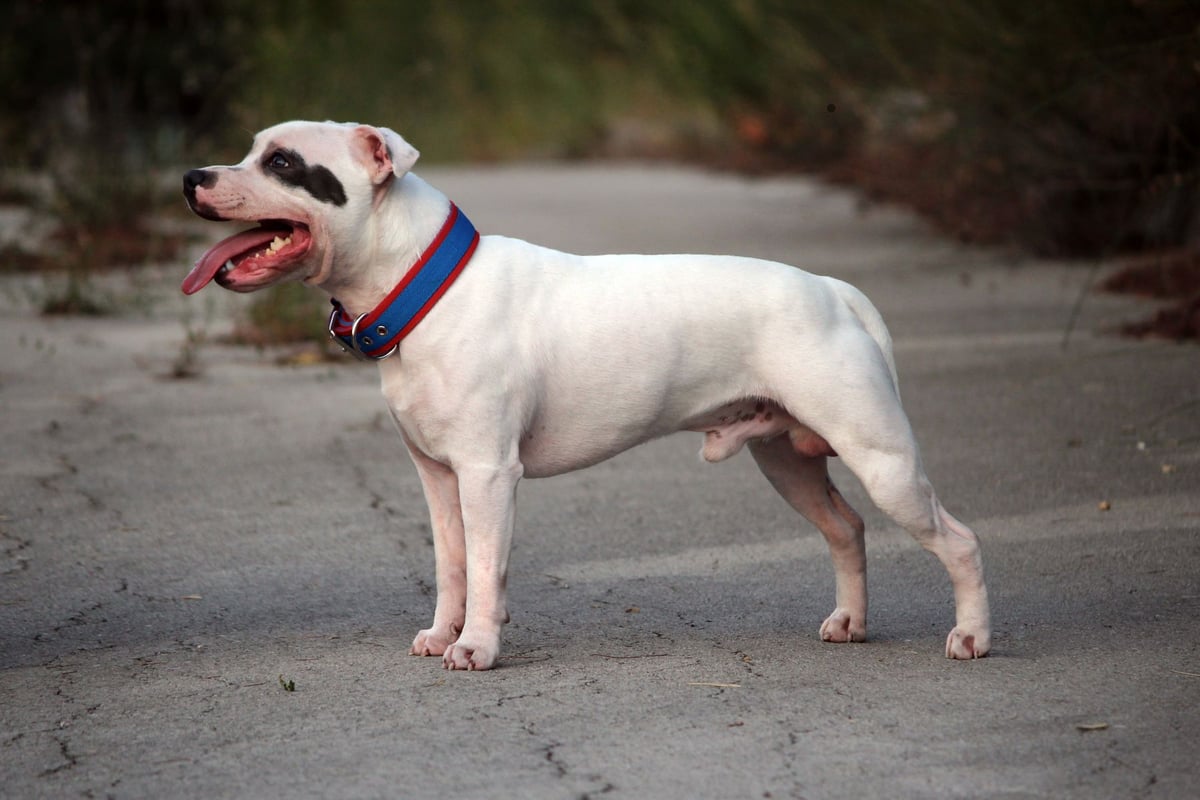
Staffordshire Bull Terrier
The Staffordshire Bull Terrier is a British terrier weighing 11 to 17 kg, recognized by the FCI under number 76, bred from crosses between the Bulldog and terriers in 19th-century English Midlands. Not to be confused with the American Staffordshire Terrier (FCI 286): a Staffordshire Bull Terrier registered with the LOF is NOT classified as category 1 or 2 in France. A breed historically nicknamed the "nanny dog" for its exceptional tolerance with children, but possible dog-on-dog intolerance requires rigorous early socialization.
- Weight
- 11 to 17kg
- Height
- 35 to 40cm
- Life expectancy
- 13years
- Monthly cost
- 65 to 100€
Personality profile
Energy 4/5
Independence 2/5
Trainability 3/5
Good with children 5/5
Barking 3/5
Space needed 3/5
Attachment to home 5/5
Good with strangers 3/5
Good with dogs 2/5
Good with cats 2/5
Coat care 2/5
Exercise needs 4/5
Scores given on measured axes, data confidence: high.
Living with a Staffordshire Bull Terrier
Description
A medium-sized breed, compact and very muscular for its build. Height at the withers 35.5 to 40.5 cm in both sexes, at 12.7 to 17 kg for males and 11 to 15.4 kg for females. Short, smooth, tight coat. Coat colors: red, fawn, white, black, blue, brindle, or any of these combined with white. Broad, deep head with a pronounced stop, powerful jaws, marked cheek muscles. Short, muscular neck, compact body, straight and well-spaced forelegs.

Temperament
Courageous, tenacious, affectionate with its family. Exceptional tolerance with children — the "nanny dog" reputation is historically documented in the United Kingdom: an approachable size, great patience, resilience to rough play. Sociable with familiar people. Possible dog-on-dog intolerance, particularly between males: vigilance is required around unfamiliar dogs, with early socialization (before 4 months) being decisive. Variable wariness toward strangers without gratuitous aggression.
Training
Intermediate trainability: sharp-witted and motivated by play and human contact, but with a stubborn nature inherited from the terrier. Positive reinforcement with treats and tug games. Sensitive to consistency — physical punishment is counterproductive and breeds mistrust. Dog sports recommended to channel energy: agility, obedience, canicross, long daily exercise sessions. Intensive dog-to-dog socialization before 4 months is the top priority for limiting adult dog-on-dog intolerance.

Feeding
180 to 250 g of premium kibble a day for a 15 kg adult, in 2 meals. A breed with an active metabolism: adjust the ration to actual exercise intensity. Count treats toward the daily ration. Glucosamine/chondroitin supplements after age 5 for athletic individuals.
Affiliate links, no extra cost to you. Legal notice

Living conditions
Adaptable to apartment living provided 1 to 1.5 hours of daily physical activity is guaranteed, including sport or intense play. Prefers a house with an enclosed garden for its exercise needs. Short coat with no undercoat: sensitive to cold, provide a warm indoor bed and a coat for prolonged winter outings. Don't leave it alone for more than 4-5 hours — a strong family attachment.

Grooming and coat care
Minimal upkeep: weekly brushing with a rubber grooming mitt. Short coat, sheds little. Quarterly bath with a gentle shampoo. Nails to check monthly. Teeth to brush 2-3 times a week — a breed prone to tartar.

Health
An overall robust breed, life expectancy 12-14 years. Documented genetic predispositions: L-2-HGA (L-2-Hydroxyglutaric Aciduria), a hereditary autosomal recessive neurometabolic disease — a DNA test is available and mandatory for responsible breeders. Juvenile hereditary cataract (HC-HSF4, also testable by DNA). Hip and elbow dysplasia. Hereditary myopathy specific to the breed. Perianal fistulas, rare.
Breed history
Bred in the English Midlands (Staffordshire region) starting in the 1830s, from crosses between the Bulldog and local terriers (including the Manchester Terrier) in the context of dog fighting, a practice banned in England from 1835. Officially recognized by the British Kennel Club in 1935. FCI standard number 76, Group 3 Terriers. Distinct from the American Staffordshire Terrier (FCI 286), bred in the United States from exported lines and more heavily built. In France, a dog registered with the LOF is not subject to the dangerous dog regulations (categories 1 and 2); a dog without LOF papers can be classified category 1 by morphological analogy.
Getting ready for your Staffordshire Bull Terrier
Five essentials to line up before day one.
Affiliate links, no extra cost to you. Legal notice
FAQ: Staffordshire Bull Terrier
Sources
- FCI Standard No 76 · FCI breed standard 76, Group 3 Terriers
- AKC Breed Profile · AKC Staffordshire Bull Terrier breed profile, Terrier Group
FCI, Fédération Cynologique Internationale, the world body that has codified breed standards since 1911. FCI number 76 is assigned to the Staffordshire Bull Terrier.
Breeds similar to a Staffordshire Bull Terrier

