


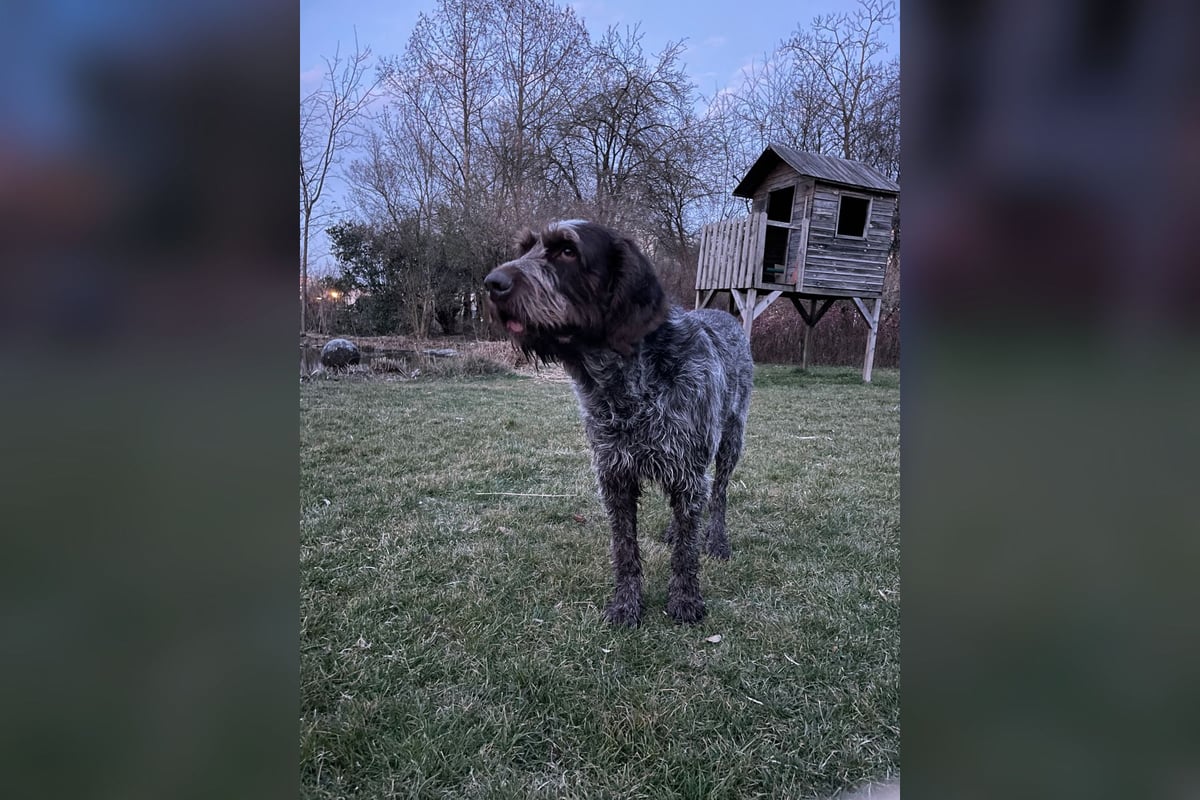
Spinone Italiano
The Spinone Italiano (FCI 165, Group 7) is a wire-coated pointing breed native to northern Italy, weighing 28 to 37 kg and standing 58 to 70 cm at the withers, with a life expectancy of 11 to 13 years. Its rough, shaggy coat of 4 to 6 cm, along with its beard and bushy eyebrows, gives it an immediately recognizable rustic look. Unlike Pointers and Setters, which gallop across the field, the Spinone moves at a slow, methodical trot of 8 to 10 km/h, suited to hunting in marshland and difficult terrain. Recognized by the FCI in 1955, it remains relatively rare outside Italy despite its qualities as a versatile pointing dog.
- Weight
- 28 to 37kg
- Height
- 58 to 70cm
- Life expectancy
- 12years
- Monthly cost
- 100 to 170€
Personality profile
Energy 4/5
Independence 2/5
Trainability 4/5
Good with children 5/5
Barking 2/5
Space needed 4/5
Attachment to home 5/5
Good with strangers 4/5
Good with dogs 4/5
Good with cats 3/5
Coat care 3/5
Exercise needs 4/5
Scores given on measured axes, data confidence: high.
Living with a Spinone Italiano
Description
The coat is harsh, dense, and sparse in undercoat, 4 to 6 cm long on the body — a trait that protects against brambles and cold water when hunting in wet areas. Accepted colors are pure white, white and orange, white and brown, and brown roan. Clearly defined eyebrows, mustache, and beard frame gentle eyes with an almost melancholic expression. Its webbed feet, a functional morphological trait, let it move efficiently through marshes and shallow watercourses. Solid bone, a straight back, a well-let-down chest: a sober working silhouette, without exaggeration.

Temperament
The Spinone is one of the calmest and least frantic pointing breeds — where a Pointer bolts into a gallop the moment it leaves the kennel, the Spinone settles into an unhurried pace. With children, its patience is remarkable: a solid build without roughness, an absence of aggression, and high tolerance make it a valued dog in family homes. It's sociable with other dogs and not very wary of strangers. Its velcro-dog side shows in a marked need for human closeness — it copes poorly with prolonged isolation and prefers to stay within sight of its owners.
Training
Positive, reinforcement-based training gives good results — its sensitivity to tone of voice makes it receptive without needing physical insistence. Its exercise needs are real: daily sport sessions or long scent walks prevent boredom-driven destructive behavior. Early socialization matters for a dog headed for varied environments, but its naturally open character makes this step easier. Its hunting instinct remains present — reliable recall is essential before any off-leash walk in game-rich areas.

Feeding
An adult of 30 to 35 kg eats between 280 and 380 g of premium large-breed kibble a day, split into two meals. During growth (up to 18-20 months), large-breed junior kibble with controlled calcium-phosphorus content limits orthopedic risks on a developing frame. The beard dips into the bowl every time: a raised, narrow-rimmed bowl reduces facial coat contamination. Avoid intense exercise within an hour of meals — the risk of gastric dilatation-volvulus, while lower than at 50 kg, remains present at this size.
Affiliate links, no extra cost to you. Legal notice

Living conditions
A house with a garden suits it better than any other setting to let its daily energy out. An apartment without access to a large space isn't recommended: this pointing breed needs long walks and scent activities to stay balanced. Its natural working trot lets it cover kilometers without apparent fatigue — one to two hours of daily activity is the baseline. Its harsh coat tolerates temperate climate variation well, but its drop ears and beard, wet after drinking, need regular checking to prevent infections.

Grooming and coat care
The harsh coat needs weekly brushing to remove dead hair and prevent mats around the beard and eyebrows. Stripping (hand-plucking dead hair) once or twice a year is recommended to preserve the coat's characteristic texture — scissor clipping alters the coat structure and doesn't conform to the standard. The beard collects water and food after every meal or swim: regular rinsing and drying prevent contact dermatitis. The drop ears must be inspected and cleaned every week to prevent ear infections.

Health
Life expectancy falls between 11 and 13 years. Hip dysplasia and elbow dysplasia are the orthopedic conditions to watch: serious breeders provide radiographic screening results for their breeding dogs. Spinone cerebellar ataxia is a degenerative neurological disease specific to the breed, with a DNA test available — any puppy bought from a responsible breeder should come from tested parents. Gastric torsion remains a real risk at this size (28-37 kg): two meals a day and an hour of rest after eating are basic precautions. Entropion and ectropion (eyelid malformations) are also reported in some lines.
Breed history
The Spinone is one of the oldest pointing breeds in Europe. Depictions of wire-coated dogs resembling the Spinone appear on medieval frescoes, notably in the church of San Lorenzo Maggiore in Milan. Its precise origin is debated: the dominant hypothesis involves ancient Etruscan pointing dogs crossed with French griffons and European setters introduced through trade and military exchanges. Its original vocation was hunting in wet terrain — the marshes, lakes, and rivers of Piedmont and Lombardy — for which its webbed feet and water-resistant coat were a decisive advantage. The FCI officially recognized it in 1955 under number 165.
Getting ready for your Spinone Italiano
Five essentials to line up before day one.
Affiliate links, no extra cost to you. Legal notice
FAQ: Spinone Italiano
Sources
- FCI Standard No 165 — Italian Coarse-Haired Pointer · FCI breed standard 165, Group 7 Pointing Dogs, Section 1.3 Continental Pointing Dogs
- Société Centrale Canine — Spinone Italiano · SCC official breed profile Spinone Italiano, Group 7
- AKC Breed Profile — Spinone Italiano · AKC Spinone Italiano breed profile, Sporting Group
FCI, Fédération Cynologique Internationale, the world body that has codified breed standards since 1911. FCI number 165 is assigned to the Spinone Italiano.
Breeds similar to a Spinone Italiano

