


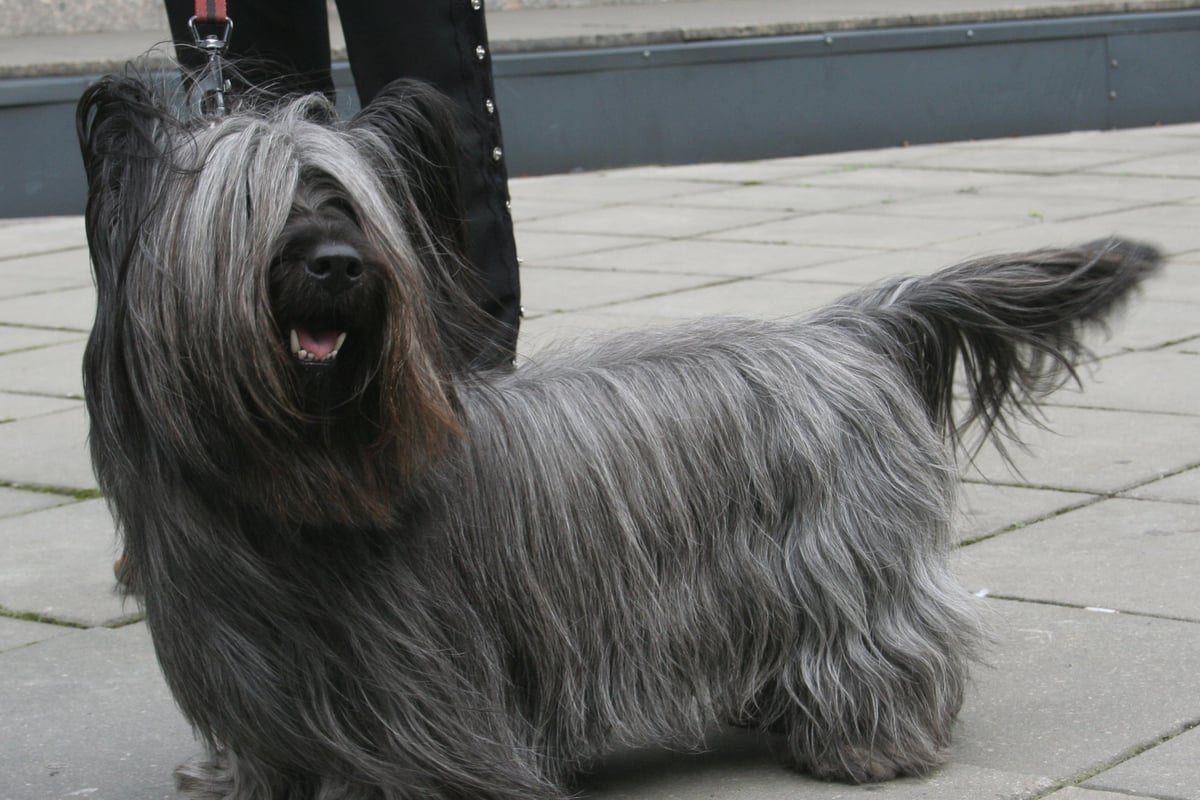
Skye Terrier
The Skye Terrier is a Scottish terrier weighing 11 to 18 kg and standing 23 to 26 cm, recognized by the FCI under number 75. Native to the Isle of Skye in the Hebrides (Scotland) and documented as early as the 17th century, it is known worldwide through Greyfriars Bobby — a dog of the breed who kept vigil for 14 years (1858-1872) at his master's grave in Edinburgh, where his statue still stands. Fewer than 30 annual registrations with the UK Kennel Club make it one of the most endangered Vulnerable Native Breeds — 5 to 15 LOF registrations a year in France. Life expectancy 12 to 14 years.
- Weight
- 11 to 18kg
- Height
- 23 to 26cm
- Life expectancy
- 13years
- Monthly cost
- 75 to 130€
Personality profile
Energy 3/5
Independence 4/5
Trainability 2/5
Good with children 2/5
Barking 4/5
Space needed 2/5
Attachment to home 3/5
Good with strangers 1/5
Good with dogs 2/5
Good with cats 2/5
Coat care 5/5
Exercise needs 3/5
Scores given on measured axes, data confidence: medium.
Living with a Skye Terrier
Description
A very elongated, low-slung build — twice as long as it is tall — on short, strong legs. Its most visible feature is its abundant long coat, which fully covers the eyes, rests on the ground on each side of the body, and forms a curtain of hair down to the floor. The FCI 75 standard describes two ear types: drop or prick, both equally accepted in the show ring. The coat is straight, hard on the surface, abundant, and long — up to 14 cm on the body. Accepted colors: ash gray, steel blue, black, fawn, or cream, with or without black ears and muzzle. The veil of hair over the eyes is a breed characteristic, not a fault.

Temperament
One of the most reserved terriers with strangers — wary, on guard, it doesn't tolerate unsolicited contact and can turn defensive if its personal space is invaded without warning. This heightened caution is a selected trait: its ancestors worked alone on an isolated island, without frequent human interaction. Toward its circle of trust, it shows firm, lasting loyalty. Vocal and quick to bark at outside stimuli. With children: caution required — it copes poorly with rough handling and unpredictable movements, and stays reserved even with the children of the household. Strong hunting instinct toward small animals and rodents.
Training
Low trainability (2/5): the breed worked alone on an island without constant human direction — initiative and independent decision-making are deep-seated traits. It learns what matches its interests and ignores mechanical repetition. Positive reinforcement only, sessions of 5 to 8 minutes with varied contexts and rewards. Trust in its owner is a prerequisite: without an established trust relationship, obedience is nil. Early socialization (8 to 16 weeks) is decisive for softening wariness toward strangers — a narrow window not to be missed. Nose work, search games, and tracking activities are well-suited pastimes.

Feeding
180 to 280 g of premium kibble a day for an adult of 11 to 18 kg depending on actual build, split into 2 meals. A calcium- and phosphorus-balanced diet suited to long-backed breeds, especially during growth (the first 18 months). Avoid kibble with an excess of legumes in individuals with a documented cardiac predisposition (DCM — a correlation observed in preliminary 2019 FDA studies, data not conclusive). Monitor the ration after spaying/neutering; weight gain is rapid and worsens the strain on short legs.
Affiliate links, no extra cost to you. Legal notice

Living conditions
Apartment or house, with or without a garden, both work — its moderate size and reasonable exercise needs (45 to 60 minutes a day) make it adaptable to small spaces. A fence is mandatory if a garden is available: recall is unreliable once it's on a scent trail. The long coat is sensitive to moisture and outdoor dirt — keep a doormat and towel handy for rainy or muddy days. Handles cold and the harsh conditions of the Isle of Skye (wind, rain, fog) exceptionally well. Sensitive to heat: don't expose it to full sun in summer. Suited to a calm household; ambient commotion stresses it and heightens its defensive vigilance.

Grooming and coat care
Intensive upkeep: the long, drop coat needs brushing 2 to 3 times a week with a wide soft slicker brush and a detangling comb to prevent mats in the undercoat. Ten to fourteen days of neglected brushing can form compact mats that are hard to untangle without cutting. Professional grooming every 2 to 3 months is recommended for evening out the ends and clearing hair around the eyes and paws. The drop ears trap moisture — clean twice a week to prevent ear infections. The coat gets dirty quickly on outings in wet terrain: towel-dry it systematically before letting the dog settle on textile surfaces. Nails every 3 to 4 weeks.

Health
Dilated cardiomyopathy (DCM): a documented predisposition in the breed, causing left ventricular dilation and progressive heart failure — annual cardiac screening recommended from age 6 (echocardiography). Hypothyroidism: above-average frequency in the breed — signs (weight gain, lethargy, hair loss) usually appear between ages 4 and 8; daily hormone replacement therapy is effective. Skye terrier puppy syndrome: an asymmetric long-bone growth disorder documented specifically in the breed, causing pain and locomotor malformations in fast-growing puppies — intense exercise before 18 months is not advised. Congenital deafness is possible but rare. Life expectancy 12 to 14 years.
Breed history
The Skye Terrier originates from the Isle of Skye, in Scotland's Inner Hebrides, where it was used to hunt badgers, otters, and foxes among the rocks and moors from at least the 17th century onward. Dogs of this type are described as early as the 16th century in Johannes Caius's writings on British dogs. The breed became famous in European royal courts in the 19th century — Queen Victoria owned several. Its worldwide fame remains tied to Greyfriars Bobby, the graveyard watchdog of Edinburgh whose story is detailed in the FAQ. Recognized by the FCI under number 75, Group 3 Section 2.
Getting ready for your Skye Terrier
Five essentials to line up before day one.
Affiliate links, no extra cost to you. Legal notice
FAQ: Skye Terrier
Sources
- FCI Standard No 75 · FCI breed standard 75, Group 3 Terriers, Section 2 Small-sized Terriers
- AKC Breed Profile — Skye Terrier · AKC Skye Terrier breed profile, Terrier Group
- The Kennel Club — Vulnerable Native Breeds · Kennel Club UK, Skye Terrier classification Vulnerable Native Breed, fewer than 30 registrations/year since 2010
FCI, Fédération Cynologique Internationale, the world body that has codified breed standards since 1911. FCI number 75 is assigned to the Skye Terrier.
Breeds similar to a Skye Terrier

