


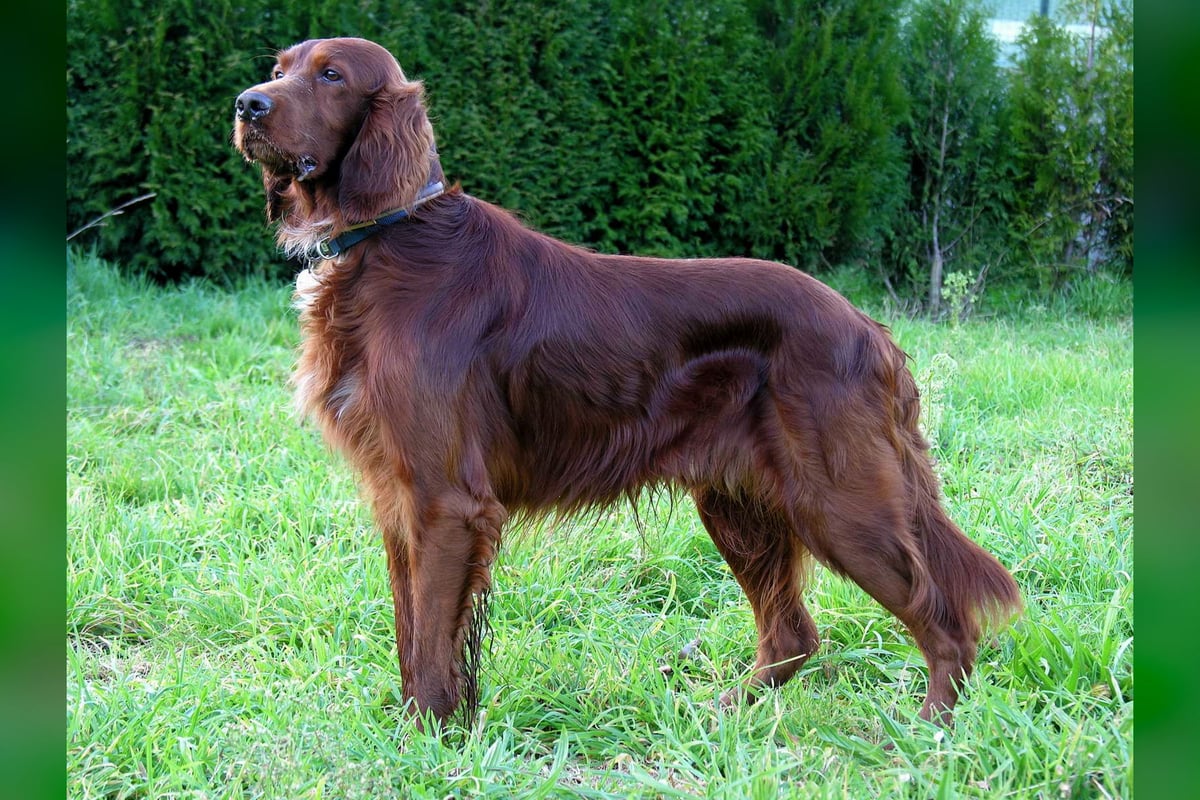
Irish Red Setter
The Irish Red Setter weighs 25 to 32 kg for 55 to 67 cm at the withers. A versatile Irish pointing hunter (open field, woods, marshland), recognized by the FCI under number 120, Group 7. A uniform mahogany-red coat with no flecking — the most distinctive of the pointing breeds. Nicknamed the "red devil" for its boundless energy. Needs a minimum of 2 hours of daily exercise. Life expectancy 11 to 15 years. Hereditary CLAD immunodeficiency, PRA-rcd1 progressive retinal atrophy, and gastric torsion (GDV) risk are the main health concerns, all of which are screenable.
- Weight
- 25 to 32kg
- Height
- 55 to 67cm
- Life expectancy
- 13years
- Monthly cost
- 100 to 160€
Personality profile
Energy 5/5
Independence 3/5
Trainability 3/5
Good with children 5/5
Barking 2/5
Space needed 5/5
Attachment to home 5/5
Good with strangers 5/5
Good with dogs 5/5
Good with cats 3/5
Coat care 4/5
Exercise needs 5/5
Scores given on measured axes, data confidence: high.
Living with an Irish Red Setter
Description
A large, lean pointing breed with a refined, elegant silhouette. Males 62-67 cm for 27-32 kg, females 55-62 cm for 25-28 kg. Long, lean head, slightly domed forehead, marked stop. Almond-shaped eyes, dark brown to hazel. Low-set, soft, drooping ears. Long coat, smooth to slightly wavy with an undercoat, feathering on the ears, legs, belly, tail and throat. A uniformly bright mahogany-red coat with no white markings whatsoever — a small white star or streak on the muzzle is tolerated by the FCI. Its solid color sets it apart immediately from other setters.

Temperament
Enthusiastic, brimming with energy and naturally outgoing — the popular Irish nickname "red devil" sums up its temperament well. No wariness whatsoever toward strangers: a warm welcome for everyone, which makes it a useless guard dog but a remarkable family dog. Excellent tolerance of children including young ones, with notable patience. Maximum sociability with other dogs. A playful, mischievous spirit that persists well beyond age 3 — late mental maturity comparable to the Golden Retriever. More easily distracted during exercise than the English Setter, with a tendency to get carried away on a scent trail and forget commands.
Training
Fair trainability, but more demanding than the English Setter or the Golden Retriever: its natural enthusiasm can turn into scattered focus as soon as a scent trail or movement captures its attention. Good food motivation, with play even more effective for longer sequences. Short but frequent sessions (10-15 minutes) — concentration fades quickly. Recall needs intensive, sustained work: don't ease off training after the first successes. Positive methods exclusively — coercion causes emotional withdrawal and lasting inhibition in this breed. With a patient, consistent handler, the breed reaches an excellent level of reliability.

Feeding
350 to 450 g of premium kibble a day for a 28-30 kg adult, in 2 strictly split meals (to reduce GDV risk). Rich in animal protein (≥26%) and omega-3s for the shine of the red coat. Avoid heavy meals before or after any physical exertion. Don't overload the ration on rest days — a breed prone to a hearty appetite, capable of gaining weight if activity decreases.
Affiliate links, no extra cost to you. Legal notice

Living conditions
Unsuited to apartment living or dense urban settings. Minimum requirement: a house with a large fenced garden (≥1.80 m) and 2 hours of intense daily exercise — free galloping, tracking, swimming. Ideally placed in a rural or peri-urban setting with regular access to open natural spaces. Its hunting instinct creates a high escape risk: let it off leash only in secure areas. An endurance breed — an hour's leashed walk does not constitute sufficient exercise.

Grooming and coat care
Brushing 3 to 4 times a week to maintain the silky coat and prevent tangles in the feathering. After every outing in vegetation (hunting, forest), a systematic inspection to remove thorns, mud, and ticks embedded in the long coat. Professional grooming recommended every 8 weeks to even the feathering and trim the ears and feet. Weekly ear cleaning. The mahogany-red coat hides light dirt well but shows dried mud — monthly bath recommended.

Health
CLAD (Canine Leucocyte Adhesion Deficiency) is a hereditary recessive immunodeficiency: affected puppies suffer one severe infection after another and rarely survive beyond age 2. A CLAD DNA test is available — every breeding dog must be certified. PRA-rcd1 progressive retinal atrophy is a recessive retinal degeneration detectable by DNA test; it begins in young adulthood and leads to blindness within a few years. Gastric torsion (GDV) is an immediate life-threatening risk: large, deep-chested dogs are predisposed — split meals (at least 2), avoid exercise within 2 hours of eating. Osteosarcoma (bone cancer) and idiopathic epilepsy documented in the breed at moderate frequency. Life expectancy 11-15 years.
Breed history
The Irish Red Setter probably descends from old Irish spaniels and Scottish setters introduced into Ireland in the 18th century. The solid red breed stabilized in the 19th century, gradually distinguished from the Irish Red and White Setter (today a distinct breed, FCI 330). The Irish Red Setter Club was founded in 1882 in Dublin; the first official standard was drafted around 1885. The breed was quickly exported to the United Kingdom and the United States, becoming popular as a hunting and companion dog. Recognized by the FCI under number 120, Group 7, Section 2.2.
Getting ready for your Irish Red Setter
Five essentials to line up before day one.
Affiliate links, no extra cost to you. Legal notice
FAQ: Irish Red Setter
Sources
- FCI Standard No 120 — Irish Red Setter · FCI breed standard 120, Group 7 Pointing Dogs, Section 2.2 British and Irish Pointers and Setters, recognized 1954, revised 2001
- AKC Breed Profile — Irish Setter · AKC Irish Setter breed profile, Sporting Group
FCI, Fédération Cynologique Internationale, the world body that has codified breed standards since 1911. FCI number 120 is assigned to the Irish Red Setter.
Breeds similar to an Irish Red Setter

