


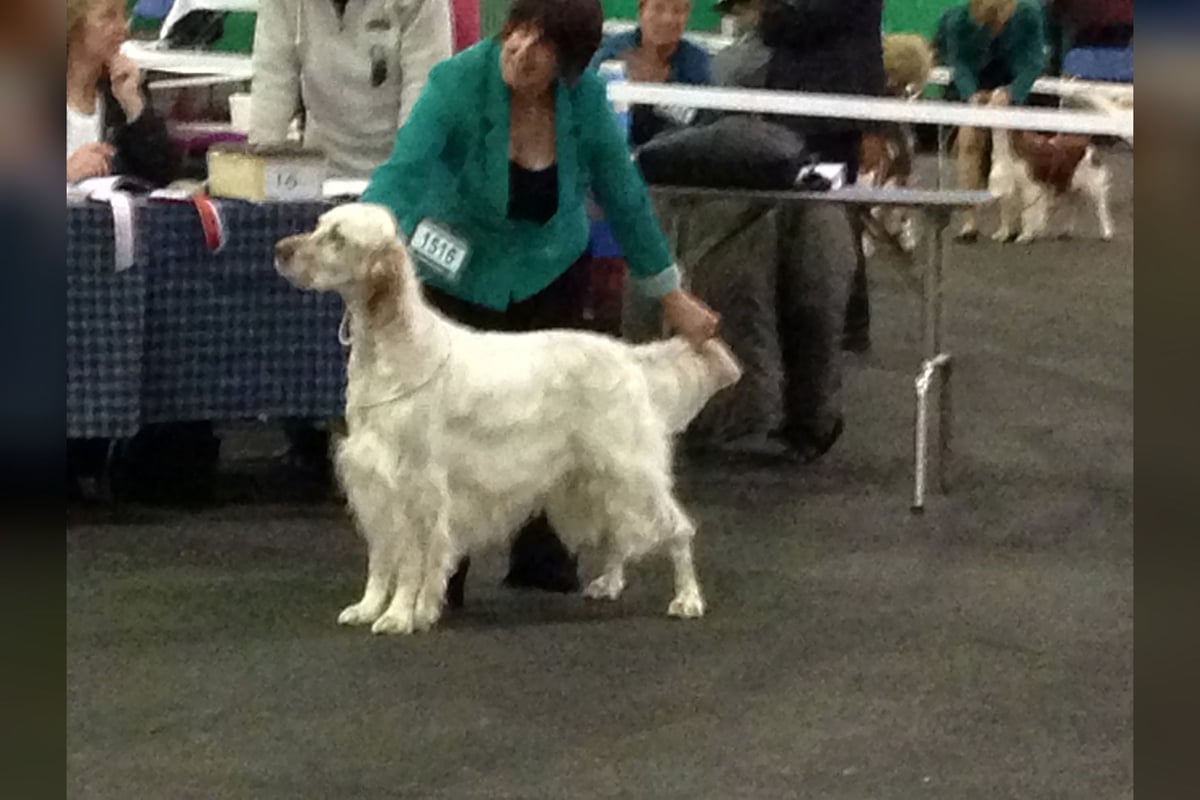
English Setter
The English Setter weighs 25 to 36 kg for 61 to 69 cm at the withers — a large British pointing breed with exceptional endurance. Selected starting in 1825 by Edward Laverack, stabilized around 1860, recognized by the FCI under number 2, Group 7. The most widely used breed in France for pointing-dog hunting according to canine statistics. A characteristic long, silky, flecked coat in belton (lemon belton, orange belton, liver belton, or blue belton). Life expectancy 11 to 13 years. Hereditary deafness (BAER test) documented in 10 to 15% of individuals; lysosomal storage disease (LSD) detectable by DNA test.
- Weight
- 25 to 36kg
- Height
- 61 to 69cm
- Life expectancy
- 12years
- Monthly cost
- 100 to 160€
Personality profile
Energy 5/5
Independence 3/5
Trainability 4/5
Good with children 4/5
Barking 2/5
Space needed 5/5
Attachment to home 4/5
Good with strangers 4/5
Good with dogs 4/5
Good with cats 3/5
Coat care 4/5
Exercise needs 5/5
Scores given on measured axes, data confidence: high.
Living with an English Setter
Description
A large, lean, muscular pointing breed, an elongated silhouette with solid bone. Males 65-68 cm for 27-36 kg, females 61-65 cm for 25-30 kg. Long, lean head, moderate stop, fine muzzle. Expressive dark brown oval eyes. Long, soft ears, hanging well below the cheek. Long, silky coat, slightly wavy on the body, with feathering on the legs, belly, chest and tail. Belton coat: a white base flecked with colored mottling — the four recognized varieties are blue belton (black on white), orange belton, lemon belton and liver belton (brown). Tricolor (blue belton and tan) also recognized. No solid coat.

Temperament
Active, affectionate and sociable, it forms a strong attachment to its household without being clingy. Copes poorly with more than 4 to 5 hours of complete solitude. Open with strangers without excessive wariness — its hunting instinct prevails over any guarding temperament. Compatible with children: naturally gentle and tolerant of clumsiness, without the overexcitement of some pointing breeds. Generally good relations with other dogs, a reflection of its use hunting in packs. The pointing instinct stays very present in daily life — the dog can spontaneously freeze on a bird in the park.
Training
Good trainability: solid working intelligence inherited from its hunting function — it quickly grasps tracking and pointing exercises. In a domestic setting, food motivation works well, complemented by play rewards (retrieving). Recall becomes problematic as soon as game scent captures its attention — specific recall work in natural environments should start at 3-4 months, with 30- to 45-minute sessions several times a week. Dog sports suited to its intense exercise needs: field trials, mantrailing, long structured walks. Exclusively positive methods: coercion produces inhibition in this sensitive breed. Less scattered than the Irish Red Setter, with more predictable training progress.

Feeding
350 to 450 g of premium kibble a day for a 28-30 kg adult, in 2 meals. An endurance breed with a high metabolism: favor kibble rich in animal protein (≥26%) and omega-3 fatty acids for coat quality. Avoid feeding immediately before or after intense exertion (a moderate gastric torsion risk in large breeds). Slow growth up to 24 months: large-breed junior kibble for the first 18 months.
Affiliate links, no extra cost to you. Legal notice

Living conditions
Unsuited to apartment living: its daily exercise needs reach at least 2 hours as an adult — galloping, tracking, swimming. A house with a large fenced garden is essential. Its hunting instinct creates a high escape risk: a fence of at least 1.80 m is recommended. A breed built for work in open terrain — a good candidate for the countryside or urban outskirts with easy access to natural spaces. Tolerates cold well thanks to its dense coat; sensitive to humid heat.

Grooming and coat care
Brushing 3 to 4 times a week to detangle the feathering on the legs and tail, which catches vegetation and mud. During hunting season, a daily coat and ear inspection after every outing (thorns, ticks, foreign bodies). Professional grooming recommended every 8 to 10 weeks to even and trim the protective areas (ears, feet). Weekly ear cleaning: the long, drooping ears reduce ventilation in the canal. Monthly bath.

Health
Hereditary deafness is the most closely monitored genetic condition in the breed: between 10 and 15% of individuals show partial or total cochlear hearing loss linked to the belton pigmentation gene. The BAER test (Brainstem Auditory Evoked Response) is mandatory for every serious breeding dog. Lysosomal storage disease (LSD), a hereditary autosomal recessive metabolic condition, is detectable by DNA test — untested breeding dogs should be excluded. Hereditary hip and elbow dysplasia: official screening X-rays required for breeding dogs. Dilated cardiomyopathy documented at moderate frequency. Clinical hypothyroidism (annual TSH testing recommended after age 5). Life expectancy 11-13 years.
Breed history
The English Setter descends from old British spaniel-type pointing dogs of the 16th century. Modern selection began in 1825 with Edward Laverack in Shropshire, who developed a line through strict breeding over 35 years — the breed was stabilized around 1860. The cynologist Purcell Llewellin later created a parallel line with enhanced hunting performance (the Llewellin type). The first standard was established in 1887 in the United Kingdom; the FCI granted the breed full recognition in 1954, with the standard revised in 1986. The breed took hold in France around 1880 and became firmly established there among the most widespread pointing breeds. Recognized by the FCI under number 2, Group 7 (Pointing Dogs, Section 2.2 — British and Irish Pointers and Setters).
Getting ready for your English Setter
Five essentials to line up before day one.
Affiliate links, no extra cost to you. Legal notice
FAQ: English Setter
Sources
- FCI Standard No 2 — English Setter · FCI breed standard 2, Group 7 Pointing Dogs, Section 2.2 British and Irish Pointers and Setters, recognized 1954, revised 1986
- AKC Breed Profile — English Setter · AKC English Setter breed profile, Sporting Group
FCI, Fédération Cynologique Internationale, the world body that has codified breed standards since 1911. FCI number 2 is assigned to the English Setter.
Breeds similar to an English Setter

